





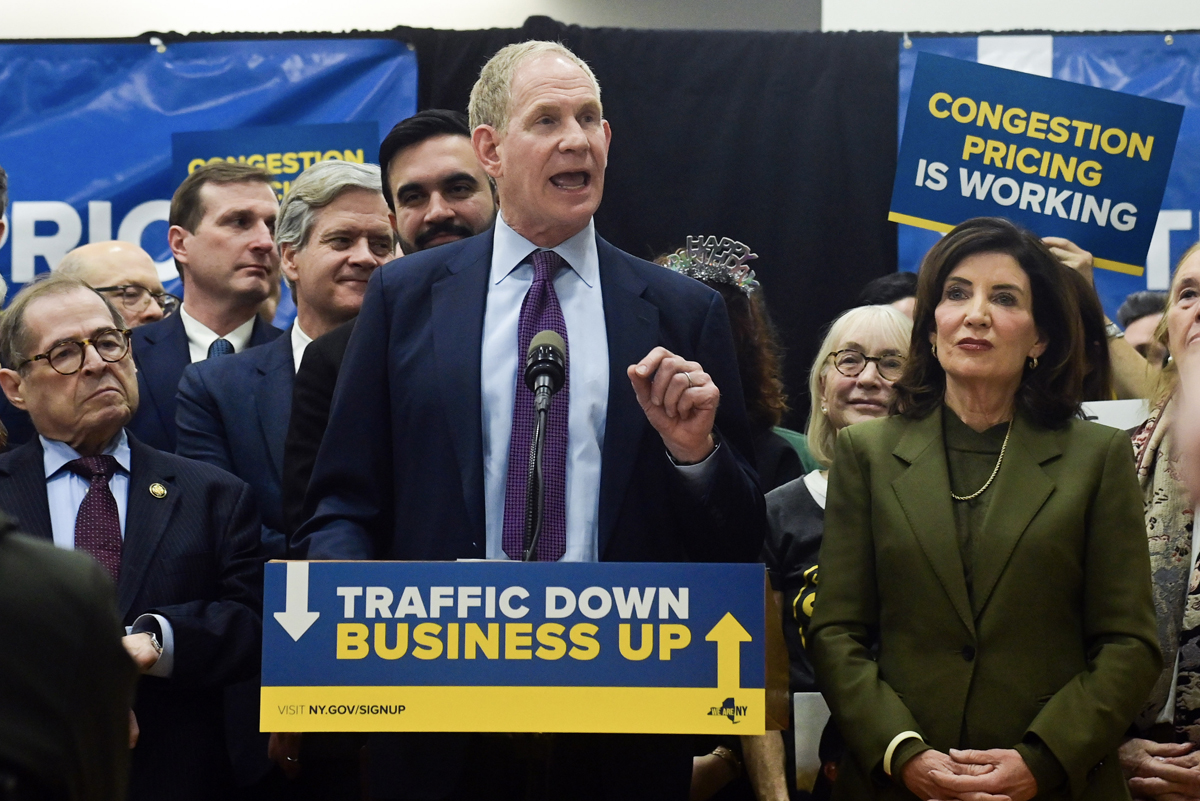
NEW YORK — New York City’s congestion pricing program has reduced vehicular traffic in lower Manhattan by 11% and increased transit ridership by 7%, officials said on Monday as they marked the first anniversary of the tolling program that helps fund Metropolitan Transportation Authority capital projects.
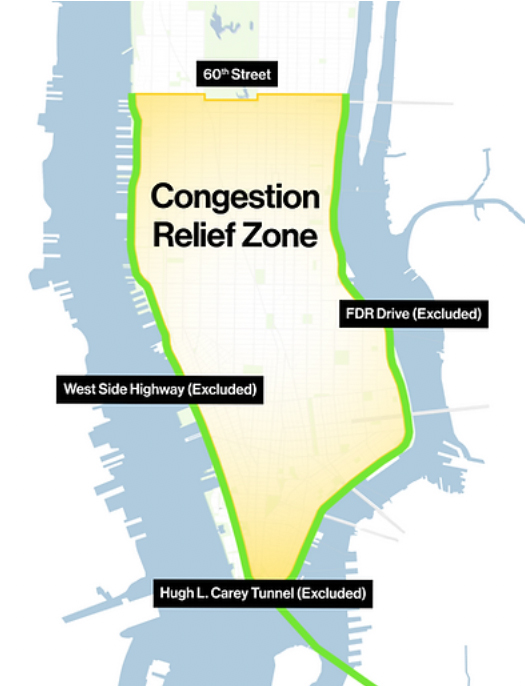
The congestion tolling, which began on Jan. 5, 2025, charges most drivers up to $9 to drive in the portion of Manhattan south of 60th Street, with exclusions for some major routes on the perimeter. It is credited with improving rush-hour crossing times by as much as 51% and overall traffic speeds in the toll zone by 4% on weekdays and 6.2% on weekends, according to an MTA report. The program, projected to generate $500 million annually in toll revenue, had collected $518 million in tolls as of November and was projected to exceed $550 million in net revenue by the end of the year.
“By every measure,” New York Gov. Kathy Hochul said in a press release, “this program has met or exceeded expectations: traffic and gridlock are down substantially, people are moving faster, air quality is improved, streets are safer, and our economy is stronger. … And there are even more benefits to come: $15 billion in transit upgrades with major projects already underway, improving the commutes of millions of New Yorkers.”
Said MTA CEO Janno Lieber, “The congestion pricing experience demonstrates what the new MTA can accomplish working with our State and City partners. The result here is flawless execution and unprecedented benefits for all New Yorkers.”
The city’s new mayor, Zohran Mamdani, said the program’s “benefits are clearer than ever. Traffic crashes and noise complaints are dropping, while funding for the MTA and air quality are rising.”
The program still faces some uncertainty. The Trump administration moved to rescind federal permission for the program, which had been authorized under the Biden administration, following through on a campaign promise by President Donald Trump to kill the tolling plan [see “New York MTA sues …,” Trains.com, Feb. 19, 2025]. But a federal judge blocked efforts to end the program, as well as a Department of Transportation effort to withhold funding because of the program [see “Federal judge issues temporary restraining order …,” May 27, 2025]. The same judge later extended that ruling to protect the program until the court case is decided; the next hearing is set for Jan. 28.
In the meantime, however, the MTA report says congestion tolling has led to impacts as varied as decreases in pedestrian and cyclist fatalities; faster trips by bus; and increased foot traffic in the tolling zone. Concerns that the program would harm businesses, meanwhile, have been countered by increases in office leasing, a decrease in the number of vacant storefronts in the congestion zone, and an increase sales tax receipts, according to state and local figures. “Despite the early hand-wringing,” said New York City Comptroller Mark Levine, “congestion pricing has stimulated economic activity across our restaurants, storefronts, and cultural hubs, all while generating millions for the MTA.”
Transit impacts, according to the MTA, include a 9% increase in subway trips into the tolling zone in the first nine months of 2025, compared to the same period a year earlier. Overall, the subway system saw an 8.9% increase in ridership while the Long Island Rail Road and Metro-North Railroad saw increases of 9.9% and 7.3%, respectively.
The New York Times offers a graphic look at various impacts in this article.
— To report news or errors, contact trainsnewswire@firecrown.com.


So far the new mayor has not got sideways with either the guv. or tough guy Janno Lieber. There will be no free busses, so that idea will disappear. Financial projections call for $550 mil per anum from congestion tolls, mostly for MTA.
How much of the increase in transit trips is due to workers returning to their offices from remote work?
But wouldn’t that also increase vehicular traffic? The article states an 11% reduction in vehicular traffic. So what’s your point?
The stats don’t lie…in every category the success of the program is documented and exceeds projections. BTW I go below 60th street by subway or walk. Where there occurred gridlock before there exists same now, no noticable change. All the naysayers can whine on.
Who, me, a naysayer? I spent four years in Manhattan for college and know all about the subways and buses. And walking …… back then the subway trains were so crowded I sometimes walked several miles to avoid them. As far as stats not lying, Curtis, oh, well, I guess you never heard the word “government”.
Charles, the tolling violates Federal Law, which the Executive Branch is supposed to enforce. So it is Federal business, as also is getting rid of judges who don’t honor the law or the constitution.
The orange one is the one who doesn’t honor the constitution or the rule of law. Where have you been the past eleven long months?
What Federal law is violated?
IIRC the law being violated was something about tolling all routes without a non-tolled alternative and/or something about using highway toll funds for non-highway purposes. New York had secured a waiver under the previous administration to allow the program as a test bed, but the current one wants to revoke it because the orange one is on bad terms with the city, to say the least.
“Concerns that the program would harm businesses, meanwhile, have been countered by increases in office leasing, a decrease in the number of vacant storefronts in the congestion zone, and an increase sales tax receipts”, to quote the article– I would be interested in seeing what other groups, such as a Chamber of Commerce say about this rather then accept the MTA’s word.
Curious as to what percentage of vehicles have no EZ Pass or equivalent and must be billed by tracing the plate owner. Does the income received at least cover the cost of this billing system and what percentage of bills sent actually collect a full payment?
I’ve always had the same question, given the occasional inaccuracy of the Illinois I-Pass system.
Someone told me that license plate include a transponder. I’m not sure I believe that. As far as I know it’s by optical recognition, which can’t possibly be reliable.
Several states use photo plate ID for tolling, PA and OK are two I can think of off the top of my head. That is not including the thousands of speed and traffic light cameras. My personal experience (good – tolling without waiting in a massive line for a toll booth – and bad – red light camera *busted*) has been that they are accurate and effective. Like all systems there are bugs, inaccuracies, and teething, but overall I suspect they perform better than the alternatives. As for cost effective, I suspect they pay for themselves given enough time and volume. Also, I wonder if they charge more for plate read tolls compared to transponder accounts? Some places the Plate ID toll is double the transponder toll.
Trump doesn’t like it because it’s a tariff he didn’t create. The difference is that it penalizes the causes of the problem and benefits the solution.
Trump isn’t a conservative.
I don’t vote in New York. Those that do vote in New York (city or state) have a right to choose their leaders who in turn have a right to enact a toll.
Trump should stick to federal business, such as invading Denmark which is a NATO ally.