





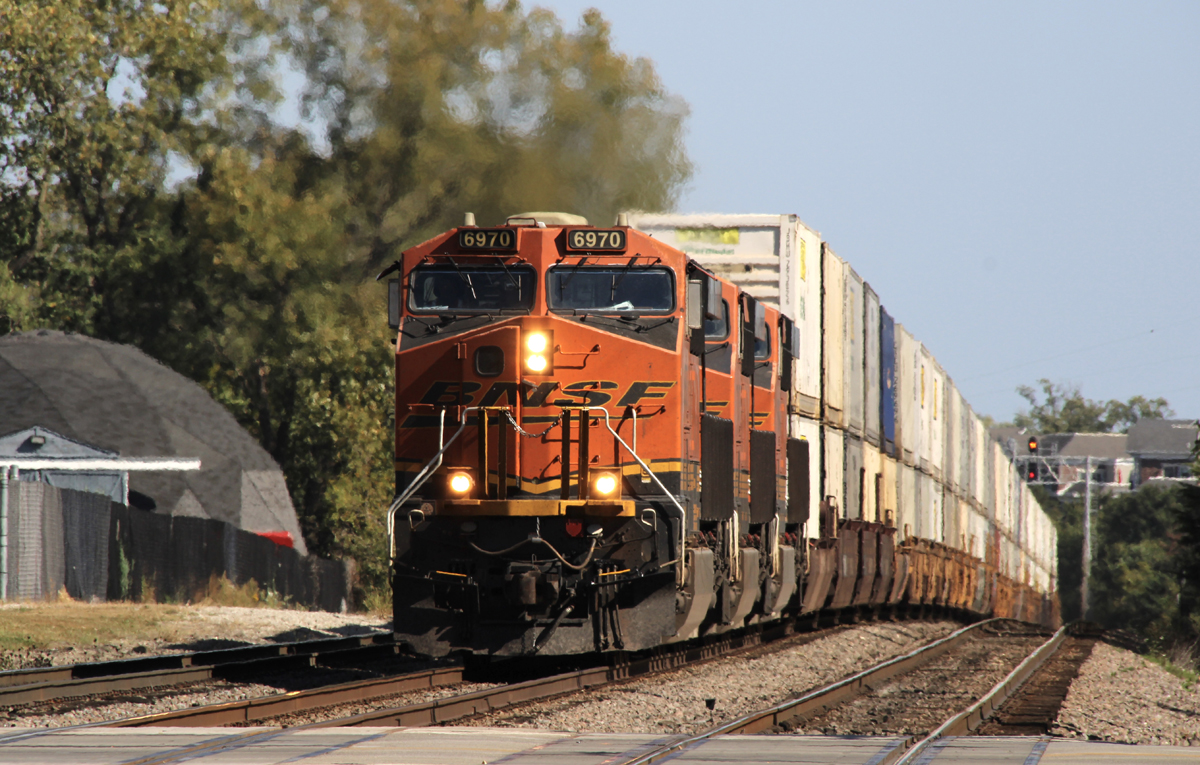
OMAHA, Neb. — BNSF Railway needs to close the operating-ratio gap with the other Class I railroads, new Berkshire Hathaway CEO Greg Abel said on Saturday in his first annual letter to shareholders.
BNSF continues to perform well from a safety standpoint and has improved its efficiency and service, Abel wrote. “In 2025, shipments spent less time idling at terminals and moved through the network faster than in nearly any year in the company’s history,” Abel noted.
“These gains matter, but they are not enough; more progress is needed to translate operational improvements into stronger financial results,” Abel wrote. “We view operating margin (the inverse of the industry’s operating ratio) as the best measure of performance. In 2025, BNSF’s operating margin improved to 34.5% from 32.0% in 2024. It remained only modestly above its five-year average.”
BNSF’s 2025 operating ratio of 65.5% was 5.7 points behind the 59.8% performance of western rival and industry leader Union Pacific.
“The gap to the industry’s best remains too wide and closing it will require continued improvements in efficiency and service. Each one-percentage-point improvement in operating margin generates approximately $230 million of incremental operating cash flow for our owners,” Abel wrote. “The team recognizes the significance of this opportunity, and we will be disappointed if we do not deliver a substantial improvement over the next few years.”
Abel’s letter indicated that the core principles Chairman Warren Buffett set at Berkshire Hathaway remain intact — including letting the conglomerate’s companies have a large degree of autonomy.
Last year BNSF produced $8.1 billion in net operating cash flows and returned $4.4 billion to Berkshire in the form of dividends. That was slightly above the five-year average of $4.1 billion.
BNSF’s operating earnings increased 7.8% last year, to $8.05 billion, on flat revenue of $23.3 billion. Net earnings increased 8.8%, to $5.47 billion. The railroad’s operating expenses declined 3.7%.
For the year, the railway’s overall volume was relatively flat at a 0.3% gain over 2024. Three of BNSF’s four business segments gained volume for the year, however.
Consumer products volume — which includes intermodal and automotive traffic — increased 1.2% last year. “The volumes increase was primarily due to higher intermodal shipments resulting from higher West Coast imports and a new intermodal customer, and an increase in automotive vehicle volumes,” Berkshire said.
Industrial products segment volume declined 4.6%, largely due to declines in shipments of construction products, plastics, and petroleum products.
Agriculture and energy products shipments increased 3.2% due to higher grain exports and petroleum fuel shipments, partly offset by declines in domestic grain and feed volume.
Coal traffic was up 1.1% as higher natural gas prices made coal more competitive for electricity generation.
— To report news or errors, contact trainsnewswire@firecrown.com.
Share this article
Cutting off your nose to spite your face is a poor way to run any business.
Laying off personnel and mothballing equipment to reduce expenses only leads to a decrease in customer service which ultimately reduces profits.
No profit will bring about no railroad.
There aren’t any dividends given by a bankrupt railroad.
Is slash and burn on the horizon?
Mr Abel, Two words: CUSTOMER SERVICE.
So Greg Able, “old rat face,” doesn’t think that BNSF is making enough money off of JB Hunt and CMA-CGM does he? Well maybe he can convince BNSF into doing more merchandise traffic per their common carrier obligation but I seem to doubt it, What will probably happen is a return to less locomotives and union jobs as well as cuts in white collar jobs, something Warren would have never done if he was still in charge. But he has to show that he is The Man nownand cutting costs is always a way to impress Wall Street and provide bigger dividends to the few BH stockholders,. Of course at $533,815.00 a share its not the kind of stock that gives very many people a say in BH…
Even more job cuts (union workers) is what this means. Shareholders only care about quick profits not the future or growth of the industry.
Railroads continue to lose market share to trucks, freight volume is flat. Focusing on OR has done nothing for growth. It prevents it. The old adage it’s making money but not enough money.
Why is the OR so damned important to a private owner, when better SERVICE is the key to greater profitabilty?
Abel is a big fan of PSR. Unfortunately railroading is a service business and customers don’t buy low costs (the railroads already have that) they buy service.
I’m afraid that the only thing that will unseat PSR is regulation which will never happen with our current government. Running an efficient operation is a good goal, but not at the expense of service.