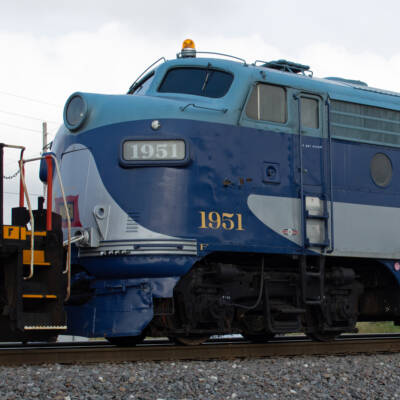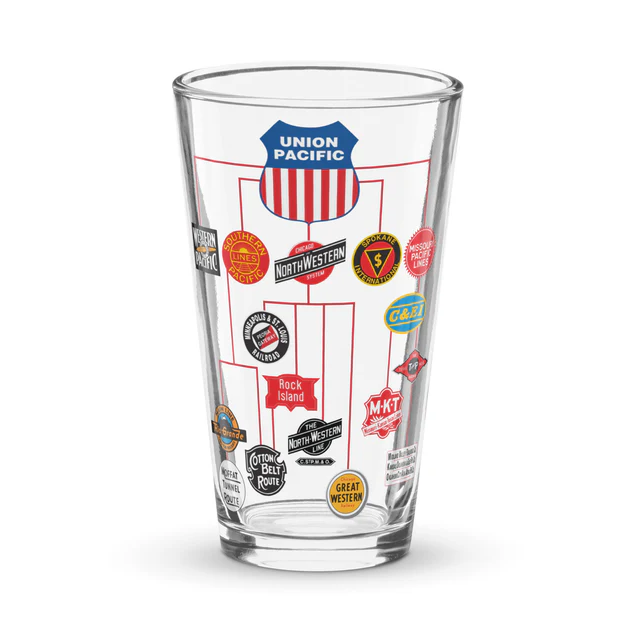

To say that the Chicago, Rock Island & Pacific Railroad (Rock Island) was in a financial slump by the 1930s is an understatement. The 30 years of mismanagement followed by the Great Depression took its toll. To revitalize the railroad, incoming CEO Edward M. Durham embraced the streamlined train craze, adopting the fitting name “Rocket” […]
Read More…
Like its Midwest rivals, the Chicago & North Western Railway jumped on the idea of brand-named passenger trains. However, it took a different route with the name in the form of a three-digit number: 400. The name [or number] stuck as the railroad rolled out a prominent fleet of Chicago & North Western 400 passenger […]
Read More…
In August 2025, my wife and I planned a trip to the Pacific Northwest to visit family and friends. While we frequently travel by air and rental car, and have taken shorter train trips in the U.S. and Europe, we’ve never done a long-distance rail experience. So, we decided to take Amtrak’s Empire Builder from […]
Read More…
Of the more than 500 stations Amtrak serves across its 21,000-mile network, most are pretty straightforward. Some serve as originating/terminating points for the carrier’s trains, while others are stops along the way for through services. But there are more than 30 Amtrak stations with both originating/terminating and through services. These dual-purpose facilities are small depots […]
Read More…
Following the delivery of dome cars constructed for the Union Pacific and Wabash for the City of St. Louis in 1958, U.S. intercity passenger rail service entered into what turned out to be a terminal illness; thereafter, no more new dome cars were ordered. However, a different factor in the U.S. railroad industry — mergers […]
Read More…
Whether they knew it or not, the Budd Co. was rolling out the final miles in its railcar manufacturing business as it headed into the 1970s. But they didn’t go down without a fight as manufacturing of passenger equipment continued for Amtrak and multiple commuter operations (mainly in the Northeast United States). Part of […]
Read More…
Railroad dome cars are a gleaming symbol of postwar passenger train status. The streamliner era in North America bookended the World War II era in the U.S., since new streamlined passenger cars were not a priority between 1942 and 1945. Following the end of the war in the latter year, they began to […]
Read More…
Summary: This article discusses riding Amtrak’s Palmetto, which runs an 829-mile route between New York City and Savannah, Georgia. It highlights the Palmetto‘s unique characteristics as a long-distance train without dining cars or sleeping accommodations. The article also delves into the train’s history, including its origins in 1976, its various route changes and service adjustments […]
Read More…
At the turn of the 20th century, the citizens and serving railroads of Kansas City, Mo., yearned to revamp how passengers arrived and disembarked from the growing gateway city along the Missouri River. The 1878-built Union Depot in the West Bottoms district couldn’t keep up with the thriving rail traffic and local desire to […]
Read More…
Having six intercity passenger terminals at one time, and that doesn’t include the electric interurbans, is a muscle flex to Chicago’s claim as the nation’s railroad capital. That is also why former Trains and Classic Trains Senior Editor J. David Ingles made regular visits to document whatever was left, prior to Amtrak’s formation in May […]
Read More…
There are standard-gauge tracks close by, but they can’t be seen here, since they’re underground in this neighborhood. We’re at Columbus Circle in New York’s borough of Manhattan, on Thanksgiving Day in 1951, Nov. 22. How can that be deduced? Well, that’s the famous Macy’s parade that’s passing down the street, complete with a […]
Read More…
Talk of Burlington Northern passenger trains inevitably conjures visions of green E units toting bilevel stainless steel coaches at rush hour. But BN has history, albeit brief, with conventional intercity passenger service. This spanned from its March 1970 inception to the May 1, 1971, startup of Amtrak – just days less than 14 months. […]
Read More…