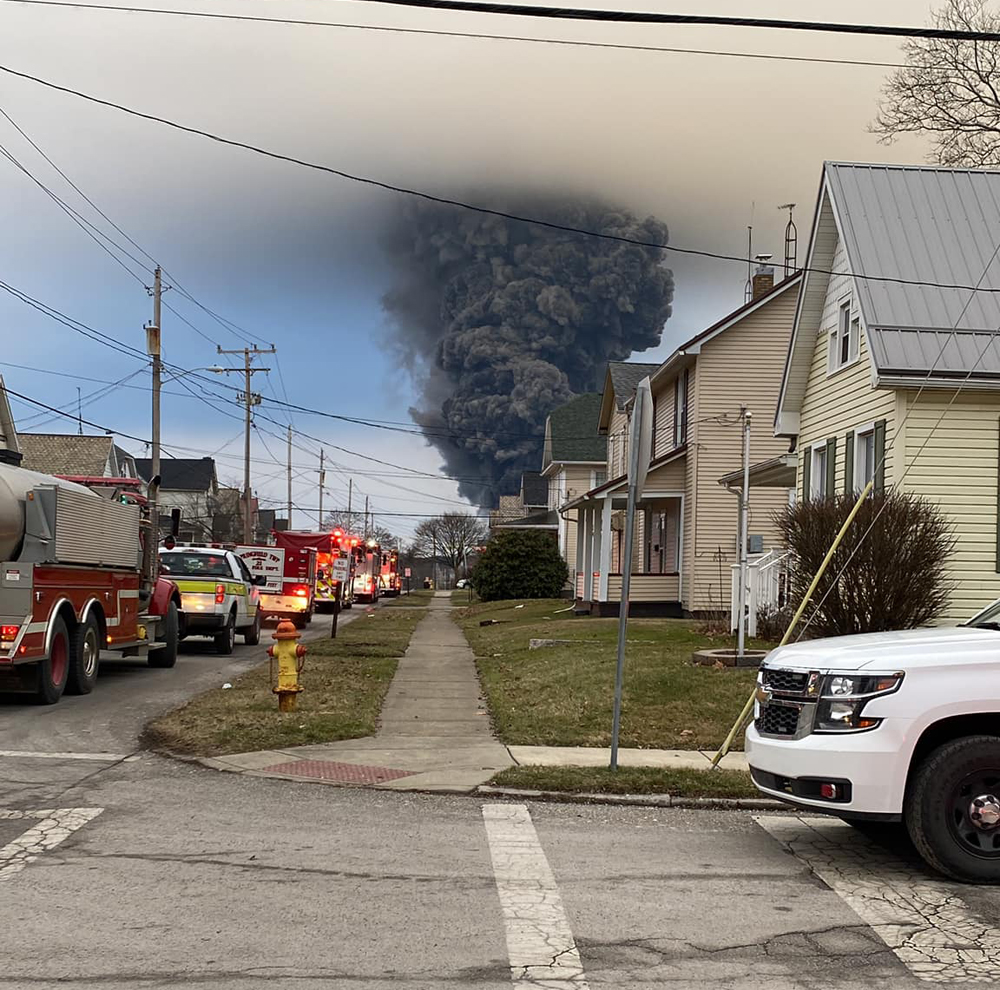
WASHINGTON – The Federal Railroad Administration today encouraged railroads to improve the way they collect and use data from wayside hotbox detectors in order to prevent catastrophic derailments like the Feb. 3 Norfolk Southern hazardous materials wreck in East Palestine, Ohio.
“Preliminary investigation of recent train derailments indicates the cause of, or contributing factor to, the incidents was a mechanical failure, specifically burnt journal bearings. Accordingly, FRA is issuing this Safety Advisory to make recommendations to enhance the mechanical reliability of rolling stock and the safety of railroad operations,” the agency says.
Specifically, the FRA safety advisory recommends that railroads:
- Evaluate the temperature thresholds for inspections based on hot bearing detector data.
- Consider real-time use of trend analysis of detector data for stopping a train for inspection.
- Ensure proper training of crews responsible for calibrating, inspecting, and maintaining hot bearing detectors.
- Ensure proper inspection of rolling stock that trigger hot bearing detector alerts.
- And improve safety culture, particularly regarding operational decisions that are based on hot bearing detector data.
The advisory notes that since 2021 the FRA has investigated five derailments that were suspected of being caused by burnt journal bearings. Three of those derailments occurred on Norfolk Southern, while the other two were on Kansas City Southern.
Two of the NS wrecks – in Warner Robins, Ga., and Sandusky, Ohio – occurred after hot bearing detectors warned of overheated journal bearings. In both instances, the train crews stopped and inspected the problem axles. But they then were instructed to continue on their way without setting out the problematic car in Georgia or the locomotive in Ohio. Both trains later derailed.
In the East Palestine wreck, a pair of hotbox detectors recorded increasing bearing temperatures on the car suspected of causing the derailment. But the temperature readings never reached the critical threshold that would have tripped an alarm and required the crew to stop the train – until moments before the derailment, when train 32N passed the detector at milepost 49.81 in East Palestine.
“Detecting overheated journal bearings before they fail is critical to accident prevention. Journal bearings are sealed components, and, as such, often do not display ‘tell-tale signs’ of overheating (e.g., leaking lubrication), making defects in journal bearings difficult to identify through visual inspections,” the FRA said. “HBDs can serve an important role in early detection of bearing defects, but the effectiveness of any HBD system maintenance standards and procedures; (2) the establishment of safe thresholds at which to act on HBD alerts; and (3) strict adherence to procedures that prescribe actions to be taken.”
The FRA noted that it does not regulate wayside detection systems and that its safety advisory does not carry the weight of law.
But FRA said it is “likely not appropriate” to allow a train transporting hazardous materials to continue to operate without restrictions after it triggers a hot bearing detector alert.
FRA said railroads should consider expanding the Association of American Railroads’ recommended operating practices for the transportation of hazardous materials to other trains. If a defect in a key train – one carrying one tank car load of poison inhalation hazards, or 20 loads of hazardous material, or one or more loads of spent nuclear fuel or high level radioactive waste – is reported by a wayside detector, but a visual inspection fails to find the problem, the train must not exceed 30 mph until it passed the next wayside detector or stops at a terminal for an inspection.
Greg Regan, president of the AFL-CIO Transportation Trades Department, praised the FRA recommendations.
“We welcome this action from the Federal Railroad Administration to improve safety in the freight rail industry. Currently, there are no federal regulations guiding wayside detectors, including their placement along tracks or temperature thresholds,” he said. “There’s not even a federal definition of wayside detection technologies. Rail workers are eager to see a complete set of federal regulations on the installation, operation, testing, repairs, and maintenance of all wayside detection technologies, including defect detectors.”
Norfolk Southern noted that the crew of train 32N was operating the train within company rules, began to stop the train after it triggered the wayside detector alarm, and that its detectors were operating as designed. The railroad also has inspected all of the nearly 1,000 detectors on its system, in addition to the regular inspections of the detectors every 30 days.
Share this article