





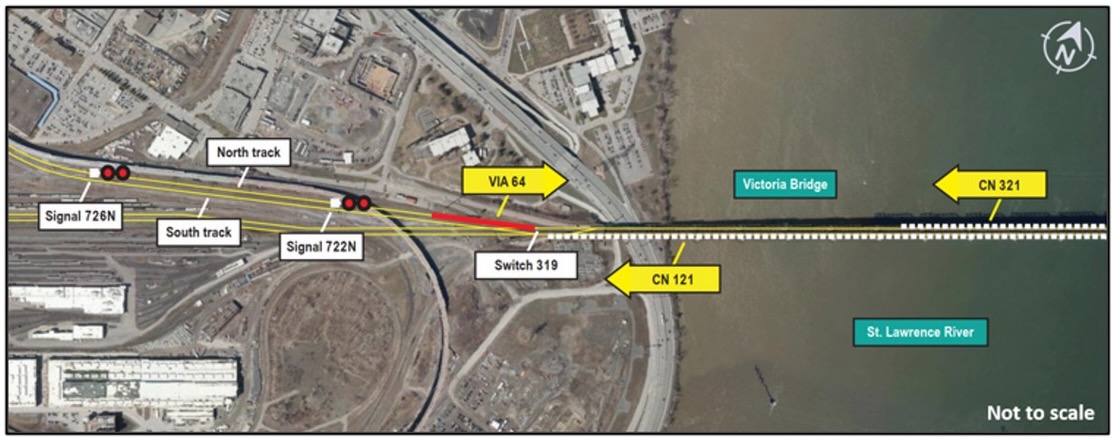
DORVAL, Quebec — The Transportation Safety Board of Canada is renewing its call for enhanced train control systems and other measures to reduce the risk of accidents following release of its investigation report on a 2024 incident in which an unoccupied VIA Rail Canada train passed a red signal. No collision or injuries resulted.
The Dec. 29, 2024, incident involved a train en route to VIA’s maintenance facility after passengers and onboard crew disembarked at Montreal’s Central Station. During a backup move, VIA train No. 64 stopped at a red signal, then proceeded after the crew member in the tail-end car saw a yellow signal. This was likely caused by reflection on the signal lens, as the signal was still showing a red indication, which the train passed. The train continued its back-up move, but the crew member saw that a switch was not lined for the train; the locomotive engineer made a full brake application, but the truck on the last car of the train ran through the switch.
Two freight trains were operating in the area; the crew of one, CN 121, saw the VIA train run through the switch, and radioed the second train, CN 321, which was approaching at approximately 4 mph. That train stopped about 1,700 feet short of the passenger train.
The TSB found that the smooth yellow lens on the signal involved in the incident reflected light differently than other the signal’s other lens; because the crew member expected the signal to change to a permissive signal, he believed the interpretation that the signal was yellow was accurate.
In a press release accompanying the report, the TSB said the incident “is another example of the risks posed by relying solely on administrative defenses to prevent signal indications not being followed.” To address those risks, it cited its recommendation dating to 2022 calling for a form of positive train control, as well as a recommendation issued last September calling for interim measures to reduce the risk of accidents.
Canadian National said in a statement that it “respectfully disagrees with the TSB findings, as many of them are not supported by a reenactment or the facts.” The company said it provided information, including a video at the location under similar conditions, that “corroborated that the signal was not affected by the sunlight.” It also said that the report cites a study where red signals can be affected by sunlight, but notes the study suggests this occurs from distances of approximately 900 meters. In the matter under investigation, the train had been stopped at approximately 100 meters from the signal, making the study findings irrelevant to this investigation.” The statement also says “there are rules and processes in place for when a railway employee cannot identify a signal’s indication with certainty. While it is unclear why the investigation report did not reference these, it is important to note that railway employees should never act on a signal unless they are positive of its indication.”
— Updated Jan. 28 at 7 a.m. CT with CN statement. To report news or errors, contact trainsnewswire@firecrown.com.

Yes, it does happen more often than people realize. PTC in the US is a positive in preventing those type of mistakes from becoming a bigger incident. LED lighting for signals is a big improvement as sunlight can make a colored lens appear to be a lit signal indication.
LED in highway traffic signals is a huge improvement until there is a sleet storm. Unlike incandescent bulbs, LED traffic indications don’t generate enough heat to melt the ice, meaning the signal can be obscured.
Also LEDs do burn out, later rather than sooner compared to an incandescent bulb. But they do burn out.
Signal misinterpretation is not as uncommon as one might think. Reinforcement is necessary.