





WASHINGTON — Insufficient track protection for a maintenance project along the right-of-way was the probable cause for an accident that saw a worker struck by a Metropolitan Atlanta Rapid Transit Authority train in an Oct. 19, 2024, incident, the National Transportation Safety Board said in an investigation report released today (Feb. 4, 2026).
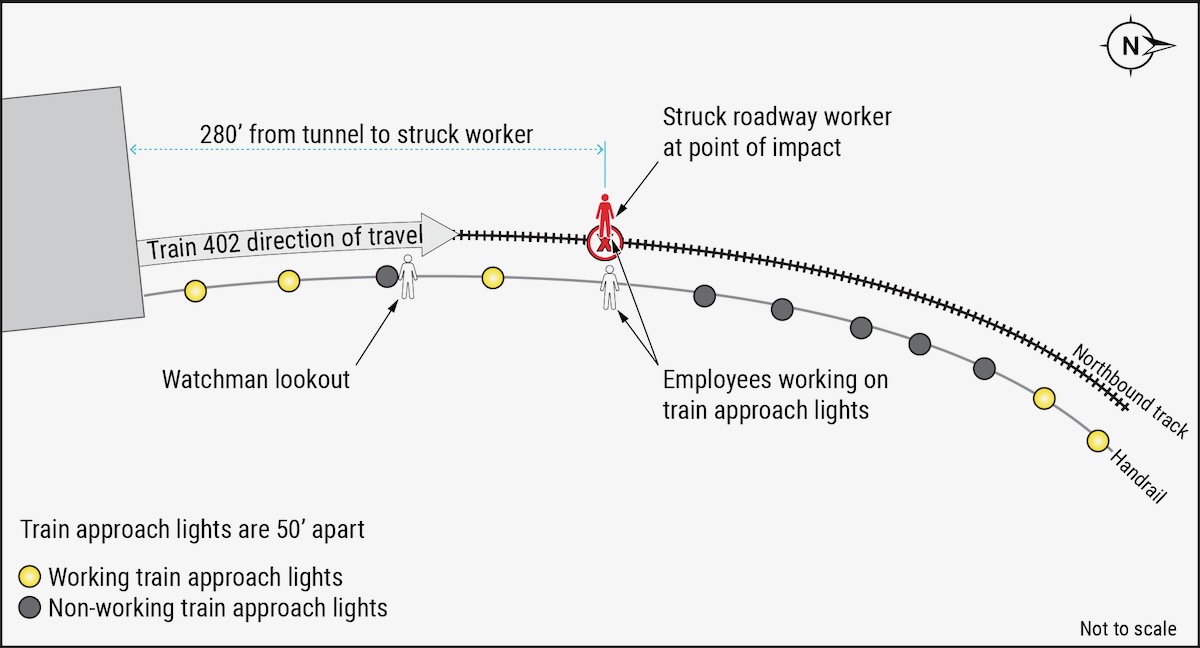
The employee suffered a below-the-knee amputation while working on a curved bridge between the Arts Center and Lindbergh Center stations. The worker was part of a crew repairing wayside train approach lights, flashing lights spaced every 50 feet that are used to warn workers of approaching trains in areas where they would not have line-of-sight visibility.
During the repair work, however, this function was overridden to make the lights flash so workers could determine which bulbs needed to be replaced. While this work was going on, trains had to receive clearance to pass through the area, but could pass through the area at maximum speed. A dedicated lookout is required to maintain a location providing ample line of sight for approaching trains while using a whistle or air horn to notify workers.
But the lookout had not yet reached his location when the accident occurred because he had been conducting a radio check. Workers on the track believed the lights were flashing because they had been activated for maintenance purposes, not because of an approaching train. One worker saw the approaching train, called out to warn the others, and moved against a fence to avoid being struck. A second worker also saw the train and moved to avoid the train, but the third worker was struck. The NTSB was unable to determine if that worker was moving from one location to another or was standing within the track envelope.
As a result of the accident, MARTA identified 32 blind zones where workers would be at similar risk and revised procedures to require Automatic Train Control protection in such zones, so trains can be slowed or stopped by work crews before entering the work area. It also created two new forms of safety clearance: Wayside urgent repair clearance, rerouting trains during emergency work, and minor maintenance repair clearance, in which a controller assigned to a work crew can control train movements and communicates with the individual in charge of the work crew to determine what action is needed before a train enters the work area. The latter would have applied in the circumstances of the accident. The agency also established speed restrictions of 25 mph when line of sight at a work site is 750 feet, and 15 mph when it is 450 feet.
— To report news or errors, contact trainsnewswire@firecrown.com.

There’s an FTA safety training video titled “A Knock at your Door” that discusses three fatal transit worker incidents–two on WMATA, one on NYCT–and breaks down the failures that led up to them (and therefore how to prevent them). I watched that video yesterday as part of safety training for a local transit agency, so seeing this report immediately afterwards was a bit jarring. Two failures are very evident here: trains were allowed to pass through at maximum speed after receiving clearance instead of restricted speed, and workers did not confirm that protection was in place before entering the workzone. It’s also noted that the watchman wasn’t in a position to give adequate warning before a train arrived, although it appears he was heading to that position and stopped due to radio trouble, so I lump that with the second failure (confirm protection).
What is it in the beginning of the GCOR: “expect the movement of trains at any time, in any direction.”
Why did the work crew get in a hurry to start work before proper safety had been established.
This work area should have required all trains to stop before going into the work zone.
The railroad was at fault for letting the trains to go maximum speed just because they had established flashing warning lights.
Both Daniel and Bruce make excellent points. RR’s have a huge number of rules. (Both of which D & B pointed out. ………I tell non RR people, “These rules are written in blood”. After someone got hurt, the rules were implemented. NOT for any other reason than SAFETY.
Obey them and all should be well, until an oversight will necessitate another rule.
Another example of, “Oh, those rules are for everyone else. I know what I’m doing”. When you have blood on your hands due to rules infraction, NO, YOU DON’T KNOW the consequences of rule breaking. endmrw0206261215