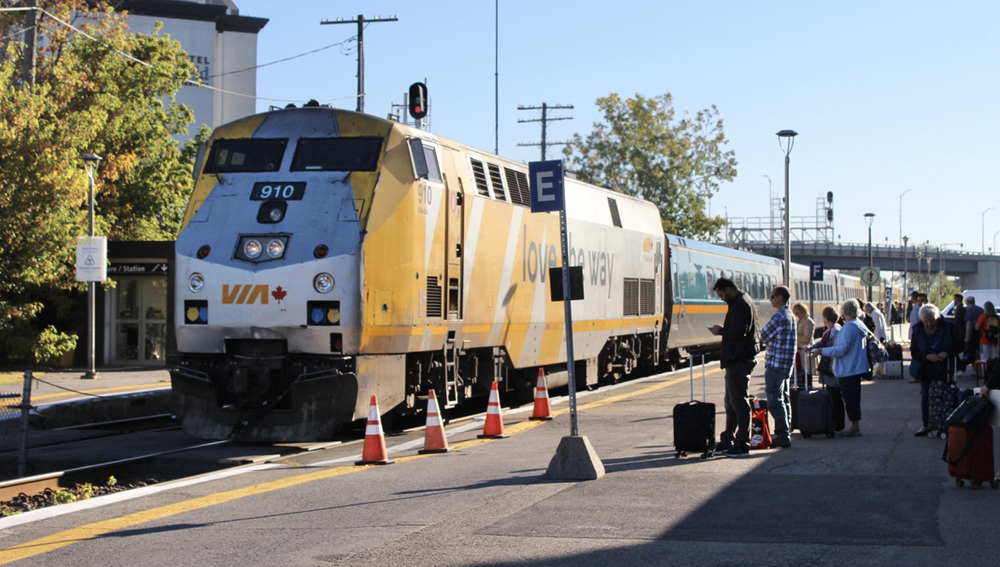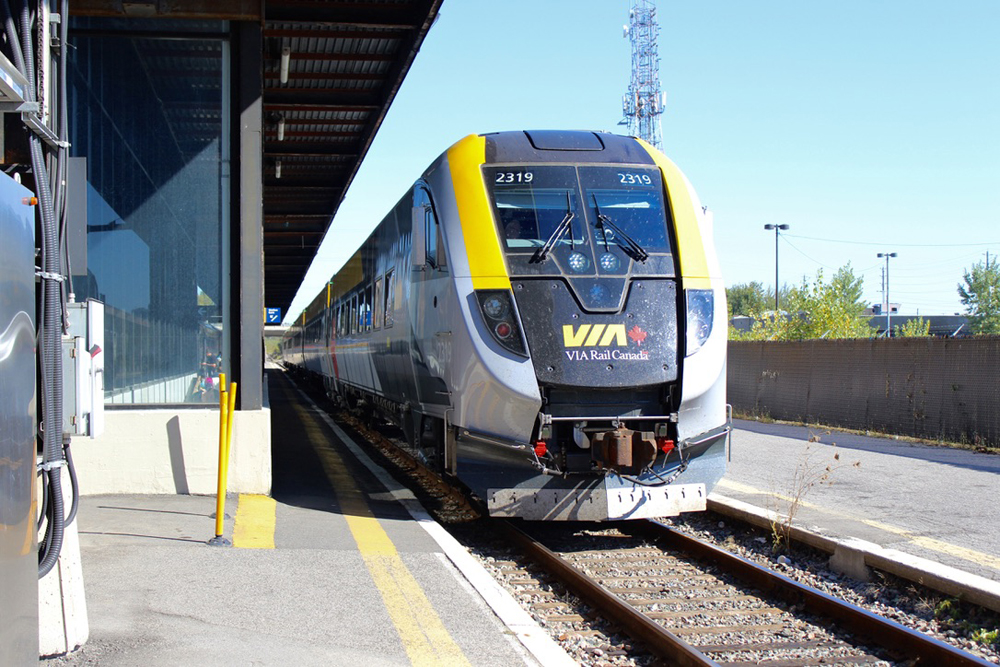
MONTREAL — VIA Rail Canada’s on-time performance plummeted in the first quarter of 2025, falling to 30% from 72% in the same period last year, the company said in a quarterly financial report issued on Tuesday, June 3.
The company also said ridership also dropped by 2.7% compared to the first quarter of 2024, the first such drop since the end of the pandemic. Total revenues, however, increased by 8.3%.
VIA said the dismal on-time performance stems from speed restrictions instituted by Canadian National Railway for the passenger operator’s Siemens Venture equipment used in Windsor, Ontario-Quebec City corridor service. CN said those trainsets had problems triggering warning devices, and requires trains to slow at some crossings. [See “VIA Venture slowdown limited …,” Trains News Wire, Oct. 17, 2024.] That has led to the trains’ ongoing inability to meet their schedules.
“The service disruptions we are experiencing are the direct result of infrastructure restrictions imposed by CN, restrictions that we believe are arbitrary and unnecessary,” VIA Rail CEO Mario Péloquin said in a statement. “We have formally appealed this situation in court while continuing to engage with Transport Canada with a goal of finding a resolution that restores reliable, efficient service to the millions of Canadians who depend on passenger rail.”
VIA filed suit over those restrictions the following month [see “VIA goes to court …,” News Wire, Nov. 13, 2024].
“CN’s restrictions have severely impacted our ability to fulfill our public service mandate: on-time performance has plummeted, customer satisfaction has eroded, and confidence in passenger rail is being undermined,” said Jonathan Goldbloom, VIA board chair. “We will never compromise on safety and remain committed to working with our partners to put an end to this unsustainable and unjustified situation.”
Also noted in the report: Ridership of the Toronto-Vancouver Canadian increased by 17%, helping spur a 28.8% increase in revenues compared to the first quarter of 2024. The ridership was helped by a 15.3% increase in available capacity.
Share this article