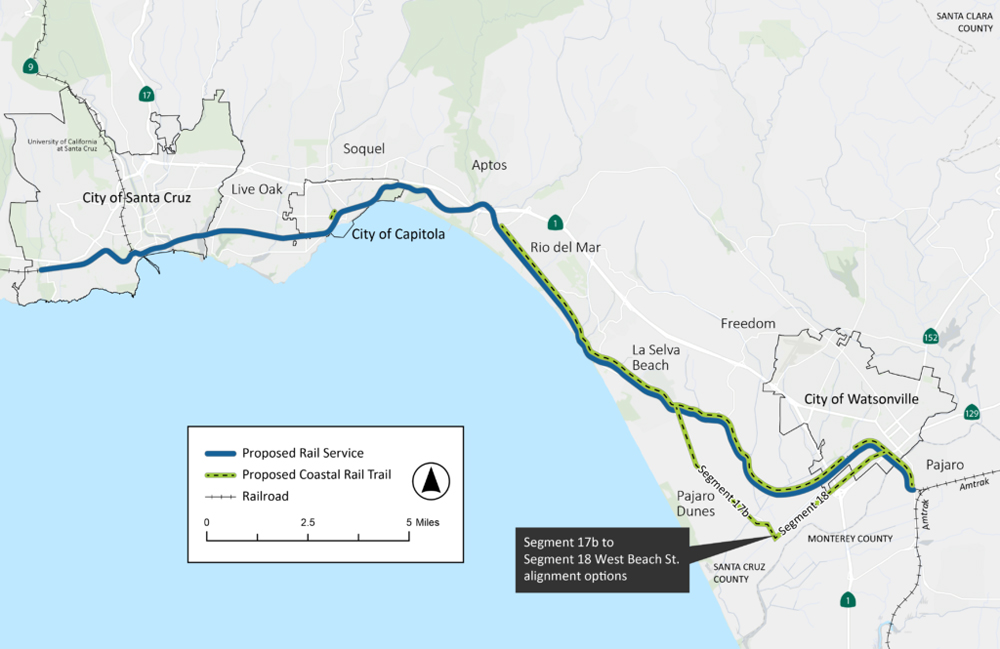
WATSONVILLE, Calif. — The Santa Cruz County Regional Transportation Commission has approved pursuing intercity rail service between Santa Cruz and Pajaro, Calif., rather than a light-rail alternative, while asking its staff to find an alternative to bridge repairs or replacement on that route that could cost almost $1 billion.
The news site Santa Cruz Local reports that at a March 20 meeting in Watsonville, the commission voted 9-1 to establish its preference for intercity rail service, which would offer a faster trip with fewer stops than light rail. That choice aligns with the California state rail plan [see “California rail plan calls for $310 billion program …,” Trains News Wire, Jan. 8, 2025], and is considered more likely to qualify for state and federal funding. It could also eliminate the need to string catenary along the 22-mile route.
However, the commission was not willing to accept the estimate of a consulting firm that all 33 bridges on route would need to be replaced or strengthened, at a cost of $980 million [see “Santa Cruz rail project could require …,” News Wire, March 15, 2025]. The commission staff had previously recommended replacement of 23 bridges, including 16 wooden structures.
“I don’t believe that there can’t be alternatives that would have less of a cost,” said Andy Schiffrin, representing commission member Justin Cummings, a county supervisor.“What I’m asking for is just taking another look.” But the commission’s executive director, Sarah Christensen, said replacing fewer bridges might save money initially while increasing long-term maintenance costs.
Share this article