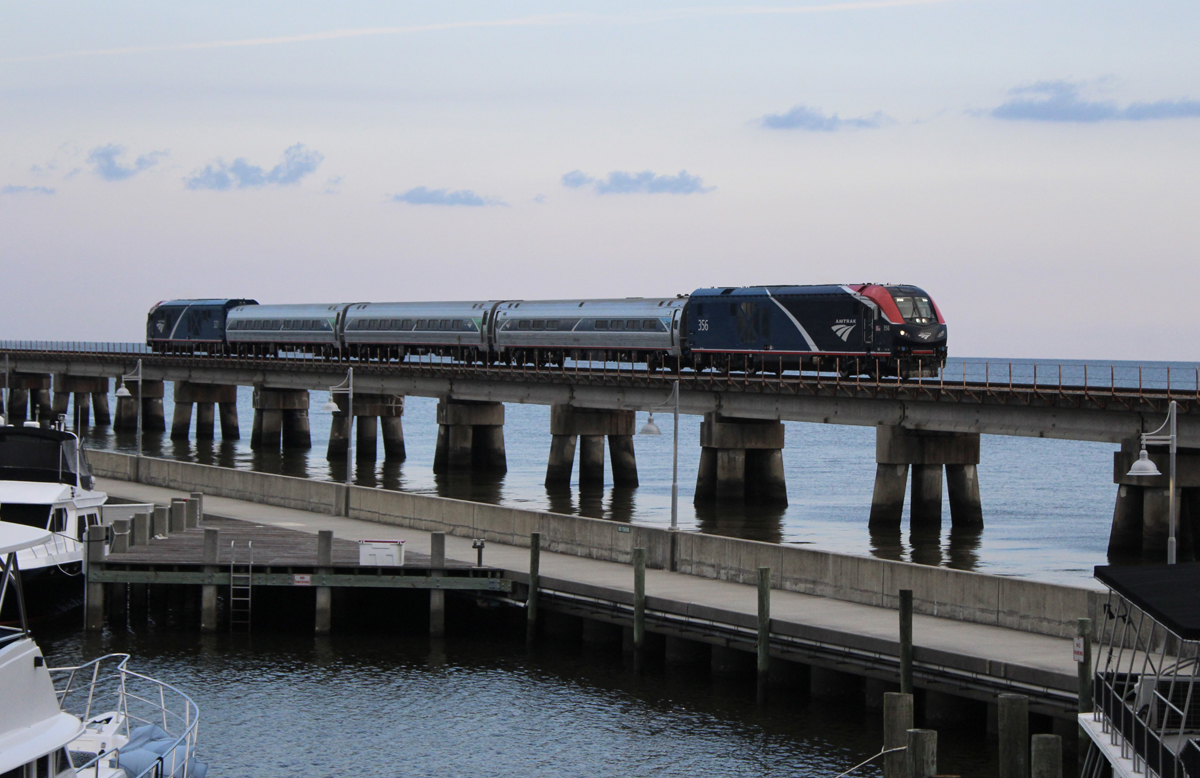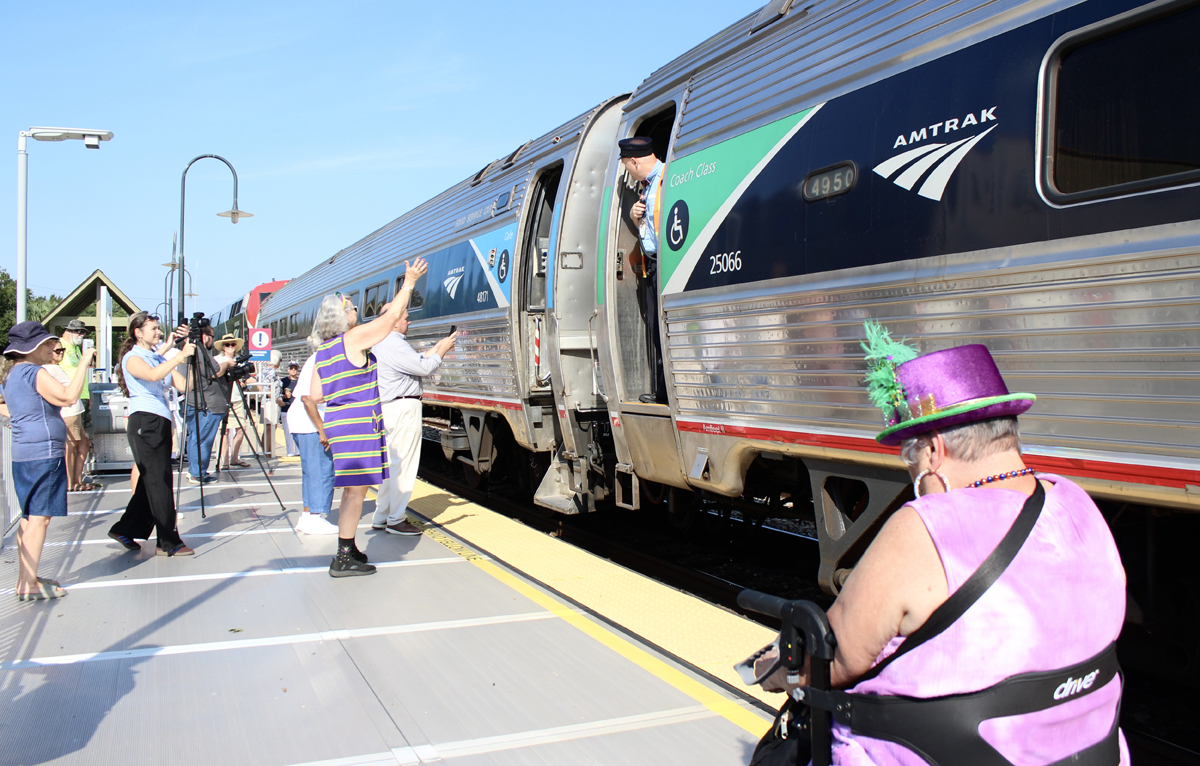
BAY SAINT LOUIS, Miss. — Perhaps no community along Amtrak’s Mardi Gras route has been more enthusiastic about the launch of the two daily round trips than townspeople at the first stop east of New Orleans.
So on Monday, Aug. 18, 2025, the first day of revenue service, it was not surprising a crowd showed up to greet the first eastbound and westbound Mardi Gras corridor trains. A total of 25 station hosts have signed up for volunteer duty to answer questions from first-time riders and promote the service. Many were among those on hand.
The schedule is designed so New Orleans-bound train No. 23 gets to Bay Saint Louis at 8:40 a.m., then meets No. 24 for Mobile several miles west of the station at the long Nicholson passing track. No. 24 is set to arrive at 8:57 a.m. if all goes well; a similar meet occurs at Nicholson for afternoon trains 25 and 26.
In the morning, at least, that didn’t happen. Fifteen miles to the east at Gulfport, Miss., a tractor-trailer driver ignored “low ground clearance” warning signs and hung up his big rig on CSX tracks near the station. Fortunately, the blue Emergency Notification System sign there enabled bystanders to call the railroad and stop all train traffic, which included westbound No. 23. It took 45 minutes to extricate the truck from the crossing; the delay was maintained into Bay St. Louis.
The route has few passing sidings, so it made sense to hold train No. 24 at Nicholson, where it could theoretically proceed east immediately after No. 23 passed.
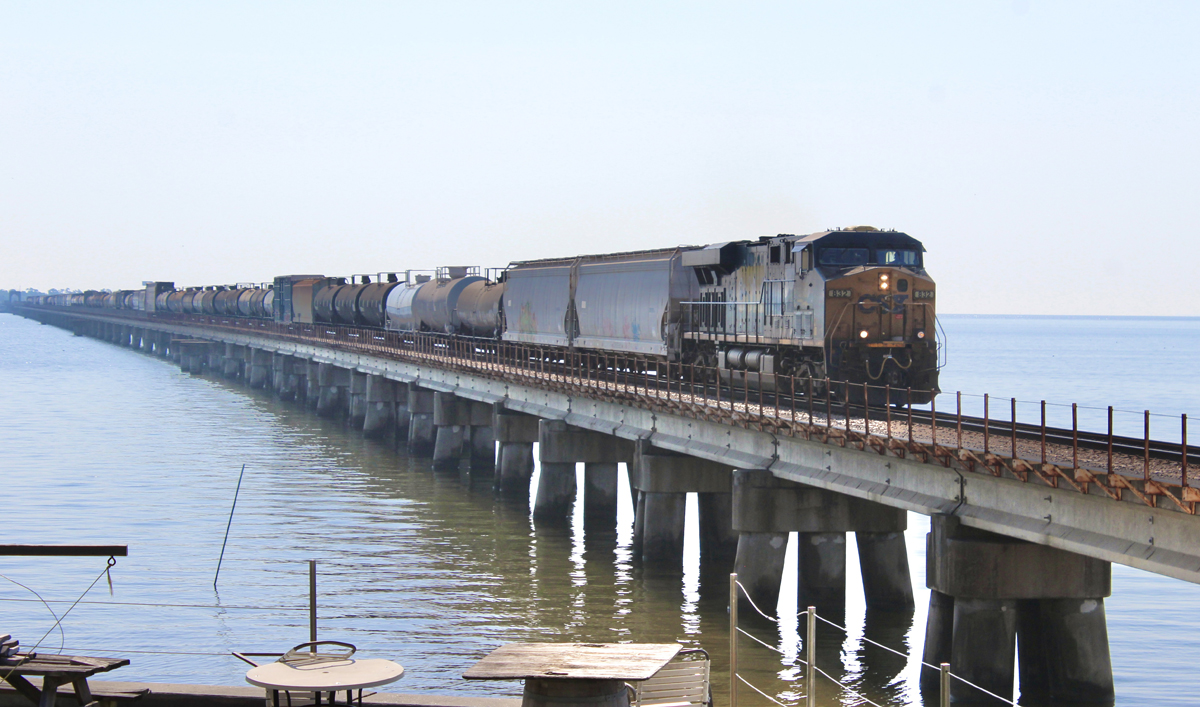
That wasn’t what CSX had in mind. The Mobile-bound passenger train lost an additional half hour waiting for a slow westbound freight that had followed No. 23 out of Gulfport. With one unit, it wasn’t one of CSX’s Precision Scheduled Railroading “non-fitters” — a train too long to fit in any passing track. The previous afternoon, before the Mardi Gras started regular service, Trains.com witnessed an approximately 206-car assemblage heading east.
A ”passenger train priority” dispatching decision would have put the westbound merchandiser into the siding at Harbin, about 6 miles west of Gulfport. That passing track is long enough accommodate this freight; two long CSX trains were spotted passing there in 2021.
Federally funded infrastructure improvements along this route as part of a settlement that remains confidential have not been implemented, and Amtrak chose not to pursue a Surface Transportation Board finding about what does and does not constitute “passenger train priority.” In fact, Trains.com learned on the Mardi Gras inaugural trip that the STB has disbanded its “passenger train desk” that was meant to handle complaints.
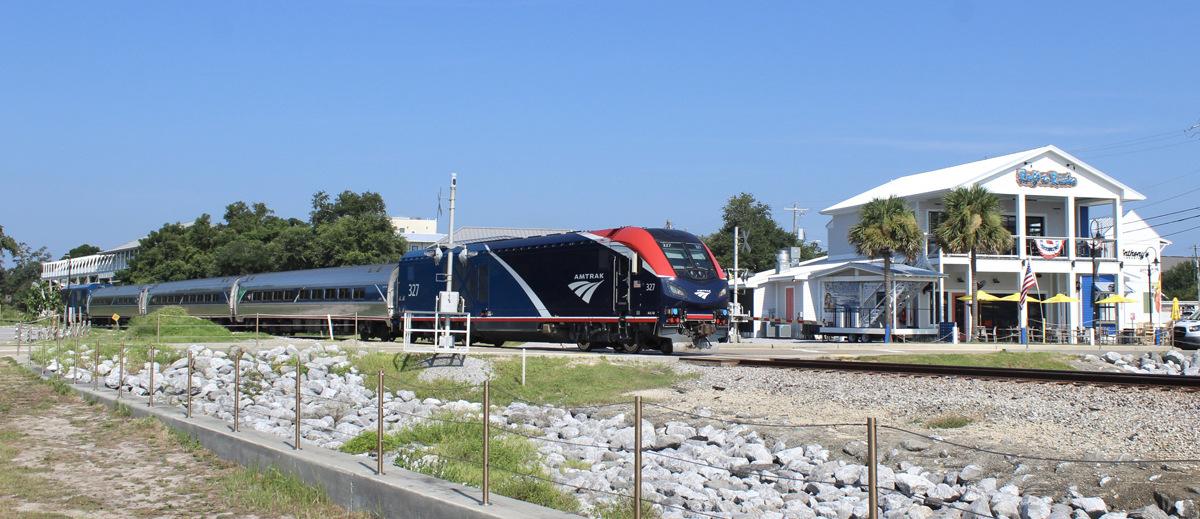
There may be reasons why the freight didn’t take the siding at Harbin; past efforts to try to pry that kind of information out of a railroad have been unsuccessful. But this was a documented instance of making a passenger train wait when CSX had another option. Is this a case of simply not being able to adjust to four new passenger trains? Or was it making a point about CSX’s position during the fight to launch service, which included a consultant-certified demand for more than a billion dollars in route improvements? The route had little traffic the rest of the day — or any previous day.
How CSX performs over the next few months will provide the answer. Triggered by the crossing incident and the delays that followed, the morning train to Mobile took advantage of some recovery time in the schedule and arrived only 34 minutes late, while the No. 23 held at 46 minutes late into New Orleans.
Some news outlets made a big deal about the morning delays, but the trains’ performance improved markedly for the evening Mardi Gras counterparts: No. 25 was 15 minutes early into New Orleans and No. 26 was 3 minutes early into Mobile. Though short, the trains were full. Now comes the challenge to keep them that way — in part by running on time.