





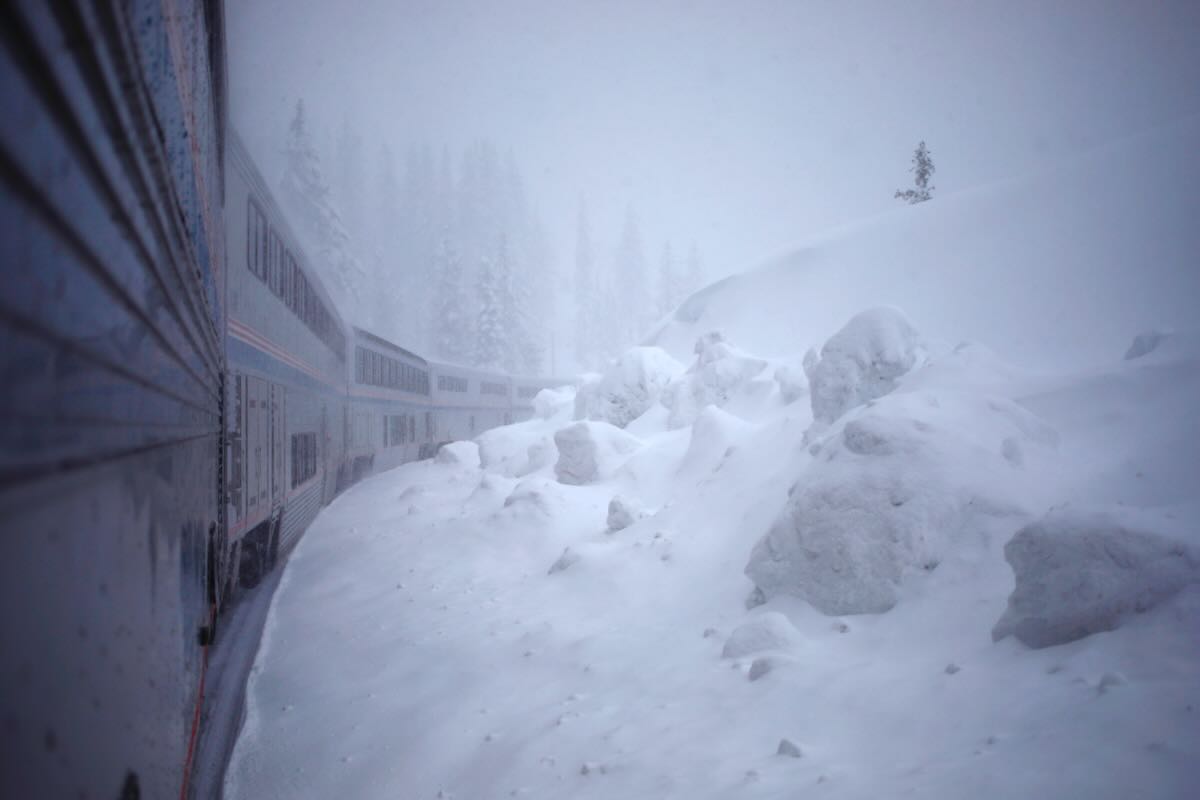
TRUCKEE, Calif.— The eastbound California Zephyr arrived in Truckee today (Feb. 20) just after 1 a.m. Pacific Time, 11 hours late. But it won the battle against massive snowdrifts that had shut down parallel Interstate 80 through the Sierra Nevadas.
Televised news reports like this one described multiple I-80 closures throughout a week that saw trapped cross-country skiers lose their lives in an avalanche. But they almost never mentioned that Union Pacific track crews kept the route open for its freight trains and the Zephyr despite the conditions.
Thursday afternoon’s train No. 6 had departed Colfax, Calif., two hours late. Westbound counterpart No. 5 had been running an hour behind schedule leaving Truckee and lost two hours heading through the increasingly heavy snow as I-80 was being closed to all traffic. Status reports from Amtrak and other sources indicate that the eastbound’s lead locomotive stalled out on the climb between Colfax and Truckee. A relief engine was called and the Zephyr was finally able to proceed. As of Friday afternoon, it remained more than 11 hours late approaching Salt Lake City.
The avalanche that closed highways and prompted travel restrictions beginning Tuesday, Feb. 17, had resulted in delays to eastbound Zephyrs no more than one hour and 45 minutes until the rescue of No. 6 Thursday evening. The longest westbound delay occurred Wednesday when the CZ arrived almost seven hours late into Colfax.
More than 90 inches of snow has fallen in the Sierra Nevada since midweek; another storm is predicted this weekend. Zephyr coach seats were sold out in both directions between Sacramento and Reno on Friday and Sunday.
— To report news or errors, contact trainsnewswire@firecrown.com.
Share this article
This should be front page news!
All kudos goes to Amtrak and Union Pacific!
Go dear California Zephyr go!
From reports it appears that Amtrak got exceptionally lucky. It certainly was the UP’s workers that bailed out the train not Amtrak. All the trees had to be removed by UP’s track workers.
Now Amtrak I hope dispatched the train with at least 2 or 3 HEP capable locos. That provides enough extra fuel in case the train stalls.
Come on people, after reading about Amtrak cancellations due to weather and delays we finally get a story about Amtrak making an effort to run thier trains thru some of the worst conditions out there. How about at least acknowledging that. Sure, there are a lot of should have, could have, would have things here, but they did it. Lets give kudos to the UP and to the crews of #’s 5 & 6.
Okay, credit where due. Amtrak can’t run trains in gentle winter weather in Illinois, but plowed through the Sierra Nevada in conditions that got a train stranded in the 1950’s.
BTW you don’t want to read about that stranded Southern Pacific train. It wasn’t a winter holiday, it was extremely uncomfortable.
At least they got through, as this could have easily have been a repeat of the 1952 City of San Francisco adventure, where the westbound train got stuck at Yuba Pass and even steam engines and two rotary snowplows couldn’t get it out! Imagine that happening in todays world…
Given the unreliability of the 30 year old Amtrak engines, given in the kind of weather it would be only reasonable to add locomotive(s) over the pass. Management doesn’t want to spend the money (might cut into their bonus pay) to provide reliable passage over the pass. They are going with a “hope for the best attitude” or “we’ll see what happens” rather than attempt to prevent a fiasco.
I recently rode train 6 from SAC to DEN and I really don’t care for the train manager of this train as the on board staff is OUT OF CONTROL.
Good job, Amtrak and Union Pacific!
These problems just go to show the need for a west coast general manager based in the Bay area. Such a person would know the need for extra locos on the CAL Z from Oakland – Reno. Maybe even a couple ACs on the front and on the rear with an extra engineer.
As well if this person had access to surge coach equipment he could attach them to take all the sell outs that were turned away. They probably would have only been needed over Donner. That much like the extra cars that once traveled that district.
Washington DC is just too far away to understand the west coast operations when there are weather problems or other problems.