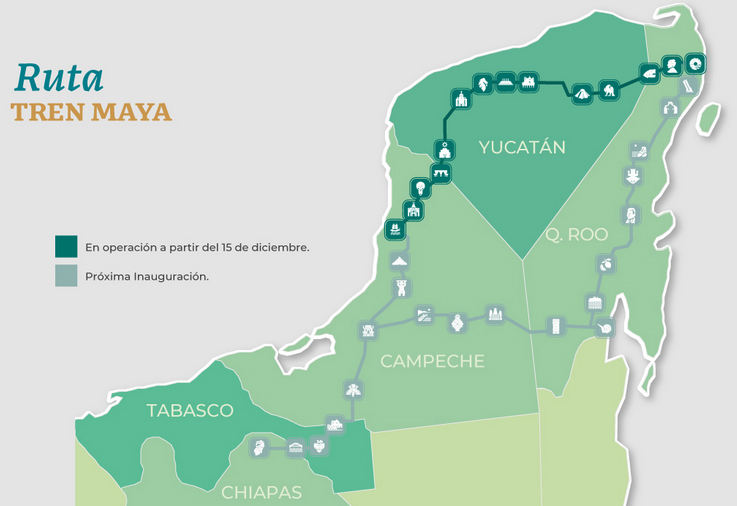
CANCÚN, Mexico — The first section of Mexico’s Tren Maya, or Maya Train — a tourism project on the country’s southeastern tip championed by President Andrés Manuel López Obrador — is slated to open today (Friday, Dec. 15), just five years after it was announced and years ahead of initial projections. But the project remains highly controversial, as it prepares to open despite protests, a series of court orders that attempted to block construction, and concerns about damage to the environment and the archaeological sites the looping 965-mile route is intended to showcase.
The initial segment, opening today, runs some 298 miles between Cancún and Campeche, with a trip taking six hours. The entire route is projected to be completed by February. As The Guardian reports, construction began before environmental studies were completed; it was built with the use of Mexico’s military forces, which will also operate the system; and legal rulings against construction have been ignored.
The government defends the construction as a way to bring tourism and investment to an impoverished portion of the country, and a United Nations report estimates it could lift 1.1 million people out of poverty by 2030. But critics also say the train is as much about freight traffic as its use for passenger tourism, with one critic telling the Guardian, “It’s part of a broader strategy for the region, to turn it into a logistical park.”
The system was originally slated to cost $7.5 billion; the Financial Times reports the cost is now at $30 billion, a price tag questioned by critics. “No study has been presented that justifies spending so much money,” Jesús Carrillo, head of sustainable economics at Mexican think tank IMCO, told the Financial Times, saying the country had more urgent but less headling-generating needs. “A train is clearly showier than a transmission line … It’s clearly another effort to leave a legacy.”
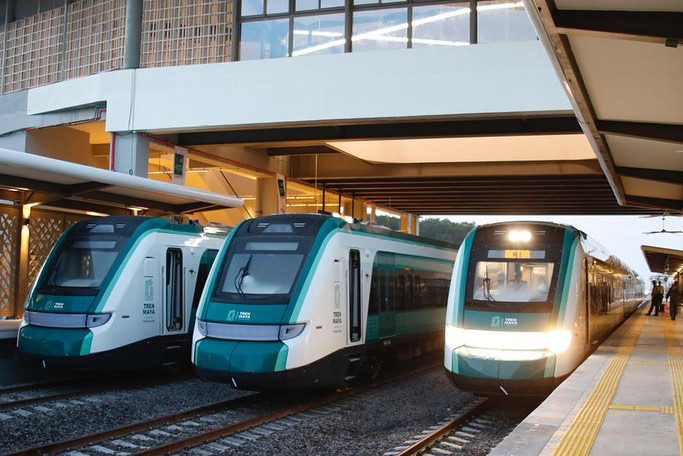
Alstom and Bombardier won a $1 billion contract to provide the Maya Train’s passenger equipment, mostly diesel-electric hybrid trains.
More information on the Maya Train is available at its official website (in Spanish).