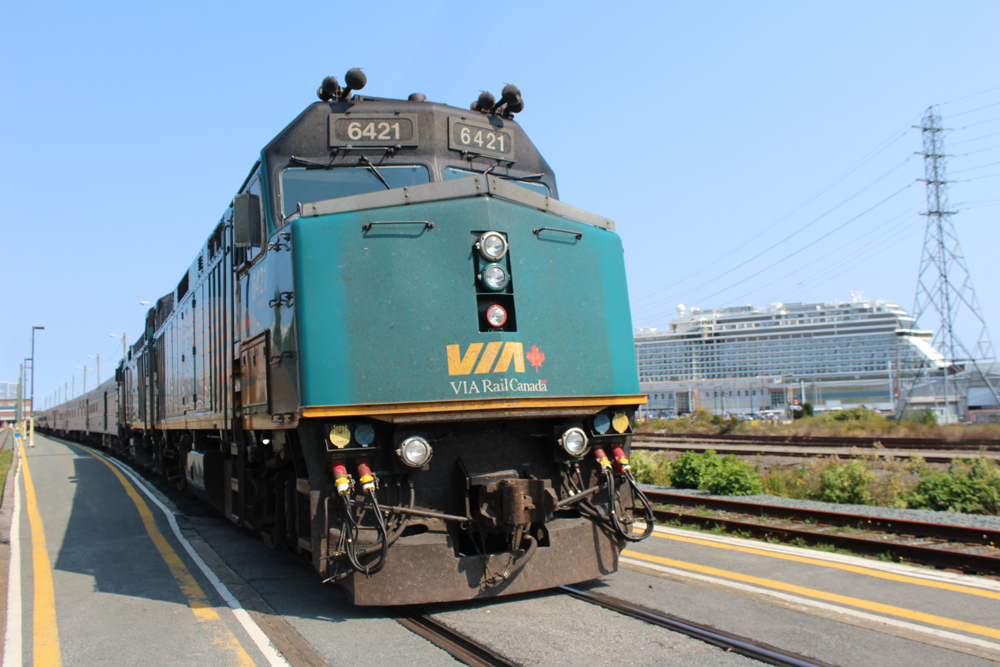
MONTREAL — Beginning June 19, VIA Rail Canada is adding 90 minutes to the westbound schedule of its Montreal-Halifax, N.S. Ocean and 45 minutes to the eastbound train, “to provide passengers with a schedule which better reflects actual travel times,” according to a statement provided by VIA in response to a set of detailed questions News Wire emailed last week.
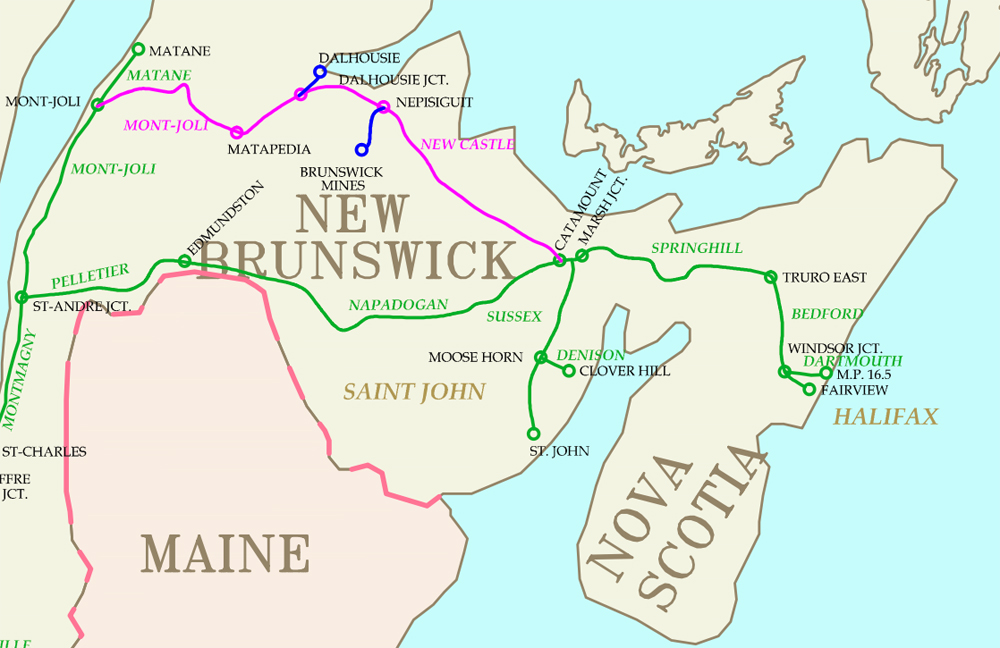
The reason for the slowdown is numerous slow orders Canadian National has begun imposing primarily on 187 miles of track between Moncton and Campbellton, New Brunswick, that also only hosts local CN freight traffic.
A comparison of old and new timings is available on VIA’s website — the eastbound schedule is here, while westbound is here.
The westbound triweekly Ocean now departs Halifax at 11:30 a.m. instead of 1 p.m., but arrives at Montreal’s Central Station at 9:53 a.m. the following morning, as scheduled previously. The eastbound train leaves Montreal 30 minutes earlier at 6:30 p.m. and arrives 15 minutes later at 6:06 p.m.
Because Canadian National has, for more than a decade, diverted most through freight between Quebec and Atlantic Canada on a more direct but lightly populated route skirting the Maine-Canada border, the railroad has demanded that VIA pay for additional maintenance to achieve passenger train speeds. If the money is not forthcoming and trackwork is deferred, the result is an unresolved dispute between the parties. The potential impact of slow orders on the route’s relevance is ignored by funders and operators, and the traveling public suffers.
A similar scenario has played out between CN and Amtrak over the Canadian portion of the New York-Montreal Adirondack, a train now is set to be sidelined north of Saratoga Springs, N.Y., until the busy summer travel season is over [see “Suspension of Amtrak’s Adirondack to Montreal will continue into September,” News Wire, June 7, 2024].
Canadian National had previously leased the Moncton-Campbellton segment to a short line and threatened outright abandonment in 2014 unless public funding was forthcoming. At the time, New Brunswick’s government agreed to provide some money, but only for freight customers; VIA provided C$18.3 million to CN for repairs between Bathurst and Miramichi, N.B, the portion of the route that New Brunswick wouldn’t cover.
“Unfortunately,” VIA says in a statement to News Wire, “the current conditions of that same infrastructure have now led to some operational changes. In response to recurring slow orders imposed by CN, along with a deterioration of operational speeds on that infrastructure due to track conditions, notably on the Newcastle subdivision, VIA Rail has no choice but to adjust the schedule of the Ocean.”
The lengthy statement adds, “VIA Rail remains strongly committed to offering its passenger rail services on the Ocean route between Montréal and Halifax. Since the vast majority of tracks between Montréal and Halifax are owned by CN, VIA Rail is subject to CN’s constraints and challenges when operating the Ocean route, pending CN’s capacity to resolve any issues.”
Asked about specifics, VIA says, “As we are not responsible for the level of upkeep of the track, we have no authority to answer questions on the condition of the tracks, the evolution of operational speeds over the past years, the nature and results of the work and maintenance done on the infrastructure or any other information pertaining to the railway infrastructure they own.”

Among the questions News Wire asked of both VIA and CN:
— Are the speed restrictions heat related?
— Are there speed restrictions below the Class 2 speed limit (30 mph) for passenger trains? (A 2016 employee timetable showed maximum speeds of 30 mph for passenger trains on a 59.2-mile section of the Newcastle Subdivision from milepost 48.4, near Rogersville, N.B., to MP 107.6, near Nepisguit, N.B.)
— Approximately how many miles of slow orders are involved?
— Has a price been quoted for track investment to raise speeds to at least 60 mph, and if so, what is the amount?
Canadian National spokeswoman Ashley Michnowski did respond to News Wire with this statement:
“Safety is a core priority at CN. Speed restrictions are implemented and modified as necessary to ensure the safe operation of the railway. Work is ongoing on the Newcastle Subdivision to increase speeds. CN’s ongoing maintenance of the Newcastle Subdivision will allow for some improvement to speed restrictions in the coming weeks and months. Last year, CN made roughly $22 million in capital investments to maintain nearly 600 route miles of track in New Brunswick, including on the Newcastle Subdivision. Maintenance work occurs regularly across our network, to the extent it is commercially reasonable.”
What is “commercially reasonable?” The trade-off between investment cost and speed achieved. Determination of that point is known only to VIA and Canadian National, as is the operating agreement between the two parties that the public is paying for. Both operator and railroad regard all contracts as too “commercially sensitive” to be divulged, even though public funding and mobility that is at stake.