



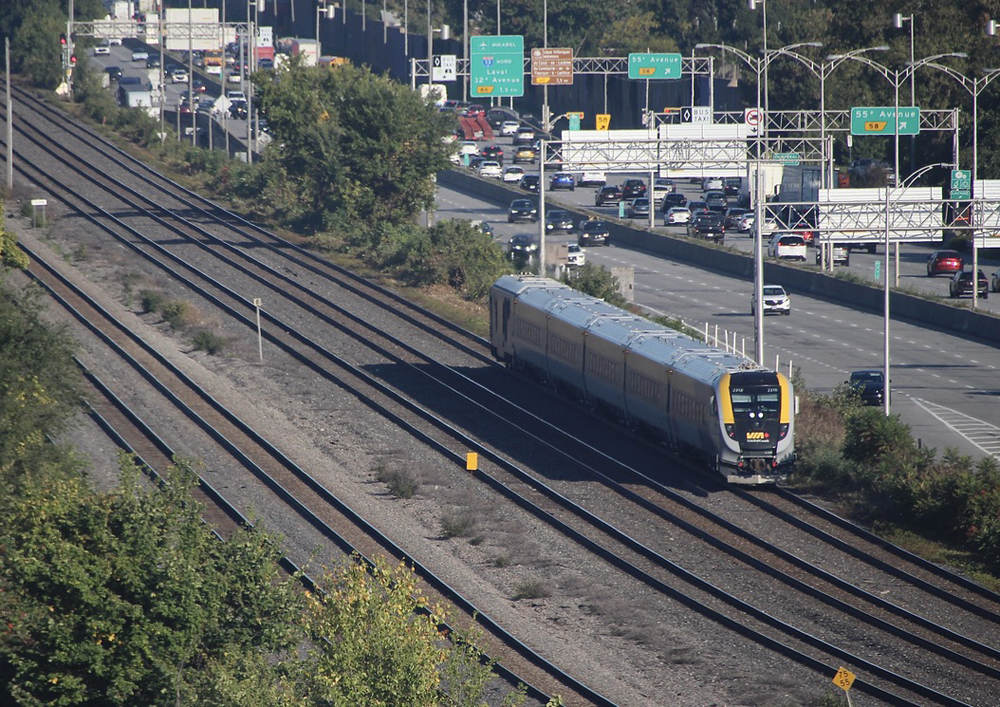
MONTREAL — Apparently triggered by one or more incidents in which a VIA Rail Canada Venture trainset failed to activate highway crossing warning devices, Canadian National is now requiring that all of VIA’s Venture-equipped trainsets operate with 32 axles.
The edict came late Friday, at the beginning of Canada’s Thanksgiving Day holiday weekend. It also follows more than two years of extensive testing and more than a year of revenue service in which VIA’s newly arriving Siemens fleet operated on every segment of the Quebec City-Windsor, Ont., corridor.
Until now, VIA has standardized each Siemens-built trainsets with one cab car coach, three “economy” coaches and one business-class car. Four axles per car on the five coaches and four on the Charger locomotive add to 24 axles on the semi-permanently coupled trainset. As a result, VIA has scrambled to add equipment to already well-booked trains.
Sources tell Trains News Wire that there were a minimal number of disruptions on Saturday and Sunday; other sources were unable to confirm a report HEP-2 heritage coaches were to be used on some trains as axle-count cars.
This is highly problematic for VIA from an operational standpoint, because the Venture deployment plan calls for push-pull operation. Many of the trainsets handle a daily Quebec City-Montreal-Ottawa train, then soon reverse on the same route. The new equipment has efficiently operated these round trips almost exclusively through the summer. However, they have been slow to migrate to departures to and from Toronto for Ottawa, Windsor, Sarnia, and Montreal until a new servicing facility is completed there.
CN discovery of shunt issues
A VIA “system notice” released Friday to employees says the axle-count requirement was implemented because Canadian National discovere, “a potential risk of short warning times on crossings equipped with Grade Crossing Predictors (GCPs). Such crossings utilize technology to estimate train’s speed to determine a sufficient warning time for vehicular or pedestrian traffic.”
It adds, ‘We can’t just add more Venture cars. Due to existing reservations and planning constraints, we are limited in our ability to extend trains on short notice. That said, we are doing all we can to minimize impact through all available means.”
The VIA-issued notice obtained by News Wire makes no mention of possibly waiving the axle-count requirement if speeds were limited. In the U.S., Canadian National has offered that trade-off to Amtrak in place of a requirement to run Superliners on a portion of Amtrak’s Illinois-financed Chicago-Carbondale, Ill., route.
It does mention that “shunt enhancer” antennas are being considered. This measure involving a locomotive-mounted device was being tested by CN in September 2023, as observed by News Wire [see “Seeking answers on ‘loss of shunt’…,” Sept. 6, 2023]. Installation in the U.S. would require a waiver currently being evaluated by the Federal Railroad Administration [see “Rail labor opposes Amtrak request…,” News Wire, July 6, 2024].
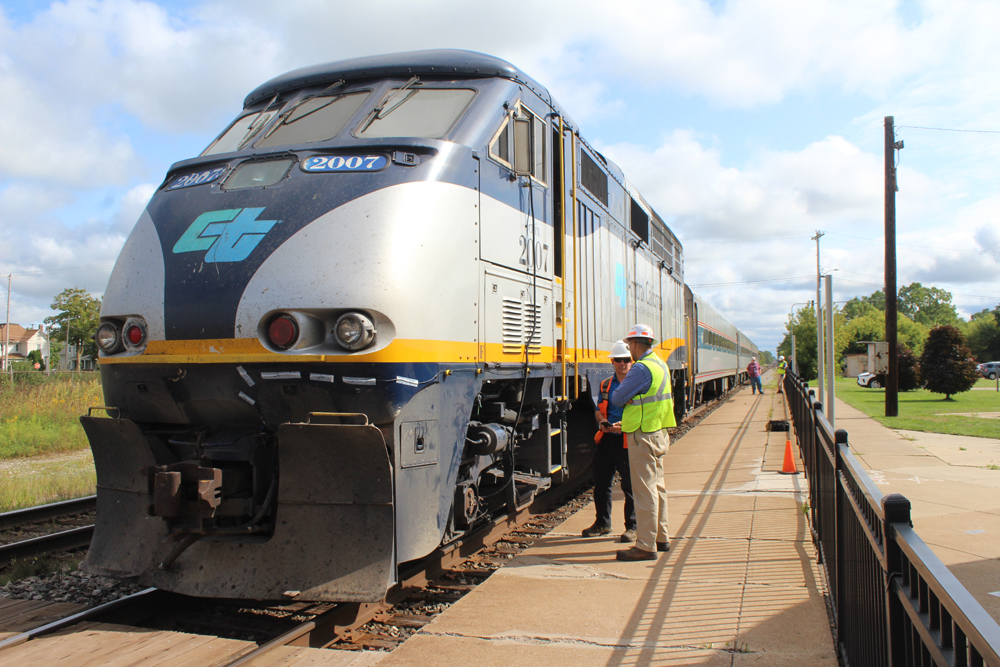
“Loss-of-shunt” instances arise sporadically on routes throughout the U.S. A specific incident or series of incidents often lead to the imposition of an axle-count or speed-limit requirement. The theory is that these increase the probability that either a greater number of wheels or more time for a train in a track circuit will ensure electric current conductivity between the rails.
VIA’s bulletin does not say what triggered the requirement on the Venture trainsets. Once such an incident occurs, regulators and operators have expressed understandable hesitancy to remove restrictions and declare, “it is now safe,” until a reason the fault occurred is explained. News Wire will continue to seek answers to those questions.
— Updated at 5:10 p.m. to note that a report of use of heritage equipment as axle-count cars could not be confirmed.
Share this article