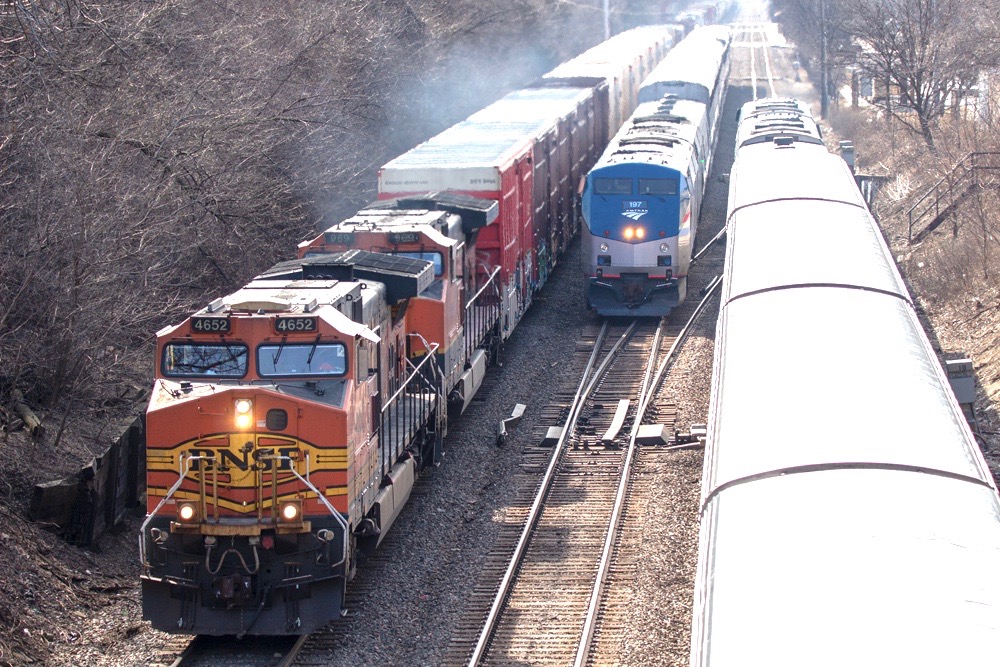
WASHINGTON — Class I railroads this week disagreed with Amtrak’s contention that its passenger trains should enjoy absolute and unlimited priority over freight trains.
Amtrak, as part of its complaint over Union Pacific’s handling of the Sunset Limited, told the Surface Transportation Board earlier this year that every individual dispatching decision must result in the Amtrak train going first — and that every aspect of a host railroad’s operations must advance Amtrak’s priority over freight traffic.
But in separate filings this week, Union Pacific, BNSF Railway, Canadian National, and Canadian Pacific Kansas City told federal regulators that Amtrak was trying to rewrite history and, in the process, dramatically expand the right of preference Congress granted the passenger railroad in 1973.
Operating according to Amtrak’s preference definition would inevitably lead to congestion that would delay both freight and passenger traffic, the freight railroads argue.
The issue has come up in the Sunset Limited case because the right of preference has never been defined. As part of its review of Amtrak’s complaint about freight train interference and the substandard on-time performance of the Sunset Limited, the STB in August asked the four Class I railroads to provide their interpretation of the preference standard.
UP urged regulators to reject “Amtrak’s attempt to redefine and expand Amtrak’s statutory right to preference.”
“Congress created Amtrak to relieve railroads from financial burdens of serving passengers that were endangering their ability to compete for freight, not to promote passenger service at the expense of freight service,” UP told the board.
Amtrak has argued that its trains should never be put into passing sidings for meets with freight trains.
“Absolute preference would undisputably reduce the fluidity of the rail network, lowering the quantity and quality of freight service,” UP argues. “As Amtrak has acknowledged to the Board, ‘in the real world in terms of trying to get two trains across a single-track railroad, it is sometimes more efficient for an Amtrak train to wait for a freight train to come through.’ Despite that prior acknowledgement, Amtrak now argues host carriers must avoid imposing a minute of delay to a passenger train, even if it would mean an hour of freight train delay or even hours of cascading delays across the rail network. Amtrak’s only justification for this extreme policy—that Congress cares about rail passengers—applied equally in 1973, yet Amtrak then recognized the folly of absolute preference.”
BNSF agreed.
“If a dispatcher were required to ensure that Amtrak never waits for, or proceeds on the mainline subsequent to, a freight train, the consequences to overall network fluidity would be disastrous,” BNSF told the board. “The interconnected nature of the rail network means that congestion at one location can negatively impact the overall network at large.”
Amtrak also contends that freight railroads agreed to prioritize the movement of passenger trains as part of the grand bargain that allowed the freight railroads to stop providing money-losing passenger service.
“This unprecedented ‘absolute’ approach both ignores and upends the original 1970 arrangement between passenger service and freight rail transportation,” BNSF argues. “That deal did not create a draconian landscape in which host railroads must submit to Amtrak’s priority, full stop.”
CPKC agreed.
“The ‘public bargain’ Amtrak describes carries no current weight. In 1971 (or later in some cases), railroads opted to join Amtrak and thereby accelerate the end of their passenger service obligations by avoiding time-consuming and costly abandonment processes,” CPKC argues. “However, there is no sense in which the freight railroads were thereby agreeing to become Amtrak’s vassals in perpetuity.”
When Amtrak was granted the right of preference in 1973, that did not mean absolute preference, the freight railroads argue. At the time, even Amtrak officials did not believe the right of preference was unlimited.
BNSF noted that when Amtrak President Roger Lewis testified before Congress in 1973 he grasped the nuances of running passenger and freight trains on the same tracks. “Well, this question of freight train interference is complicated. There are cases in railroad operations, a number of them, where freight train interference might be justified . . . I feel and I have felt, that to try to legislate that and say, ‘You will always give preference to the passenger train, or never let a freight train interfere,’ is just not a real-world approach,” Lewis said.
UP highlighted a different portion of Lewis’s testimony. “Mr. Lewis instead noted there ‘are cases in railroad operations, a number of them, where freight train interference might be justified’: ‘For example, maybe in an operation in an area where you had a siding that would take five cars, which would be enough to accommodate that particular passenger train, but would not accommodate a 100-car freight train, it would be sensible to put the passenger train aside and get the freight train out of the way, not only for that segment, but for all of the operations that that train might later interfere with.’”
UP and CN cited 1976 congressional testimony from Amtrak President Paul Reistrup, who rejected the notion that passenger trains should never take sidings for meets with freight trains. “Being a former operating man, I would disagree with that. We can actually get faster passenger trains in some cases, depending upon the situation, by putting a passenger train, which is short, into the siding and getting that freight past it on the main line, particularly when the freight train won’t fit in the siding. This is just prudent operation,” Reistrup told Congress.
CPKC argued that Amtrak’s current view of passenger train preference is unrealistic.
“CPKC respects Amtrak’s well-founded desire to receive top priority relative to other trains using a given line and to achieve good on-time performance. But Amtrak’s position is inconsistent with how railroad dispatching works, and its perspective on what ‘giving preference’ means is likewise out of touch with reality,” CPKC wrote. “Rather than a series of isolated red light/green light decisions, dispatching involves something more akin to a ‘strategy’ for managing traffic flows across a rail line with less-than-infinite capacity.”
A high-priority intermodal train, for example, will get preference over other freights operating on a single-track main line, but even it would “occasionally take sidings, slow at approach signals, and stop at red signals so trains moving the opposite direction can proceed,” CPKC wrote.
“Is this consistent with the higher priority train being given preference? Yes, it absolutely is. That is because expediting the movement of the priority intermodal train involves a more holistic approach to dispatching than just calling every ball or strike that arises in the train’s favor,” CPKC wrote. “It involves a corridor approach, taking into account the capacity of the line and all of the trains — both freight and passenger — that must move across it. It means planning in advance for efficient meets or passes, when sometimes the best way to expedite the priority train to its next station is to have it wait for a fleet of oncoming, lower-priority trains to move out of the priority train’s path. The same is true of Amtrak’s trains, which of course have priority even relative to expedited intermodal freights.”
“But that level of priority,” CPKC wrote, “does not mean that the Amtrak train will only see green signals or never be paused in a siding.”
CN told regulators that passenger train preference is relative, not absolute.
“Providing Amtrak preference means giving it the highest priority in dispatching, that is, giving greater weight, when dispatching trains, to avoiding delays to Amtrak’s passenger trains than to avoiding delays to freight trains seeking to use a rail line, junction, or crossing, so as to minimize, to the extent practicable, delays to Amtrak,” CN wrote. “Amtrak’s notion that its trains have an ‘absolute’ right to proceed like a presidential motorcade, as if rail carriers ran no freight trains on their rail lines, ignores the text of the statute, Congressional intent, the realities of mixed (freight and passenger) use, the Board’s mission of protecting freight customers as well as passenger interests, and the basic property and constitutional rights of rail carriers.”
UP also argues that if Amtrak were granted absolute preference it would generate costs so huge that they would jeopardize Amtrak’s very existence.
“The costs to Amtrak and the public from absolute preference would be staggeringly high. Amtrak must compensate the host carriers for the incremental cost of its access. This standard requires reimbursement of all costs incurred by a host carrier due solely to Amtrak’s presence on a line,” UP said. “If host carriers had to ensure every dispatching conflict is resolved in Amtrak’s favor, Amtrak would have to pay for the costs imposed on host carriers as a consequence.”
STB precedent confirms that incremental costs include all costs that a freight railroad would avoid if a rail line did not host Amtrak trains, UP argues.
“Amtrak’s cost to compensate host carriers for absolute preference on routes such as the Sunset Limited Route would be enormous, threatening the viability of an Amtrak operation that is already losing tens of millions of dollars each year,” UP wrote.
The STB has wrestled with the preference issue before. In 2015, the board issued a proposed policy statement that indicated it would “not view the preference requirement as absolute.” Instead, the board said it would “take a systemic, global approach in determining whether a host carrier has granted the intercity passenger trains preference.”
The board subsequently withdrew that policy statement a year later, however, noting that “its approach to preference issues can be developed and refined in the context of specific … cases.”
Now the Sunset Limited case will provide the STB with an opportunity to issue a landmark decision on passenger train preference that would extend far beyond Amtrak’s triweekly Los Angeles-New Orleans train.
Share this article