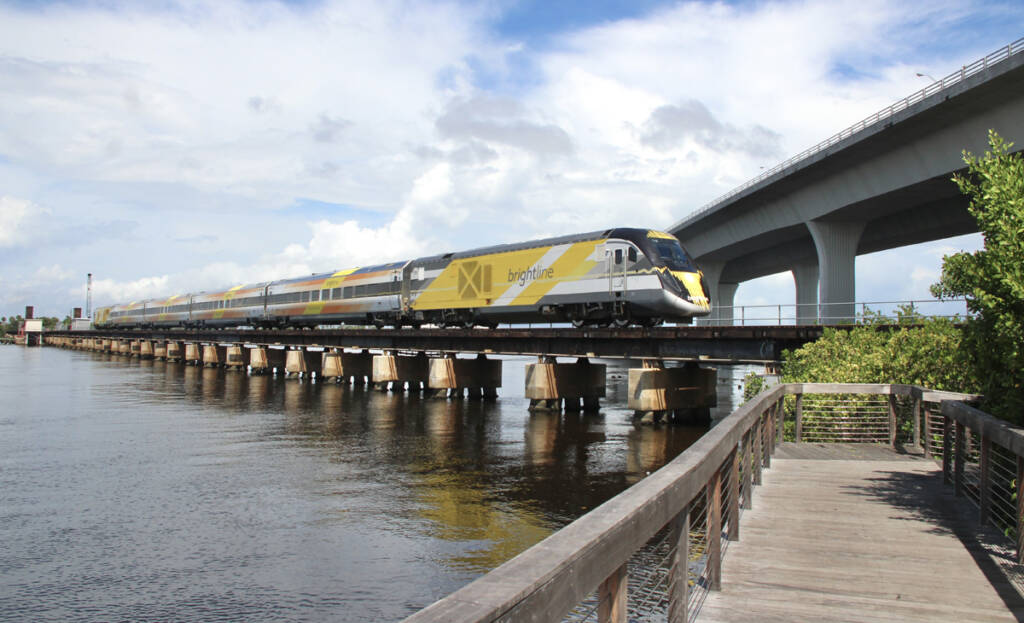
MIAMI — Brightline last week deferred interest payments on private activity bonds after initially indicating it would draw from financial reserves to make the payments.
The company’s just-issued December revenue and ridership report says it elected to defer interest payments on debt due Jan. 15 on 11 bonds issued by the Florida Development Finance Corp., saying this is “permitted under the All Aboard Florida Operations Holdings bond documents.” This was the second deferral of interest after a payment was deferred last July on the same bonds. Default doesn’t occur unless three interest payments are deferred.
The day before the interest was due, Brightline had said in a filing with the FDFC that it would use a portion of its “debt service reserve” to make the payments.
The company also executed an amendment to $985 million in bonds from last year [see “Brightline remarkets $985 million …,” Trains.com, Aug 13, 2025], removing the requirement that it make interest payments in cash. This could pave the way for its pursuit of “a substantial amount of equity, the proceeds of which would be used to repay principal and interest debt of ours and to increase cash reserves.”
In a paywalled article, Bloomberg reports the company also has $1.1 billion of corporate notes that have an interest payment due Jan. 31.
After the deferred payment was revealed, the Fitch bond rating service on Friday downgraded Brightline’s debt, explaining why in an extensive analysis. This followed a bond downgrade by Standard & Poor’s in December [see “Brightline confronts cash crunch …,” Jan. 12, 2026].
These events follow the announcement, also last week, that the company has tapped former Eurostar CEO Nicholas Petrovic to become Brightline’s chief executive. [See “Brightline hires …,” Trains.com, Jan. 14, 2026].
Meanwhile, Brightline’s December report shows continued trends from November, confirming that additional premium capacity on fewer long-distance trains registered gains of 25% in both ridership and revenue. Miami-Orlando Smart class passenger counts were off slightly with fewer departures, but revenue was up 9%. Additional Miami-West Palm Beach frequencies netted a 23% increase ridership to a level not seen since 2023.
The company reports that its Brightline Rewards program has more than 515,000 members. It still has work to do in attracting out-of-state visitors; Florida residents represent 82% of the ridership total.
— To report news or errors, contact trainsnewswire@firecrown.com.

You can make money off a passenger train, but you can’t run enough passenger trains to make money. Not my quote, but I have generally found it to be true.
Interesting point Peter. Especially in countries with heavy freight traffic on the rails (I’m thinking USA and Canada) there’s only so much capacity for passenger trains. Also what rail advocates don’t take into account is that the terminal and yard capacity a vigorous passenger train network would require no longer exists. There’s two cities I am familiar with that have huge airports, but whose center-city passenger train terminals have restricted capacity. (1) Detroit Amtrak New Center. Great location, one platform. (2) Denver, most of the platform capacity at Union Station was given over to RTA.
Of course there’s more to passenger rail than downtown terminals and that is the strength of passenger rail. The Boston area has Route 128 Station (which goes back to New Haven days). The Detroit area has an important Amtrak station at Dearborn, serving populous suburbs like Dearborn and Livonia. Milwaukee has added the General Mitchell Airport Amtrak station which has little to do with aviation and a lot to do with being a south suburban (though within the Milwaukee city limits) park-ride for rail passengers.
(1) There’s no way to make a profit in passenger rail. Accept that passenger rail will run at a loss and that taxpayers will in every case make up the difference.
(2) Brightline is a private company but in part it’s publicly financed. Call it what it is.