





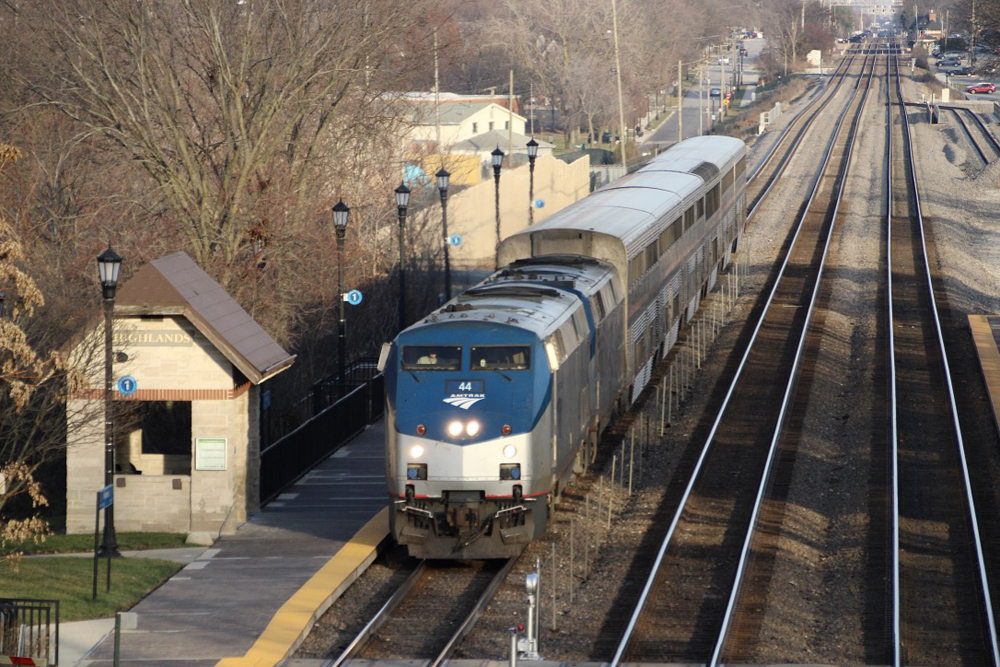
HARRISBURG, Pa. — Amtrak has turned down a private company’s proposal for a transcontinental passenger train that would have included an auto-carrying feature.
WPMT-TV reports that Amtrak said in a statement that it reviewed the proposal from AmeriStarRail and “found it to be lacking a fundamental business case to support its lofty proposal.”
Earlier this year, AmeriStarRail proposed partnering with Amtrak on a “Transcontinental Chief” train to offer 72-hour service between New York and Los Angeles to begin in 2026. The proposal called for drive-aboard service for truckers and Auto Train features for passenger cars and other vehicles, including charter buses. [See “Private company AmeriStarRail proposes …,” Trains.com, July 1, 2025]. Under its plan, the new train would have replaced Amtrak’s Southwest Chief and Pennsylvanian, using existing Amtrak equipment and TTX flatcars and auto racks. Amtrak declined comment when the proposal was released.
AmeriStarRail chief operating officer Scott Spencer told WPMT that Amtrak never held “serious meetings and discussions” about the proposal. He said he will now aim to get Congress, the Federal Railroad Administration, and the U.S. Department of Transportation to push Amtrak into negotiations, with the idea of starting the service by the 2028 Olympics in Los Angeles.
AmeriStarRail regularly proposes changes to Northeast Corridor passenger service, including privately funded high speed trains, new infrastructure, and three-class high-speed service. Those proposals either do not address funding or do so only in general terms. More on AmeriStarRail is available at its website.
— To report news or errors, contact trainsnewswire@firecrown.com.


Lost in the mists of history were the many thru sleepers that were truly “transcontinental” which afforded passengers all the comforts of not changing trains in Chicago or St. Louis or wherever.
Interesting concept… a “Chunnel” train without the “Chunnel…”
I’ve seen several proposals of various sorts from AmeriStarRail, and pretty much all of them sounded half-baked. Examples:
1. Turn trains at Alexandria, VA (3 track through station on the main) vs at Washington, DC (25+ track stub and through station). For…what gain?
2. Use the first Airo cars on the NEC instead of in Washington State so the Amfleets can get retired sooner. This was admittedly suggested before the Horizons got pulled from service and replaced by, you guessed it, Amfleets, but even then I didn’t like the sound of it. Maybe that’s just a bias towards the Cascades.
3. Keep the current Acelas for use as secondary trains on the NEC, and maybe even expand them. Y’know, the Acelas that are getting cannibalized for parts to keep the rest running.
4. Now this proposal–replace two long-distance trains with a single train, running on a 72 hr schedule, and hauling automobiles too! Even with limited stops for the auto cars, you still need quite a bit of time to switch them out of the consist, which will significantly lengthen the schedule. And you can’t run into NYC Penn with Superliners, which I think the plan called for, so you have to go to Hoboken and make people take a ferry across to NYC. And all of this assumes the host railroads can run the train on time.
Now admittedly, I did find the “Baltimore Grand Slam” proposal intriguing. Replacing the existing tunnel and station with a new deep-bore station on a straighter alignment. Still too expensive for what Amtrak can afford, but intriguing.
I’ll repeat my comment from the 12/22/25 Intercity article forum:
With the advent of advanced railroad safety technology and scheduling concepts, such as positive train control (PTC) and long distance scheduled fast freights, (precision scheduled railroads for freight, PSR), combined with much improved railroad infrastructure over the past 20+ years, such as double (+) tracking old single track mainlines with reverse traffic signal capabilities, I could envision the possibility of (certain potential routes) efficient and profitable transcontinental and regional passenger train service, where Amtrak has always operated at a financial loss at the expense of the tax payers.
With proper planning and co-ordination with the freight train industries, passenger trains could move more efficiently, sometimes being tacked to the rear of a transcontinental scheduled intermodal fast freights, thereby competing with the heavily subsidized airline industry, with all their (near) recent airline accidents, not to mention so much atmospheric contrail pollution.
This only works one way, A completely separate rail line with no interference with freights and no automobile railroad crossings. This is how Australia made it possible to run unmanned ore trains on short timetables because they didn’t have to worry about cars at crossings or any other interference. You might have to create some tunnels top get through the Rockies and the Sierra Nevada’s. But to expect to run a 72 hour train without freight train interruption on their lines is nearly impossible unless you pay through the nose for the right and then who can afford your train. Pie in the sky ideas are great until you factor in the reality of the situation. If it was simple, there would already be a transcontinental High Speed Rail train and I don’t see one anywhere on this continent … yet!
Hi Vince Saunders, one has to crawl before they can walk. My above thoughts allow for high(er) speed passenger trains to grow slowly on existing RR RoWs. as a low cost experiment.
IF AND WHEN the results should appear successful, especially competing against the airlines in select areas, then MAYBE us U.S. tax payers can afford an exclusive transcontinental RoW for “bullet trains”.
Either that or keep on using the existing infrastructure permanently as I described above, for PROFITABLE higher speed passenger service. PTC and PSR, along with double track reverse traffic capability, and attaching certain passenger cars to the end of PSR scheduled intermodal fast freights , used efficiently, could/should help with all that.
IMO, the Socialist-Fascist authoritarian Oz Penal Colony has plenty of empty Outback public lands and prison labor for their RR RoW high speed expansion, and little government incentive to make any profit with their far lesser population.
I should add to my above comments that the very idea of allowing the UP-NS merger for faster long distance cross country freight traffic should also benefit higher speed cross country passenger service as well, whether the passenger cars are attached to the rear of scheduled fast freights, or if the passenger train agency, (whoever that might be beyond Amtrak), provides their own motive power.
This company obviously has no clue how Amtrak runs (poorly) and there is little to no existing equipment to support a new venture such as this.
These characters in this proposal company should ride Amtrak from NY to LA and experience the engine failures and other mechanical failures along the way. Not to mention freight train interference.
No Amtrak is NOT capable of such a venture.
Amtrak is definitely not capable, but a true transcontinental railroad, as proposed by UP and NS, could pull it off. In the same way that Florida’s Brightline service got the green light while in common ownership with FEC, a 72-hour coast-to-coast hotshot of some sort or another is possible with a unitary railroad.
Transcontinental, not “Trancontinental”
Sounds like the right decision by Amtrak given the less than stellar OT performance of the Chicago-Washington DC-Miami Floridian.
“Amtrak said in a statement that it reviewed the proposal from AmeriStarRail and ‘found it to be lacking a fundamental business case to support its lofty proposal.'”
Amtrak’s response is more wordy and diplomatic than the more-direct: “Batshit Crazy.”
For all its shortcomings, Amtrak is trying to be an actual railroad. It’s under no obligation to negotiate with, or to talk to, or to bond with, this vaporware.
Granted Amtrak is quasi-public, but so what. Suppose some vaporware went to American Airlines and said, why don’t you talk to us about using ten of your gates at DFW Airport. American doesn’t have to talk to them and should not be criticized for not doing so.
Vaporware! Nice Charles!!
There is not a snowball’s chance in heck that they’d get this train running before 2028, even in Amtrak was okaying it – which they’re not. This company is just talking castle-in-the-air nonsense.
On the one hand, not surprised to hear a government agency turned down a radical new idea with no consideration. Innovation is not their strong suit.
On the other hand, this does sound like a rather “ambitious” plan…