WASHINGTON — Responding to criticisms from members of Congress in a House hearing last week, Amtrak has posted a 14-page PowerPoint presentation aiming to justify a controversial incentive system that pays millions of dollars in bonuses to company executives.
Board Chairman Anthony Coscia said the compensation of senior executives would be posted on the Amtrak website during the hearing by the Transportation and Infrastructure Committee’s Subcommittee on Railroads, Pipeline, and Hazardous Materials [see “Lawmakers spar over Amtrak’s profitability and transparency …,” Trains News Wire, June 12, 2024]. The information appears at the end of “Pay for Performance Rewards,” which can be found by clicking successively on “About Amtrak,” then “Reports and Documents,” then “Performance incentive program.”
Top executives: $9,195,835 in salary and bonuses
Near the end of the report, separate slides list the fiscal 2023 long-term incentive awards and base salary for the “Executive Leadership Team” of 15 high-ranking officials: CEO Stephen Gardner, President Roger Harris, nine executive vice presidents, and four vice presidents.
The long-term incentive bonuses ranged from $305,808 to $154,962, and total $2,976,784, a $228,983 average for the 13 of 15 officers that received them. Base salaries were $490,000 to $305,000, totaling $6,219,051 (a $414,603 average).
Not addressed was the smaller “short-term incentive” program for which managers at many levels are eligible, other than an explanation that these rewards “are based on performance metrics tied to the company’s overall performance goals. If the company does not meet or exceed these rigorous goals, our employees are not rewarded with majority of awards since program inception awarding at below target levels.”
According to the description, “Improving performance” incentives also are generated by “delivering more trains to more places with improved customer satisfaction” with “increasing financial and operating efficiency (lowering operating losses and doing so with fewer delays).”
Bonus components
Formulas used to determine the long-term incentives have three categories, with separate thresholds that must be met for executives to receive at least 75% of the award:
— Customer satisfaction index (CSI) weighted at 30%; the index must achieve a minimum of 80%.
— Amtrak-caused delays weighted at 20%; it must be under 463 minutes per 10,000 miles.
— Adjusted operating income weighted at 50%; the loss must be reduced to $885 million.
If the minimum goals are not met, there is no award for the category. But if they are exceeded, the award could be 100% (“target”), or 130% (“superior”). The CSI index, generated from post-trip online customer surveys, came in at 79.6%, so no bonus was awarded for that component. The delay figure was 431 minutes, so a 23.1% bonus was awarded. But the operating income bonus was adjusted upwards to 130%, because the loss came in at $772 million — $1 million under the 130% “superior” threshold. That “bottom line” number is the product of cost allocation formulas, which have been under the microscope for two years by a special committee of the States for Passenger Rail Coalition.
Several pages of the presentation are devoted to comparing Amtrak’s bonus program to the “peer group” of “similarly-sized companies and industries that reflect the marketplace for talent in which we compete.” That assumes the skill set needed to effectively operate a passenger railroad is not unique.
Unmeasured management actions
A reasonable question, however, is what “performance” is being quantified to earn the compensation? Are there other possible measures for which managers could be held accountable?
The current system offers no provision for negatively adjusting management compensation for customers turned away and mobility denied as a result of poor asset management.
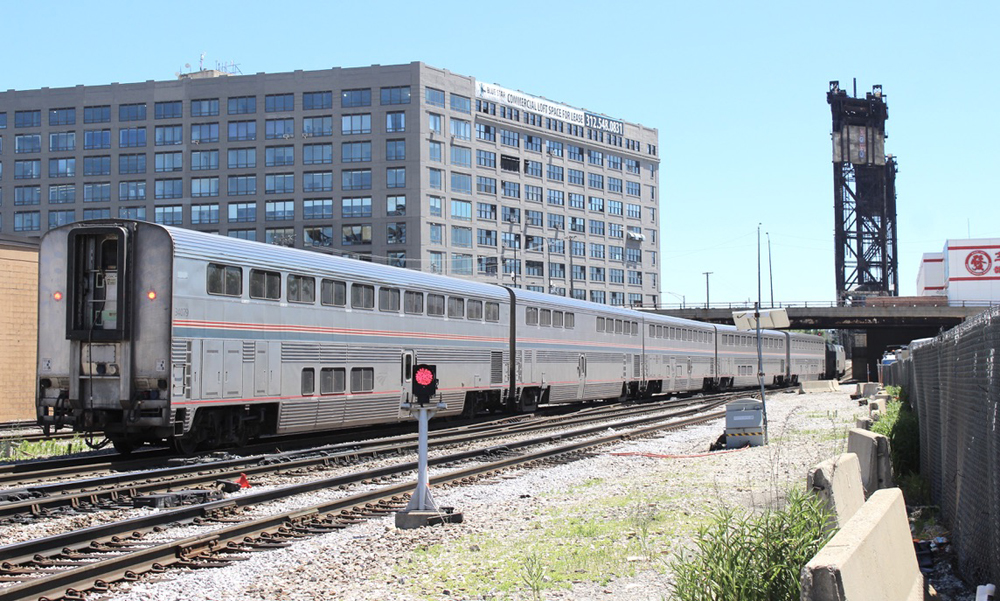
Capacity became constricted when current executive leadership furloughed personnel and sidelined revenue-producing Superliners and single-level sleeping cars in October 2020 — despite strong patronage in the long-distance segment even before vaccines were developed or bailout funding announced. Since then, management has settled on a minimally promoted lower-capacity/higher-fare business model that continues today.
Stored Horizon coaches and cafes used in state-supported service received required brake rebuilds, refurbishment, and inspections ahead of the work needed to return the stored equipment to service, because management was obligated to do so. Operating authorities are billed an allocated maintenance charge for the work, so there is a built-in revenue component that offsets the negative impact on executive bonuses.
Though interior freshening and scheduled overhauls have continued, returning long-distance Superliners and Viewliner sleeping cars to active service in response to demonstrated demand has not been prioritized in the same way. Not surprisingly, the “25%-off summer fare” sale promotion ending today (June 20) was limited to where excess capacity exists: Northeast Regionals and Acela.
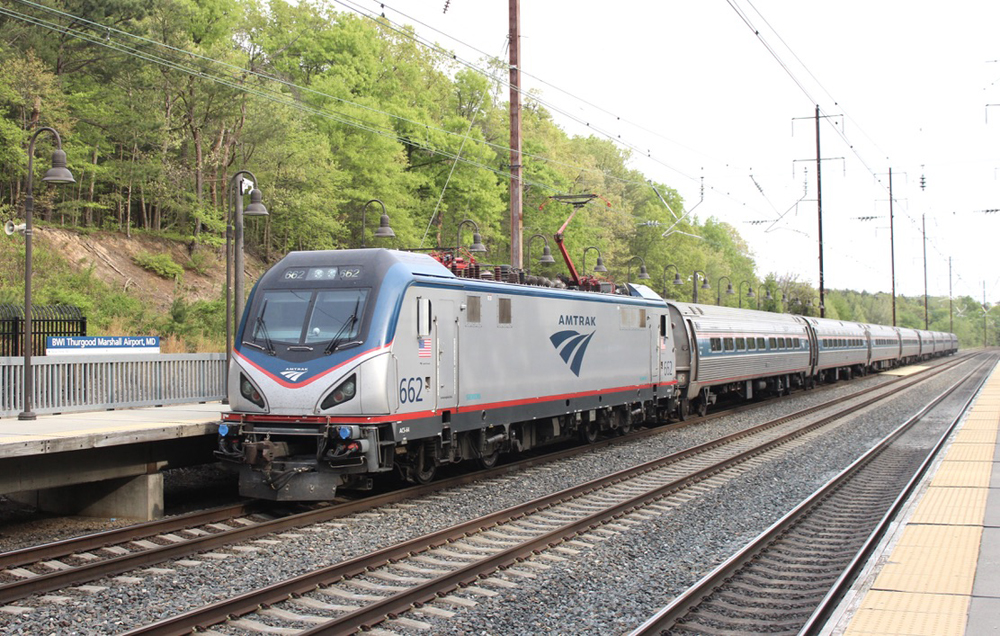
Stepped-up reinvestment in existing assets, and the human capital to make it happen, would add expenses certainly adversely affecting current-year bonuses, even though the revenue benefits of increasing capacity could pay dividends in subsequent years.
Similarly, the bonus system offers no incentive for dealing with customer-facing deficiencies, such as inadequate crew supervision, lack of marketing expenditures to strengthen national network routes, subpar food offerings, and expediting repairs to inoperative car washers that cause trains to operate for days with dirty windows. These long-running shortcomings would presumably be reflected in low customer satisfaction scores, but exactly how those are weighted remains shrouded in secrecy. Besides, bonuses totaling nearly $3 million for the top 15 executives were achieved without hitting the CSI target.
What bonuses replaced
As Coscia has often remarked at Congressional hearings, the current bonus system’s “savings” are derived from the projected cost of pensions jettisoned in 2015 that it replaced. The argument is also advanced in the “Pay for Performance Rewards” presentation.
The fact is that Amtrak pensions, coupled with generous railroad retirement benefits, succeeded in retaining employees with valuable institutional marketing, pricing, hospitality, and operational knowledge that wasn’t necessarily transferable from other industries. Those functions were either dropped or had to be staffed with newcomers. Amtrak’s board of directors and a revolving door of imported chief executives including Richard Anderson, Wick Moorman, and William Flynn — all walking away with bonuses — championed cost-cutting buyout programs that decimated in-house expertise.
The presentation claims, “Closing pension and retiree healthcare saved nearly $790 million in debt and closer to $2.2 billion in future benefit payment as of 2023, almost seven times higher than the cost of incentive awards since program inception, if the [pension and healthcare] program were ongoing.” But a three-pronged bonus system which places 50% of its value on bottom-line efficiency, without factoring in unmeasured negative impacts, doesn’t necessarily make for optimal management decision-making on behalf of the traveling public.
Finally, observers must wonder what else could be achieved by siphoning some of the executive bonus and salary compensation to customer-facing personnel responsible for effectively delivering Amtrak’s potentially unique transportation product. An organization chart showing every manager’s function does not appear on the website. So perhaps someone could be hired to at least wash windows.
Share this article