WASHINGTON — More details have emerged from President Donald Trump’s proposed Amtrak cuts in the 2020 federal budget, which specifically target the elimination of long-distance trains. Meanwhile, Amtrak requested continued funding at 2018 levels.
The document released last week shows exactly how the administration would cut service to rural and medium-sized cities, many where Amtrak is the only public mobility available. Most observers believe the proposed cut of Amtrak’s annual appropriation to $936 million, from the $1.9 billion enacted by Congress in fiscal 2019, has no chance of being approved.
The budget would immediately remove funding for the long-distance network — itself an arbitrarily devised amalgam of 15 routes comprised of trains traveling over 750 miles defined under 2008’s Passenger Rail Investment and Improvement Act.
“The budget proposes that federal operating support for long distance routes would now be provided through the Restoration and Enhancement Grant program, not Amtrak’s annual grant, then phased out entirely,” the document explains on page 78.
The 2020 budget would create a transition plan in which the Department of Transportation, Amtrak, states, and local governments would “rationalize” the long-distance network “to more efficiently serve modern market needs as a series of shorter-distance, high-performing corridor services where passenger rail as a transportation option makes sense.” Low-population areas, it said, would be better served by other modes of transportation, like intercity buses.
The concept is exactly what Amtrak proposed in 2018 when it suggested replacing the Dodge City, Kan., to Albuquerque, N.M., portion of the Southwest Chief ‘s Chicago-Los Angeles route with buses. That rationale was soundly rejected by a bipartisan group of U.S. Senators from the affected states; furthermore, lawmakers appropriated $50 million to Amtrak specifically to pay for improvements on the route that the company refused to make until forced to do so after the budget bill passed.
Rail Passengers Association President and CEO Jim Mathews points out, “By moving long distance train funding to a competitive grant program — controlled by the White House — the administration gets to choose the winners and losers.”
Aside from dismissing transportation needs of rural America, rationale put forth in the budget document’s “justification” section fails to disclose other consequences, shortcomings, and flaws of eliminating the long-distance network:
— Infrastructure facility, station, and route costs now shared with Amtrak would now be the complete responsibility of the states, sharply raising their expenses. States would also lose connection revenue.
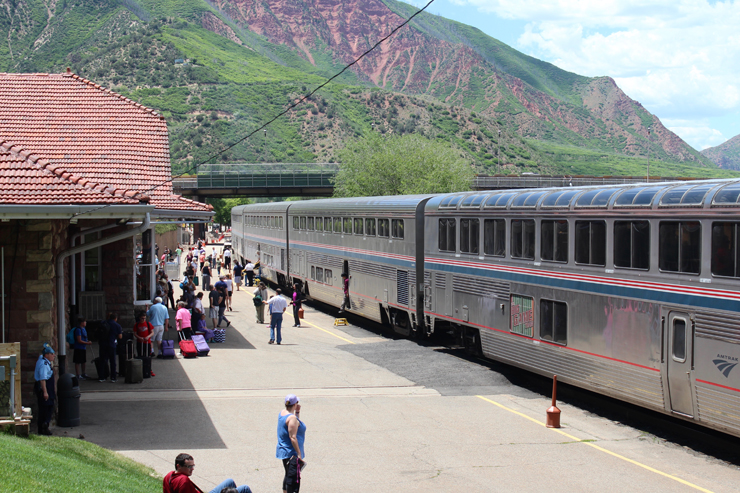
— Travel options provided by long-distance trains on state corridors such as Chicago-Carbondale, Ill., Chicago-St. Louis, New York-Buffalo, N.Y., and Santa Barbara-Los Angeles, Cal., would disappear. Coordination efforts between states have failed when the money ran out for both long-distance (the first New York-Chicago Lake Shore Limited) and regional services (three versions of the New Orleans-Mobile, Ala. Gulf Coast Limited).
— Adding frequencies on routes which “make sense,” as defined by the Department of Transportation, would require agreement with host railroads to protect their capacity with infrastructure improvements.
— “Loss per passenger” figures are listed for several long distance trains — while ignoring the revenue or passenger miles they contribute. As for “losses,” Amtrak has yet to provide Trains with line-item expense accounting data for the Southwest Chief that we asked for in connection with a cost allocation report [see “Amtrak’s money mystery,” January 2019 Trains].
— Saying that “only 12 percent of long-distance passengers are riding endpoint to endpoint, with most passengers traveling less than 500 miles” proves that category’s strength, not weakness. It means 3.97 million intercity riders (out of 4.51 million in 2018) used the overnighters to create their own “corridor” at an average ticket price of $107.72, compared with $33.79 for state-supported trains and $75.55 for Northeast Regionals.
If these Administration talking points seem familiar, it’s because they mirror the same language Amtrak senior management uses in its fiscal 2020 grant request, also released last week.
The “Amtrak Response to the Administration Budget” section (page 17), makes no attempt to discuss why a 52-percent cut to the company budget would be detrimental to all operations and put Amtrak even further behind in its state-of-good-repair backlog.
Instead, there’s this: “Amtrak appreciates the administration’s focus on expanding intercity passenger rail service to today’s many underserved cities and corridors across the nation. We believe a modernization of the National Network with the right level of dedicated and enhanced federal funding, would allow Amtrak to serve more passengers efficiently while preserving our ability to maintain appropriate (emphasis added) long distance routes.”
The fact that both Amtrak management and the Trump administration choose to gloss over challenges that help explain why they (incorrectly) charge Amtrak’s long-distance network “has not changed from its original iteration 40 years ago,” as the budget document claims, means lawmakers will have to fill the credibility gap in upcoming Amtrak reauthorization discussions.
In 2018, Senators on the Southwest Chief route became involved on behalf of their constituents. With all non-Northeast Corridor services affected, perhaps more legislators will decide to get involved.