





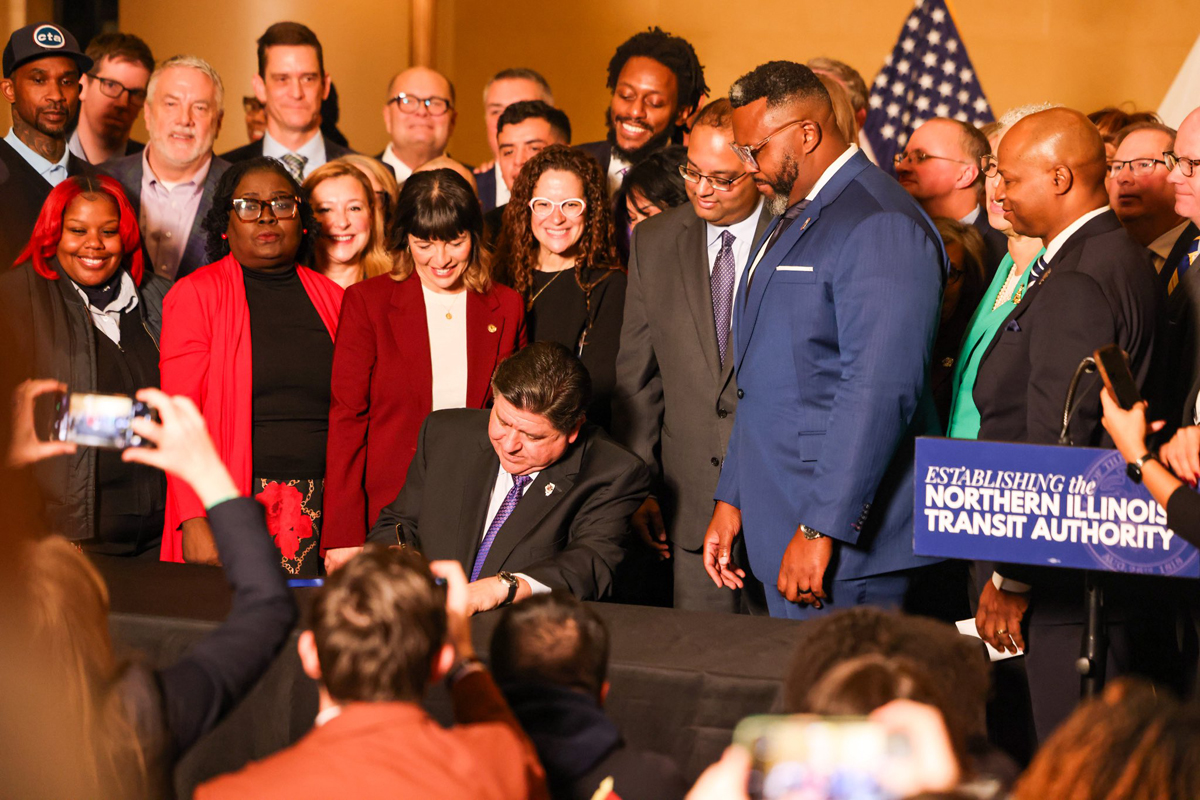
CHICAGO — Illinois Gov. JB Pritzker on Tuesday (Dec. 16) signed into law the legislation providing $1.5 billion in new funding for Chicago-area transit and authorizing the restructuring of the Regional Transportation Authority, the parent agency of Metra, the Chicago Transit Authority, and Pace.
“This new law not only averts the [fiscal] cliff but preserves affordability and makes transit safer and more reliable,” Pritzker said in a signing ceremony at Chicago Union Station, according to a WBEZ Radio report.
The bill, passed in the early-morning hours of Oct. 31 as the Illinois legislature concluded its fall veto session, provides the funding annually through a mix of increases in local taxes, redirection of some tax money from fuel sales, increased highway tolls, and diversion of money from a state road fund. [See “Illinois legislature passes bill …,” Trains.com, Oct. 31, 2025.] It also restructures the membership of the RTA board under the new name of the Northern Illinois Transit Authority, and gives the NITA more power to set fares and schedules across the three operating agencies.
Pritzker had previously indicated he planned to sign the bill.
Critics of the bill include suburban officials who feel the new makeup of the NITA concentrates too many board positions with representatives of Chicago and Cook County, and downstate politicians concerned that the rest of the state will see few benefits from the legislation. One aspect that could benefit those outside Chicago is a change in the law that will allow transit funds to be used for intercity passenger service, which could aid the long-stalled effort to launch train service to the Quad Cities [see “Illinois transit bill could boost …,” Nov. 1, 2025].
— To report news or errors, contact trainsnewswire@firecrown.com.


You obviously didn’t read my post entirely highways do not stand on their own financially their siphoning $100’s of billions from non user sources to make up for the insolvent HTF. Drivers now cover less than 50% of their ride. But obviously you don’t see that as an issue only transit & psgr rail.
Galen-
You are correct about the Federal Highway Trust Fund not fully covering the cost of Federal Transportation expenditures, but the bill signed by Pritzker only impacts State Road Funds- not Federal. The bill does indeed divert funds intended for roads over the entire state and in to transit instead- which is almost all in NE Illinois. It remains to be seen how this will impact the maintenance and upkeep of roads across the state, but you cannot pull half a billion dollars out annually and not expect it to not be missed.
Driving is subsidized by keeping it cheaper than it should be by not taxing sufficiently for what it costs to maintain for said hwys. And let’s not forget the subsidies & tax breaks for oil companies to keep the oil flowing for a reasonable price and the of military presence in the regions to protect the uninterrupted flow of oil.
Transit is stealing highway funds??? Highways don’t have any funds to steal they’re funding system (HTF) is broke & has been since 2008. They’re doing what you’re accusing transit of doing spending money they don’t have. Raise fares, cut service??? How about raise the state & Federal gas taxes to where they should be allowing for inflation and then some & no new hwy projects until the hwys are self sufficient which was the original intention. Highways have siphoned well over a $200 billion from the Treasury already & there are no plan in the offing to remedy this disaster. If drivers had to pay the true cost of their ride I have no doubt transit would experience a renaissance which would solve any funding shortfalls transit is now experiencing due to drivers current subsidized alternative.
If capital amortization for car-miles or truck-miles is subsidized, how does that compare to capital amortization for rail passenger-miles.
That’s right. Raise the gas tax and soak the motorists so that here would be more money for the corrupt politicians to use for either their own pet projects or for useless transit. I’m for all modes of transportation to stand on their own financially. The first to go would be Amtrak long distance trains then the state subsidized trains then bloated transit. Autos and airlines would survive because they are used and useful.
Anyone who believes costs will decrease and patronage will increase,is delusional.
Everyone who wants to ride public transportation in Illinois is already riding it.
In the 70’s when METRA was founded at least the politicians restricted the shakedown to the 6 county Chicago metro area,that actually had access to the
system. Now the rest of the state gets nothing but the bill.
In my post (below) I was trying to be neutral, fair, anodyne. Of course I don’t believe NITA costs will decrease or that patronage will increase.
This relatively small work-around gives NITA a year or two to get Illinois’ collective head out of its collective bum. Do I have any hope that will happen? Of course not.
Let this thread be a warning to people giving their opinions on these pages. There can be no new services when it’s a proven fact we can’t support what we have. By and large METRA benefits from existing capital infrastructure. It has tracks and bridges to run on, it has suburban stations and downtown terminals. It has two big maintenance facilities. And it’s going broke. But some people reading these pages believe that Mexico can build all-new R/W in the remote jungle, Canada can build hundreds of kilometers of HSR when VIA can barely get a train onto the rails, Madison (Wisconsin) can build rail transit to replace its freeways, CalHSR is viable, and Brightline West can magically afford to build hundreds of miles of track in the drainage ditch between NB and SB I-15.
I ride METRA and I think it’s a great system. What will it look like ten, fifteen, twenty years down the road? I don’t want to think about it.
Don’t Democrats love to spend other people’s money. Any needed increase in funding should come from fare increases and service cuts rather than tax increases. And again, they are stealing from the highway funds so that people who don’t know better or don’t want to see that the highway fund doesn’t cover the cost of highway maintenance. When are the people going to wake up and throw these bums out of office. To Charles’ comment, what does that $50 per year buy the residents of Cairo and other communities not in northern Illinois? Nothing is the answer so I wouldn’t suggest as Charles does that this isn’t a big deal especially considering Illinois’ current financial condition.
A state the population of Illinois can absorb this cost. If my math is correct, this comes out to $12 per each person in the state, or about $50 for a family of four. I assume this is per year, every year. $50 for a family of four per year every year, on top of the tolls, fees and taxes already paid.
This bailout is relatively painless and doable. Going forward, NITA’s challenge will be to maintain service without a further increase in its cost structure such as pensions. To me, the issue isn’t the bailout per se, but whether or not costs decrease and whether or not farebox patronage increases.