





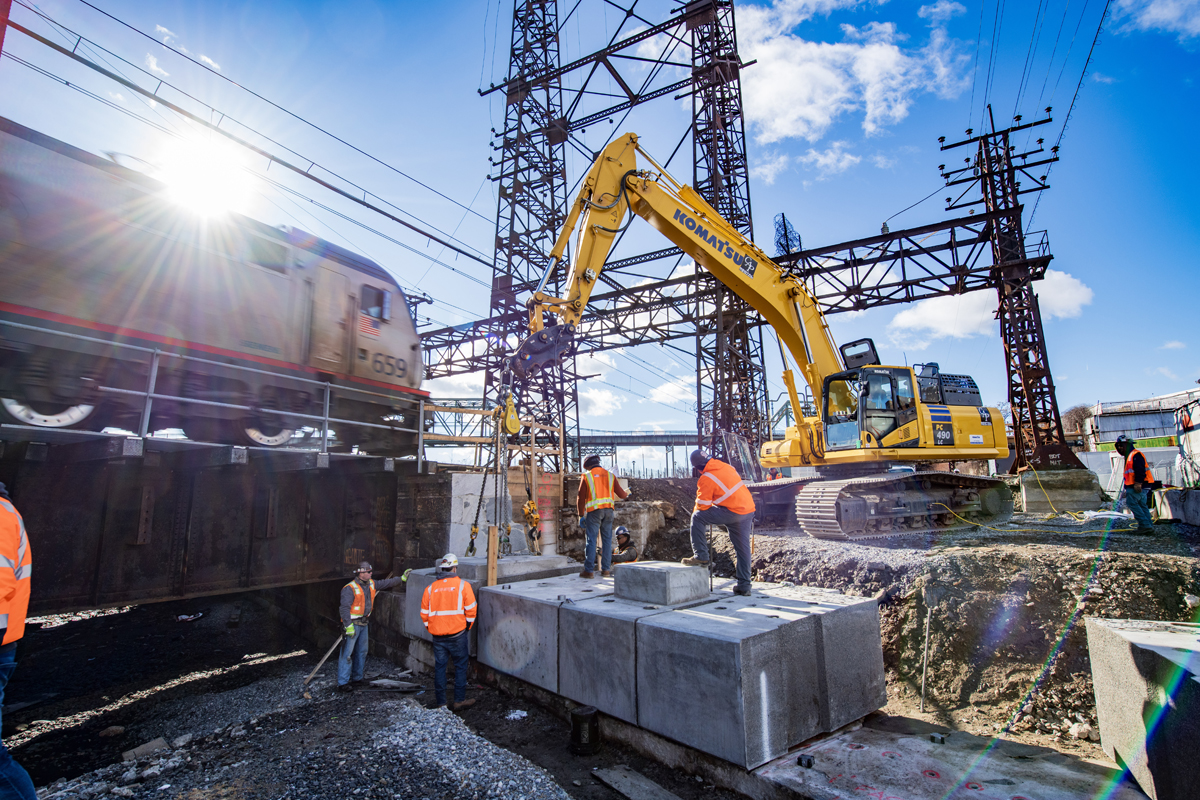
NEW YORK — The Metropolitan Transportation Authority would have to reduce Long Island Rail Road service into New York’s Penn Station to accommodate its proposal for temporary Metro-North service on its Penn Access route through the Bronx, according to Amtrak — which MTA CEO Janno Lieber says is not an option.
In a paywalled article, Long Island newspaper Newsday reports Laura Mason, Amtrak executive vice president, capital delivery, said in a Nov. 12 letter that “any new Metro-North service must also be accompanied by a reduction in Long Island Rail Road service levels.” This reflects ongoing work in Amtrak’s East River tunnels to repair Hurricane Sandy damage, which led Amtrak to reduce its own operations for the duration of the tunnel project [see “Amtrak schedule revisions …,” Trains.com, April 27, 2025].
Amtrak’s schedule changes have undergone some revision, most recently with the announcement that an additional round trip between New York City and Albany would be restored [see “Amtrak, Metro-North to provide more …,” Trains.com, Oct. 20, 2025]. Once the tunnel project is finished — in 2027 at the earliest — Penn Station should be able to accommodate both Metro-North and Long Island service.
Newsday reports that Lieber told reporters after an MTA board meeting that making the Metro-North service contingent on reduced LIRR operations is “a non-starter,” saying the existing infrastructure should be able to accommodate three additional Metro-North trains per hour.
The temporary service proposal stems from construction delays for the Penn Access project, which seeks to add additional tracks and four new Metro-North stations on Amtrak’s double-track Hell Gate Line between New Rochelle, N.Y., and Harold Interlocking in Queens. The MTA has said Amtrak has failed to live up to its obligations to accommodate MTA construction, pushing the completion from 2027 to at least 2030 [see “MTA says Penn Access project …,” Trains.com, Oct. 27, 2025]. In the interim, Metro-North has proposed limited, temporary service — 31 daily trains, instead of the 105 eventually planned — at three stations, Parkchester, Morris Park, and Co-op City, using the existing Amtrak double-track route. The fourth station, Hunts Point, would not be included in the temporary plan because its site cannot accommodate a temporary platform while allowing construction to continue, the MTA says.
But the construction industry publication Engineering News-Record reports that Mason’s Nov. 12 letter rejected the MTA’s version of events, saying the national passenger operator has “more than met” its obligations since some early difficulties. It demanded that Lieber retract statements “that we are in breach of contract.” Mason told the Engineering News-Record that the MTA did not publicly address contractor and design issues and safety incidents, among other problems.
— To report news or errors, contact trainsnewswire@firecrown.com.




I have been watching the Hellgate line from the east end of 116th St, which offers a clear view of both bridge and approach. So far no sign of work relaying 2 tracks or restoring catenary. And have yet to see a freight movement.
Mr. Lieber is one tough cookie…expect him and his argument to prevail as he has creds and Amtrak none.
All I can say is “stay tuned.” Today I ride NE Regional D.C.-NYPenn; “twill be of interest to compare w/the day before Thanks.
Actually, here is Mr. Landey, usually well in-formeded wrong. The original McKim & White design was spacious, modelled after the Roman baths of Caracalla, which I have seen in situ. The spacious platforms were ruined by pilings driven to support MSG. Access the NY Times excellent coverage. The obvious solution is to rid MSG and build anew. Even the cost est. to restore the original is ballpark.
The usually well-informed me would have been well-informed a few hours later when I remembered a key fact.
You know, Curtis, I actually thought of that in the hour or so before I read your post (above). Thought it might be that. You know why I thought that? One summer in Boston, 1966, on a summer job at a foundation site for a new clinic building at Mass General Hospital, between semesters in college, I met a hard-a$$ed hardhat who worked on MSG a year or two prior. And built those foundation piles just as you describe. So, bad me, I should’ve known.
The New York-based foundation construction company was named Thomas Crimmins. I remember that after about 59 years.
I’m not old enough to have seen the original (the real) Penn Station. I rode the New Haven Railroad to/from college, to/from Route 128 in Westwood, Massachusetts. Prior to Amtrak, the New Haven trains alternated between Penn and Grand Central. (Amtrak changed to NYP only.) Those years were 1964-1966. Starting Thanksgiving break, 1966 I usually flew BOS to LGA, EWR or JFK, not the train.
Very fine multi-page article in today’s NY Times analyzing Penn Station, past, present, and future. Good schematics, pix, and track diagrams. The new Moynihan train hall was described as “ornamental”…which is accurate since it still causes passengers to line up before the descent down into Hades. But it works as a food court.
The article also had a clear description of the Hydra-headed monster jockeying for power there: MTA, NJT, LIRR, Amtrak. The important date to remember is 2028, which is when the Dolan/MSG lease is up.
Thing is, Curtis, even before the 1960’s demolition of Penn Station, the tracks were always below grade with narrow, unattractive platforms. If the tracks and platform have been “descent down into Hades” since the 1960’s station demolition, were they any better before then?
Getting on/ off a train has always been nicer at Grand Central Terminal. Or just about anywhere else, like Chicago Union Station or Boston South Station.
It made a difference using the station once MSG was constructed. Before, everything was spacious before heading to track level. However, afterwards I felt not just crowded but constricted, as my head might hit the ceiling. Further, now there is much less space side to side than before MSG.