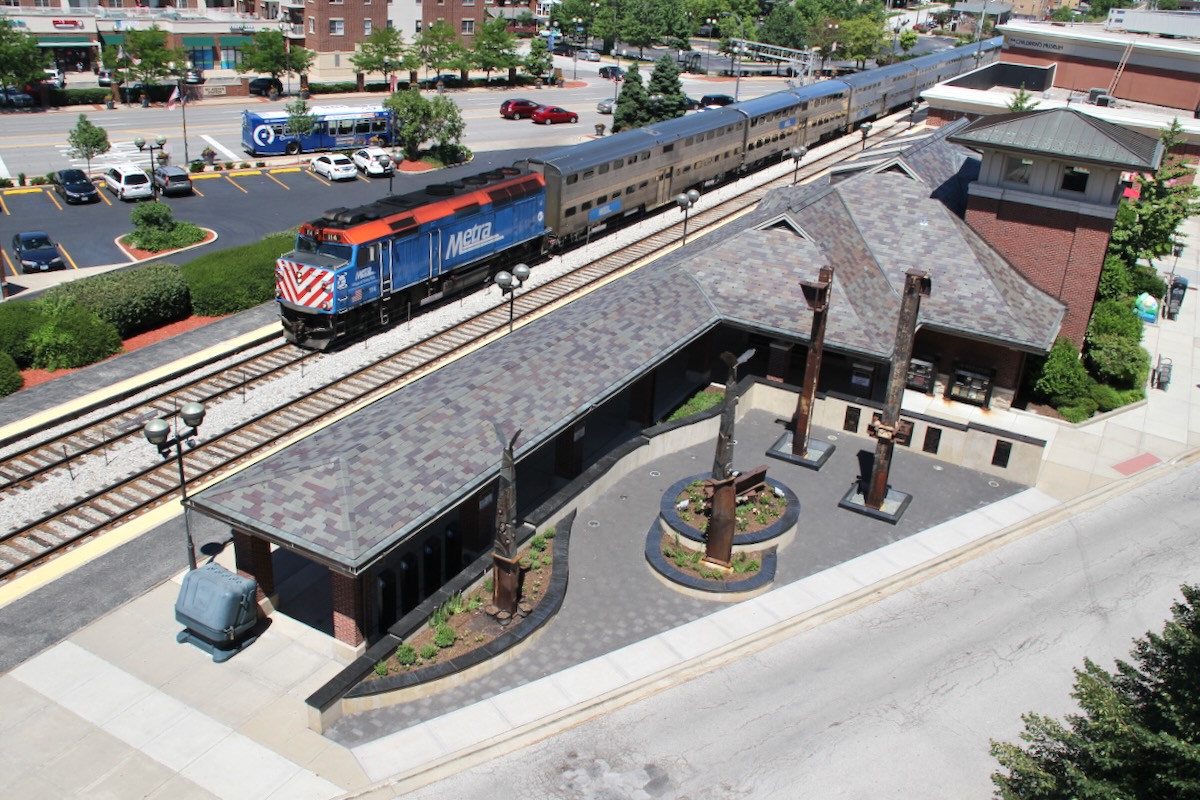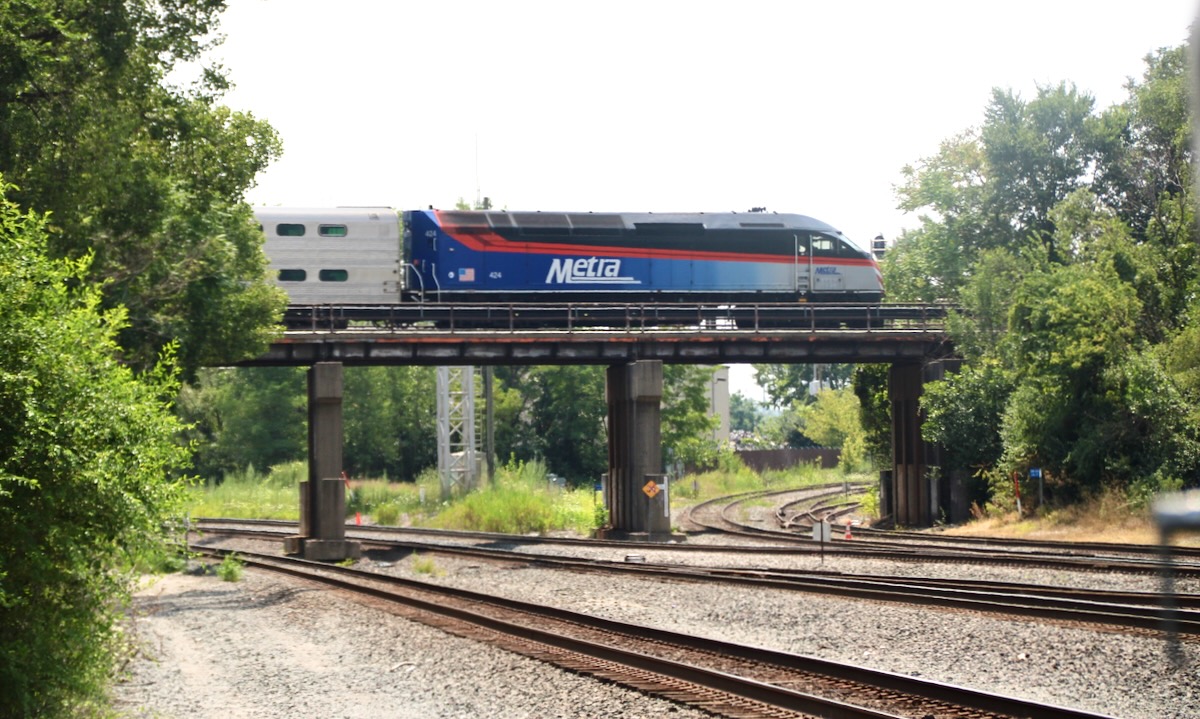
WASHINGTON — U.S. Sen. Tammy Duckworth and U.S. Rep. Mike Quigley (both D-Ill.) on Wednesday introduced legislation to create a $1.5 billion grant program to fund bridge repair, maintenance, and replacement on commuter rail lines.
The Building Rail Infrastructure for a Durable and Growing Economy (BRIDGE) Act would use funds from the Mass Transit Account of the Highway Trust Fund for a program to provide $1.5 billion annually in fiscal years 2027 to 2031. The program would be administered by the Federal Transit Administration.
In announcing the bill, Duckworth highlighted the more than 200 bridges on Chicago’s Metra system in need of repair.
“Across Chicago and cities around the country, thousands of commuters rely on rail bridges that are more than a century old — bridges that were never meant to carry today’s level of traffic, Duckworth said in a press release. “This legislation is about more than just bringing our infrastructure into this century — it’s about protecting safety, growing our economy and making it easier for people and goods to get where they need to go.”
Said Quigley, a member of the House Transportation Appropriations Subcommittee: “Too many of the bridges on our commuter rail system, and other systems across the country, rely on are in desperate need of repair. Yet there is no dedicated federal program to address their condition. The BRIDGE Act closes that gap by creating a reliable source of funding to modernize commuter rail bridges, improve safety, and ensure these systems can serve riders efficiently for decades to come.”
Metra has endorsed the bill, as have the American Council of Engineering Companies, Illinois Road and Transportation Builders Association, International Union of Operating Engineers Local 150, and International Association of Sheet Metal, Air, Rail and Transportation Workers-Transportation Division (SMART-TD).
“The BRIDGE Act represents a critical investment in the long-term safety and reliability of our region’s commuter rail system,” said Metra Executive Director/CEO Jim Derwinski, “and will deliver urgently needed resources for bridge replacement and rehabilitation, ensuring commuter rail remains a safe, reliable, and efficient transportation option for generations to come.”
The full text of the bill is available here.
— To report news or errors, contact trainsnewswire@firecrown.com.

Interesting. What this article doesn’t say is that the total cost of this Bill is 7.5 billion dollars and how will this money be spent in an fashion that will spread the money appropriately across the domestic mass transit systems. On the surface it appears that Illinois is looking for another big cash pool this time funded by all American Taxpayers!
“Pretend money?”
ROFL! You are too, too funny, Charles Landey. You should do standup.
Thanks, Mike. You should contribute more to these pages, on topic, which I would read. You’re obviously a smart guy with well-considered opinions, but I don’t see them.
So many entertaining and misleading comments. Where to begin?
First, virtually all of these bridges and viaducts are at least 100 years old. And I do not know of any physical structure that lasts forever. And it should also be noted that the original constriction costs of the entire network of rail viaducts located within the city limits of Chicago was paid for 100 percent by the freight railroads.
Second, I think that our friend Mr. Landy would agree that typical winters here in the Midwest (like the one we are having right now) can be very unforgiving on outside structures. And as we all know railroading is an outdoor sport.
Third, Metra’s farebox recovery ratio is around 50 percent which I understand is the best of any public transit systems in the U.S. And Charles if we are talking about US government transportation subsidies can we please include Milwaukee Mitchell Field, not to mention Interstate Routes 90, 94, 43 and 794 running across the great state of Wisconsin.
I rest my case.
May I reply? I have never opposed tax subsidies of public transportation. On these pages, from time to time, I have disclosed that I am among the beneficiaries, including having been a regular rider of subsidized Amtrak, METRA, MBTA and NYCTA at various times in my life. (Few of us on these pages are bus transit foamers. I have also been a regular rider in Detroit both the city buses and the suburban buses. Earlier in life, I commuted on a bus in Massachusetts. I don’t recall if this was before or after MBTA absorbed the bus routes of the so-called Eastern Massachusetts Street Railway.)
What I oppose is deficit spending in Washington, along with state or local units of government counting federal grants as “revenue” in balancing their books. I consider that widespread and widely accepted practice to be accounting fraud.
METRA is a great system. I speak both as a railfan and as a customer. I respect its farebox recovery ratio, but as I point out, including (cue the italics) in today’s discussion, transit subsidies come in different “buckets” and so the true subsidy ratio tends not to be truthfully disclosed.
The reason I don’t talk about highway or aviation subsidies is that I don’t know anything about them, except what I read on these pages. For example, I know that many highway projects are federally-aided but I don’t know how much of that is from fuel taxes as opposed to general revenue.
When these bridges were designed how much load were the designers anticipating? Locos were certainly not that heavy with just x-4 -x and x-6 – X wheel arrangements. Now the bridges carry 286K 4 axel cars that ideally are 70k per axel but may vary 20 %.
You cannot assume impending bridge failure just because of age. Some designs and construction materials will last longer than others.
I question the statement that traffic on these lines is greater today than it was a century ago. The cumulative weight per unit of time might be greater but I doubt that the number of trains running over the lines is greater.
And why is this the federal government’s responsibility? Don’t privately owned railroad companies actually own the lines that Metra uses?
JAMES – METRA owns many of the lines — on these the freight railroads (even if previous owners) pay METRA for use of the tracks.
If I understand correctly, taxpayers have built new bridges on lines still owned by UPRR.
I never heard of Rep. Mike Quigley, so I looked him up. A Democrat, he represents the 5th Illinois Congressional District. I looked up the District. It looks like something mapped by gerrymanders while the gerrymanders were loaded off LSD.
You would need GPS and Google Maps, and maybe LSD in addition, to know whether or not you live in the district.
But in Tejas, all such gerrymandering is OK, innit?
Sadly, and I say this as an engineering consultant, I read this to say “$1.2Billion in consulting fees for $300Million in construction to partially replace three bridges that were built in 1902 for $85,000.”
But hey, it is better than nothing…
Bridges used by METRA trains (and other commuter systems) need repair or replacement. Therefore, fund from Washington, where pretend money is printed, rather than from state and local budgets, where actual taxes paid in actual money have to be actually raised.
That’s how the game is played, as it was in the beginning, is now, and ever shall be, world without end, amen. We all know it (voters and office holders of both parties), and nothing will be done to change it. Hey, it works for me, big time. I can buy a $10.00 METRA ticket when the actual cost of the ride provided for me is way more than that. The difference is made up, in part, by federal deficit spending that will continue apace for the remaining years of my life.