





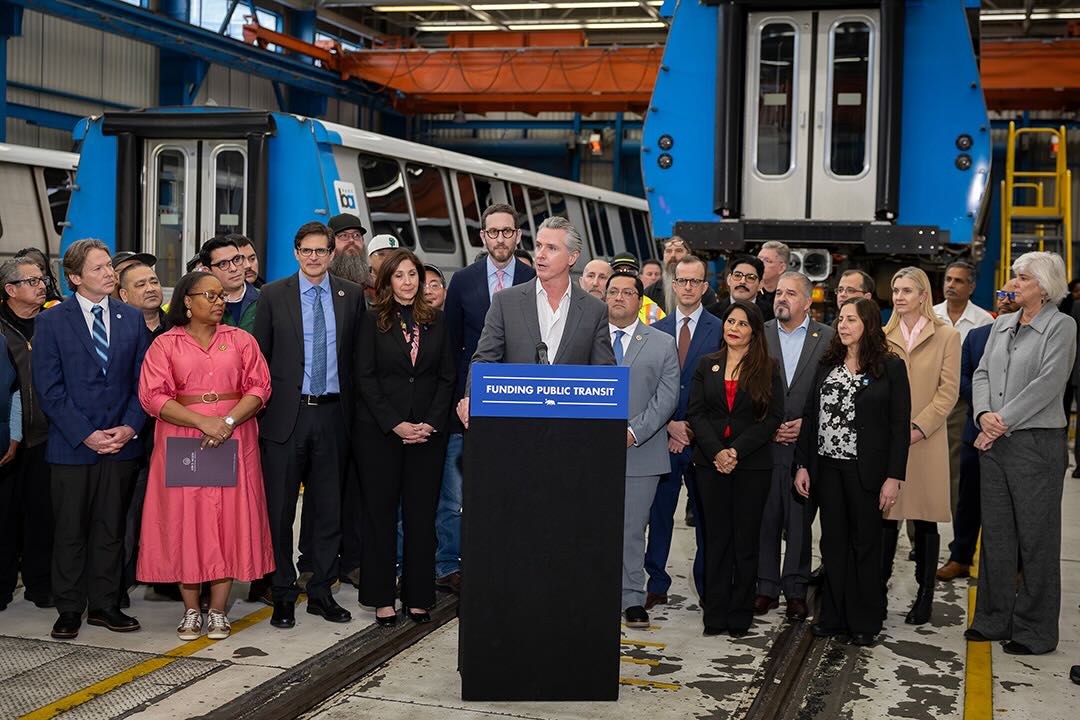
COLMA, Calif. — California Gov. Gavin Newsom has signed legislation providing a $590 million loan to transit agencies in the San Francisco Bay Area, avoiding service cuts until a ballot initiative can go to voters.
The money provided under AB 117 will go to the Metropolitan Transportation Commission, the agency coordinating transit funding and planning in the nine-county Bay Area. Caltrain, Bay Area Rapid Transit, and San Francisco Muni are among the agencies expected to receive short-term operating funds as a result. The loan will be repaid in quarterly installments over 12 years.
Newsom said in a press release that the legislation “will help protect transit service for more than 3 million monthly riders. … I’m proud of the progress the Bay Area transit service and operators are making on ridership recovery, and this loan will continue to build on that success as the region works together on long-term funding solutions.”
Voters will be asked this November to approve a sales tax increase — a half-cent in Alameda, Contra Costa, San Mateo, and Santa Clara counties, and a cent in San Francisco County — to provide transit funding over the next 14 years. The state legislature approved that measure last year [see “California legislature clears path …,” Trains.com, Sept. 13, 2025].
The commission said the funds will benefit transit agencies facing a projected deficit of more than $800 million in the next fiscal year.
“MTC greatly appreciates the time and energy the Department of Finance and the Governor’s office put into this loan negotiation,” Sue Noack, chair of the commission as well as mayor of Pleasant Hill, said in a press release. “It was critical to reach agreement on funding that would avert major service cuts this year while also protecting the Bay Area’s priority capital projects and this agreement does just that.”
BART General Manager Bob Powers said the loan “gives us reassurance money will be available to continue to deliver the best service possible for the Bay Area.” BART is currently working on two scenarios to address a projected $376 million budget deficit in fiscal 2027, he said, “through either new revenue and efficiencies, or through service reductions, station closures, fare increases, layoffs, and across-the-board internal cuts.” The more draconian second option would come if the ballot measure is not approved.
Caltrain General Manager Michelle Bouchard said the loan “will allow us to preserve the service that made Caltrain the fastest growing transit agency in the U.S.” The commuter operator has seen significant ridership increases since electrifying its San Francisco-San Jose corridor, although it remains below pre-pandemic levels [see “Caltrain continues to see ridership rise …,” Trains.com, Jan. 27, 2025].
— To report news or errors, contact trainsnewswire@firecrown.com.







A loan against hoped-for revenue from a possible future tax increase? A loan to transit agencies running huge deficits that will if anything get worse? A loan floated by a state government running a big annual deficit and with unfunded pension obligations.
I’m sorry, I’m pro transit, pro subsidy. But the numbers just aren’t there. The numbers scare me. We’re seeing transit systems where the combined cost of a ride, as between capital amortization added to O+M, run to three digits for a seat that’s sold for the low two digits or the high single digit. It can’t go on.