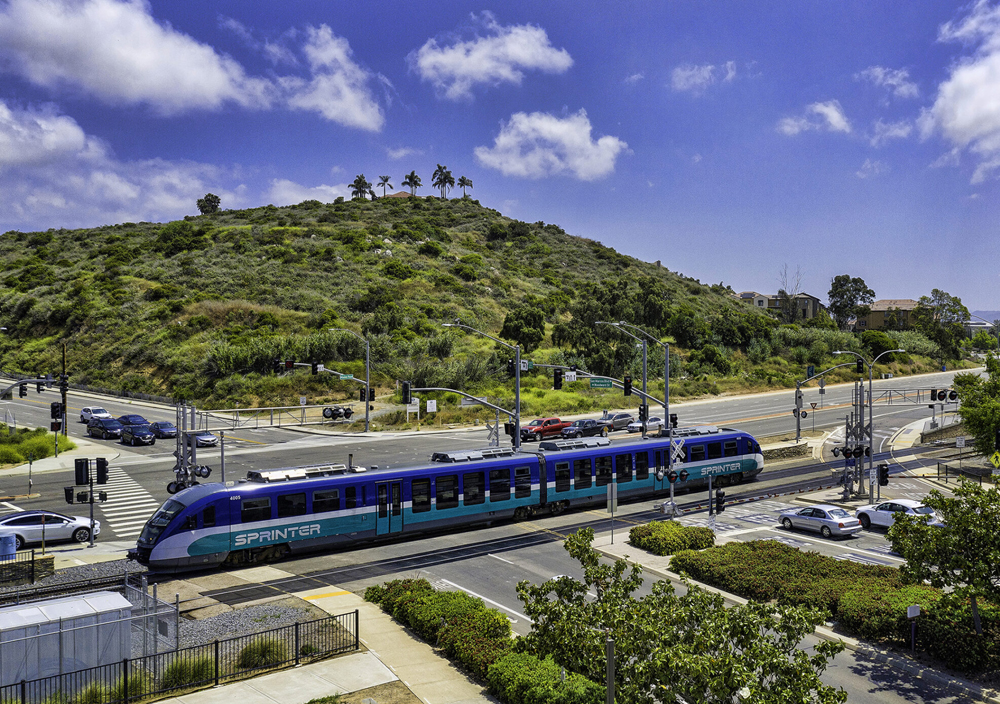
SAN DIEGO — The North County Transit District’s Sprinter rail service is facing an unexpected need to replace its fleet of diesel multiple-unit trainsets, which could place the service between Oceanside and Escondido, Calif., in jeopardy.
The San Diego Union-Tribune reports that maintenance issues have sidelined all but five of the Sprinter’s 12 two-car trainsets, with the others being used for parts. The Siemens Desiro trainsets were delivered in 2006, before service on the 22-mile, 15-station line began in 2008, and had a projected 30-year lifespan. But the maintenance issues appeared early, with Sprinter service suspended for 10 weeks in 2013 because of problems with brake rotor wear.
NCTD Executive Director Shawn Donaghy told the newspaper the Sprinter equipment is “a very one-off, boutique system that in the 1990s was widely used in Europe. Now it’s widely used nowhere.” He said trainsets have issues with traction motors, as well as “the rail trucks themselves and how the electronic components fit into that.”
According to Siemens, a variety of diesel and electric Desiro trains are in operation in the UK, Austria, Germany, and elsewhere, but they are different variants of the Desiro family. No other U.S. operator has used the Desiro equipment; Stadler trainsets been the choice for other systems using DMUs, such as TEXRail and the Denton County, Texas, A-Train, and the Arrow service in San Bernardino County, Calif.
Replacing them now could cost $351 million, although the exact cost will depend on the choice of replacement equipment. The agency would also like to spend another $542 million to modify the route’s stations to the new equipment, add more double track and replace signals at grade crossings. The double tracking would allow the NCTD to run trains every 15 minutes during peak periods instead of the current every 30 minutes.
Federal money, in the form of grants from the Federal Railroad Administration and Federal Transit Administration, has helped fund prior NCTD capital projects, but that sort of funding is in doubt going forward because of new policies enacted by the Trump administration [see “Trump administration shakes up funding formulas …,” Trains News Wire, Feb. 4, 2025].
NCTD Chief of Staff Mary Dover told the Union-Tribune in an email that the agency is pursuing “all funding options at the state and federal level” for the new rolling stock, and also said should that pursuit be unsuccessful, “Sprinter service could be jeopardy.”
The Sprinter recorded 1.2 million riders in fiscal 2024, an 8.2% increase from the previous year, according to the NCTD. Ridership is expected to continue to increase because of transit-oriented development near stations along the route.
Share this article