





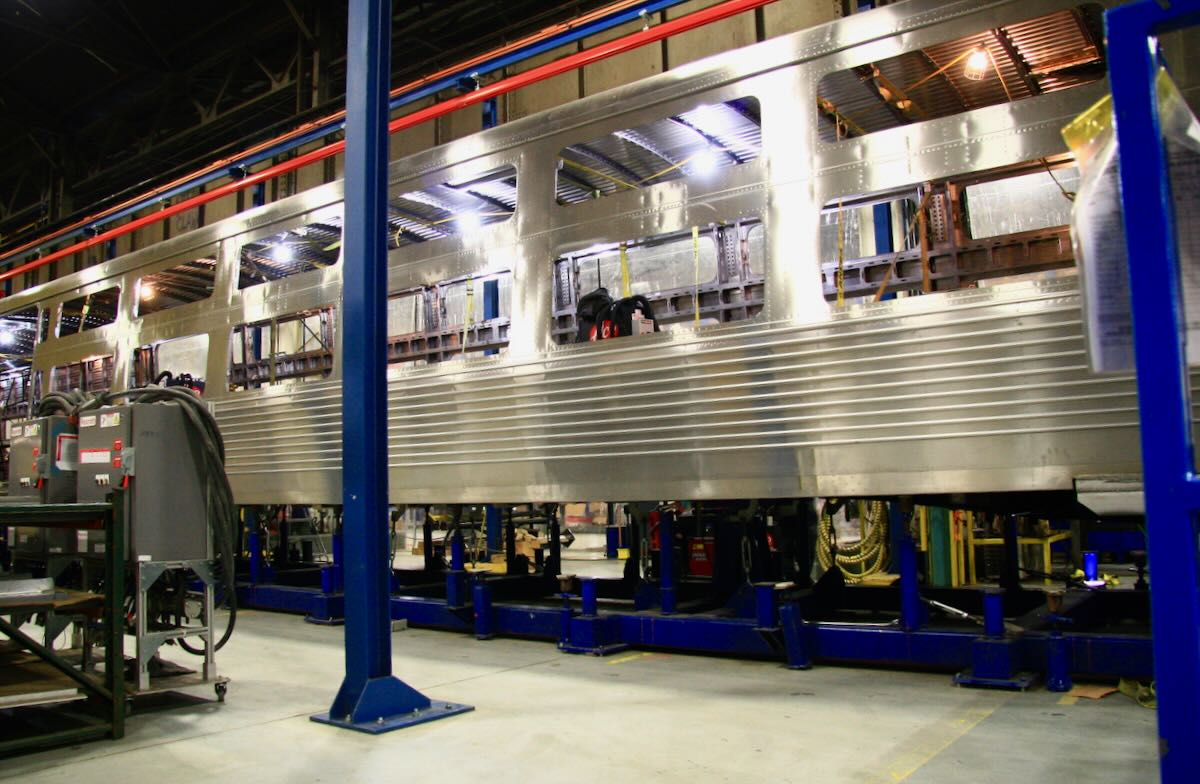
WASHINGTON — There were plenty of signposts warning that building Superliner replacements would be a tall order.
The decision to throw in the towel on that procurement [see “Amtrak ends plans for new bi-level cars,” Trains.com, Feb. 26, 2026] could have been made years earlier if candid discussions had taken place with potential manufacturers before Amtrak issued a series of “build this” proposals. All were eventually rejected by qualified carbuilders, even as car types were reduced.
And yet, the fact the current administration endorses moving ahead with a single-level fleet means long-distance trains won’t be sidelined — as long as management continues to maintain and enhance existing equipment availability until the new fleet arrives. That will come “in the early 2030s,” Amtrak president Roger Harris predicts.
Decades of inaction
Except on the restricted clearances of the Northeast Corridor, Amtrak’s bi-level Superliner fleet has been the backbone of its long-distance network since the first cars began arriving from the Pullman Co. in 1979. Those 284 coaches, coach-baggage cars, sleeping cars, diners, and Sightseer Lounge cars were followed by a 195-car Superliner II order adding transition sleepers with end-of-car steps to single-level equipment. The Superliner II cars entered service between 1993 and 1996.
The design, conceived in-house by Amtrak, derived from hi-level cars built by the Budd Co. for the Santa Fe’s El Capitan and other trains in the mid-1950s.
Pullman and Budd were driven out of business in the 1980s by nonexistent Amtrak equipment funding, coupled with foreign competition underbidding on more prevalent transit orders. Calls to “zero out” Amtrak spending were a State of the Union address topic for the Reagan and both Bush administrations.
Meanwhile, Canada’s Bombardier acquired the Pullman patents, building the Superliner II shells in Quebec and assembling the cars in Barre, Vt. Only minor modifications were made to “grandfathered” designs developed more than a decade before the Americans with Disabilities Act of 1990 was passed.
Finally, some funding
Despite an ongoing need to come up with a replacement strategy for 30-plus-year-old bi-levels, Amtrak management failed to act with any sense of urgency until Congress passed the Biden administration-sponsored Infrastructure Investment and Jobs Act in late 2021. The railroad was to receive $66 billion through 2026; about $7 billion would finally be allocated for new long-distance equipment.
Still, there was a lack of urgency at Amtrak or the Federal Railroad Administration, in part because requests for information and subsequent requests for proposals had to be solicited from potential carbuilders that might compete for a massive, one-time-only order.
Those in charge of the process viewed this as an opportunity to ask carbuilders to execute a wish list that included nine different car types and full upper-level accessibility. Sources privy to the manufacturers’ responses tell Trains that only two bidders, Alstom and Siemens, continued procurement discussions.
Warning signs
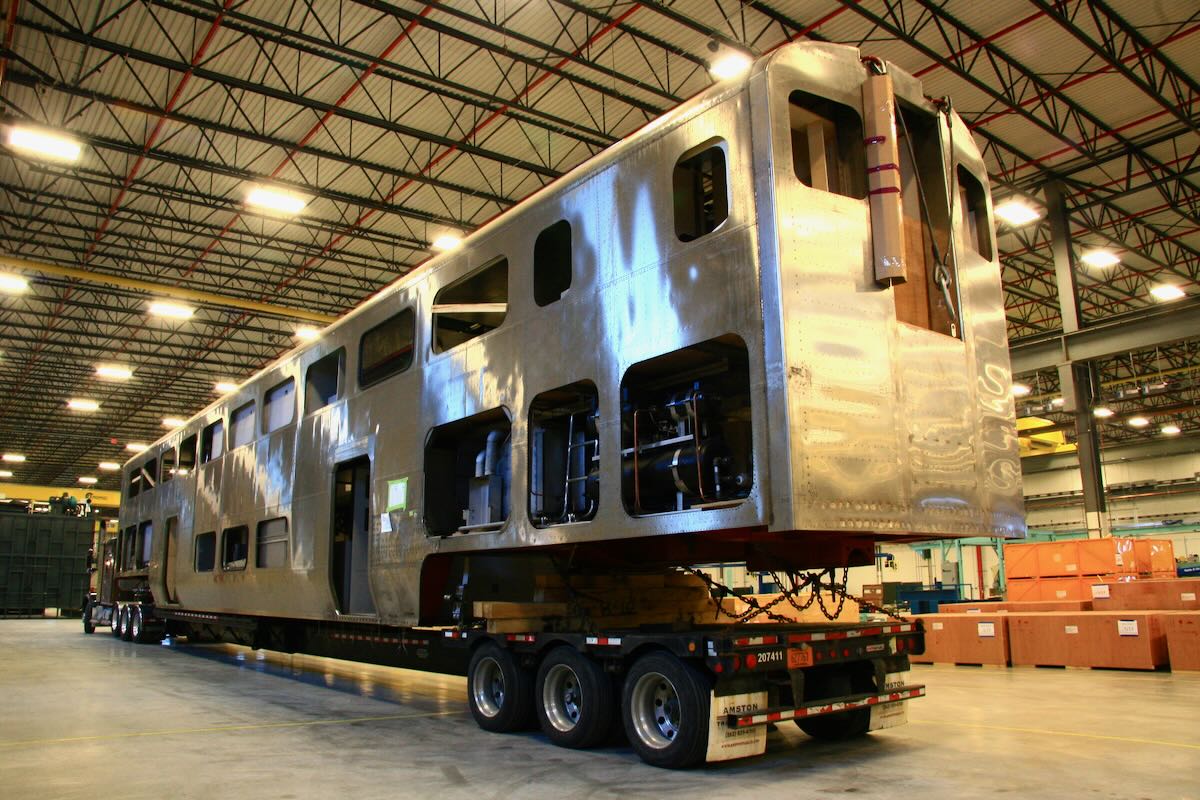
Clear challenges for developing new bi-level designs should have been evident from low bidder Nippon Sharyo’s failure to deliver such cars for California and the Midwest. After years of missed production benchmark deadlines, the company’s prototype failed compression tests in May 2014. That led the procurement to be abandoned in favor of Siemens equipment based on the Brightline-commissioned single-level design. [See “Expensive questions surface …,” Trains.com, Nov. 9, 2017].
During Amtrak’s most recent order for new long-distance equipment — 130 single-level stainless steel Viewliner IIs built in the U.S. by Spanish manufacturer CAF — the cars were delivered by type, beginning with 55 baggage cars and ending with 25 sleepers. Even with a homegrown design originating at Amtrak’s Beech Grove shops in 1987 and executed previously in the mid-1990s, the order took more than a decade to complete when the carbuilder ran into engineering, execution, and quality-control problems.
Moving forward
The problem is that developing single-level car types suitable for long-distance service that manufacturers are capable of and willing to risk building — a variation on the Viewliner design, perhaps — could be just as tortured a process as the bi-level procurement.
A primary concern: Will the money for this commitment be sustained? Morrison-Knudsen, the winning bidder of the first Viewliner order, lost more than $1 million per sleeping car in the mid-1990s when it had to eat start-up and engineering costs meant to be amortized across “add-on” orders for diners, coaches, and lounge cars. Funding was cut, so those purchases never came. The company went bankrupt. Continued and predictable Amtrak funding as part of this year’s surface transportation reauthorization therefore needs to be addressed.
VIA Rail Canada announced in late 2024 it was embarking on single-level equipment acquisition to finally replace passenger cars dating from 1954 now running on the Canadian, Ocean, and Hudson Bay service [See “VIA Rail Canada seeks bids …,” Trains.com, Dec. 9, 2024].
Amtrak spokesman W. Kyle Anderson tells Trains, “We’ve had informal conversations with VIA Rail but as they are in active procurement, there are limits to what can be discussed.”
He adds, “Amtrak will continue to engage with international partners to identify potential efficiencies. The most reliable path to timely delivery and long-term performance is a fleet tailored to U.S. standards and Amtrak’s national network.”
That is certainly necessary. But the process needs to be expedited so the collaborators — Amtrak and the carbuilders — don’t make the same mistakes with the single-level procurement that doomed bi-level Superliner replacements.
— Updated at 1:35 p.m. CT to correct date on Nippon Sharyo compression tests. To report news or errors, contact trainsnewswire@firecrown.com.


1. It shouldn’t take over five years for the first new cars to arrive. It took less time than that for Pullman to deliver brand new luxury trains sets for the PRR and NYC in the 1930s, even with the railroads constantly changing the specs.
2. What is it about North American specs that European designs can’t be used.
3. Given the procurements with Siemens (consistent cold weather failure), I don’t trust AMTRAK and VIA to get it right.