





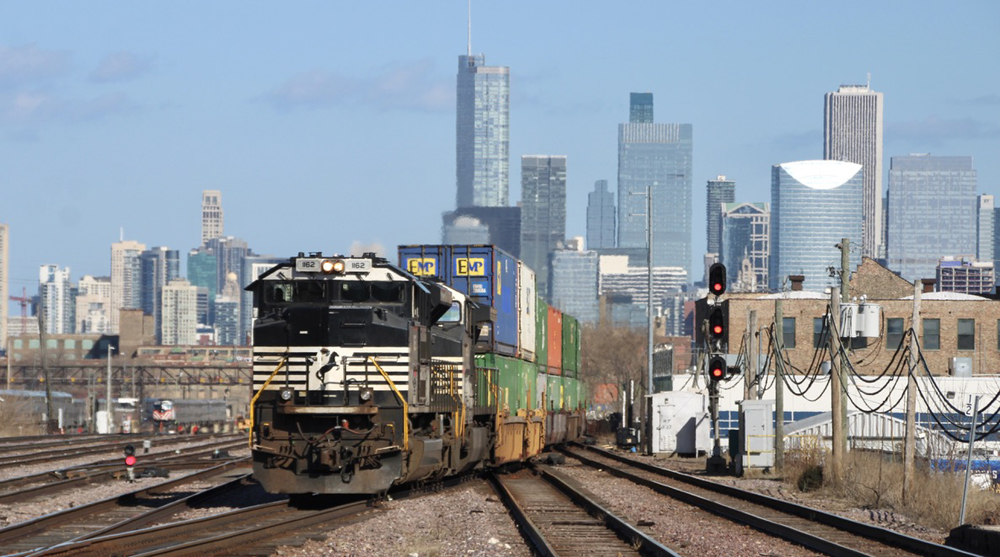
Union Pacific and Norfolk Southern currently have more than 2,300 locomotives in storage and anticipate, at least initially, a further reduction in motive-power needs if the railroads are allowed to merge, the railroads say in their application to the Surface Transportation Board.
But the combined railroad would need more than 1,000 additional locomotives by year 3 of the merger, based on its growth projections. Those would come from storage, not new purchases. The merged railroad similarly anticipates a slight initial decrease in its active railcar fleet, with the car count growing as traffic increases.
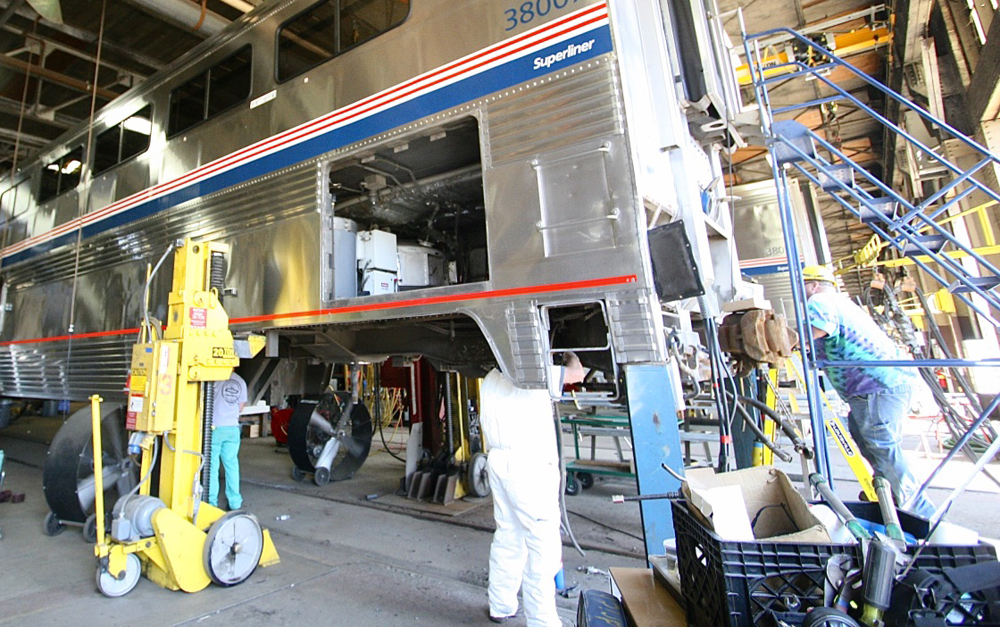
Plans also call for idling or reducing operations at four locomotive maintenance facilities — Decatur, Ill; Ft. Wayne, Ind.; Inman (Atlanta); and Louisville, Ky. Positions from those facilities would be relocated. Consolidations are also expected in locations where both railroads have facilities.
Locomotive needs
In all, the two railroads currently own 9,045 locomotives (5,790 for UP, 3,255 for NS), while UP has an additional 1,195 leased units. As of Oct. 9, UP had 1,524 locomotives in storage, while NS had 867 in storage.
That gives the railroad a combined fleet of 6,979 currently active locomotives — 5,121 in road service and 1,858 for switching. They project reducing that by 58 road locomotives and 159 switching units when the railroads are merged, because of efficiencies created by reductions in interchange, yard touches, and trip scheduling. Most surplus units will continue to be stored, although some older models may be sold, depending on market conditions.
But as traffic grows, the railroads say they will need an additional 1,096 locomotives above that projected “optimized active” figure of 6,762 units, adding 890 more road units and 206 for switching. Those will come from the excess of the current fleet. The railroad does not plan to retire any locomotives.
Investment firm Susquehanna, in a note to investors, said the fact the merged railroad didn’t plan on buying new locomotives was bad news for Wabtec, then added that the better news was that UP and NS hadn’t been buying anyway, opting instead for Wabtec modernization rebuilds. That business will likely continue; the merger application says that the optimizing of locomotive assignments will create “an opportunity to remanufacture older locomotives to meet future demands.”
Rolling stock
Between them, the two railroads currently control more than 240,000 railcars, including those owned, leased, or allocated from the TTX pool. Intermodal double-stack cars (93,780 total) account for the largest single type.
Of that total, 199,190 cars are currently active; the application anticipates a reduction of 468 cars through retirement of older, less efficient cars. By Year 3, however, the combined railroad anticipates it will need an additional 5,795 in its active fleet, an increase led by auto racks (1,350). The additional rolling stock will come from the current fleet; no new car purchases are anticipated.
Maintenance facility reductions
UP currently has 28 locomotive and railcar maintenance facilities with 20 or more employees, employing a total of 3,295 workers; NS has 24 such facilities, employing 2,212 people. NS also has personnel at more than 15 other locations available for locomotive servicing or running repairs. In addition to identifying locomotive facilities at Decatur, Ft. Wayne, Inman, and Louisville for elimination or reduction, the application notes it anticipates consolidation of mechanical facilities around current interchange locations in Chicago, Kansas City, New Orleans, and St. Louis, saving $21 million in position reductions and $6.2 million in reduced overhead. An NS car backshop at Portsmouth, Ohio, will also be idled.
One place where the railroads say jobs will increase is at the car shop in De Soto, Mo. The combined companies will bring auto rack repairs in house., requiring the addition of 19 new craft employees by the end of year 3.
— To report news or errors, contact trainsnewswire@firecrown.com.

Mergers in most industries lead to job losses, I hope this is not the case here.
The inflation on housing will come as a devastating shock to those who have to move. You can bet they will come out loser on that.
This story seems to be a good antidote to the happy talk about a rail renaissance that could come from the UP-NS merger. When it comes to real planning they are taking the opportunity to rationalize some assets and labor forces but no sign of significant new traffic development.
Color me unsurprised. Little efficiencies that can trickle down to Wall Street. Otherwise, move on, nothing to see here.
“Investment firm Susquehanna, in a note to investors, said the fact the merged railroad didn’t plan on buying new locomotives was bad news for Wabtec, then added that the better news was that UP and NS hadn’t been buying anyway, opting instead for Wabtec modernization rebuilds.”
UP has has many EMD branded locomotives as it does Wabtec/GE locomotives so rebuilds will be formulated through both companies. Interesting that Susquehanna only sees Wabtec as the loser. Maybe they are stockholders? Interesting…
I love this. After the article details all kinds of closures and consolidations, which will undoubtedly result in hundreds facing layoffs or relocation, there is this at the end: “On the other hand, auto rack repairs will be brought in house at De Soto, Mo., requiring the addition of 19 new craft employees by the end of year 3.” Looks like things will balance out for the employees just fine.
At least 19 of them.
They are not laying off any union jobs. But that doesn’t mean that people will be able to stay where they are… they may have to move to different facilities to keep their positions in the company. There will have o be some up-rooting and relocation as happens in any company. I my self was forced to move twice although in the same general 300 mile area… which while not excited to do so, I was more interested in maintaining my employment and so I did so with an eye to minimizing the impact on my family as much as possible. Employee’s of the combined railroad will be faced with same choices, and I am sure seniority will probably factor in to who stays and who moves. That is what happens in companies where labor is controlled by unions. But a guaranteed job is just that… until an employee decides they are not willing to move and then that is a decision they must accept the consequences of as well.
In one of the articles, the railroads stated that all union employees at the “time of the merger” will have lifetime employment. That sounds like the hatchet will fall for job loss before the merger. Hopefully not, but with most mergers of any business the immediate gain is from reduction of redundant assets, people, places and things.
Mr. Saunders says “I am sure seniority will probably factor in to who stays and who moves. That is what happens in companies where labor is controlled by unions.” As a former Union member I say PROTECTED by Unions!