NORFOLK, Va. — Norfolk Southern’s decision to purge older locomotives reduces the size of its fleet by 22%, which executives say was made possible by the Precision Scheduled Railroading focus of moving traffic on fewer but longer trains.
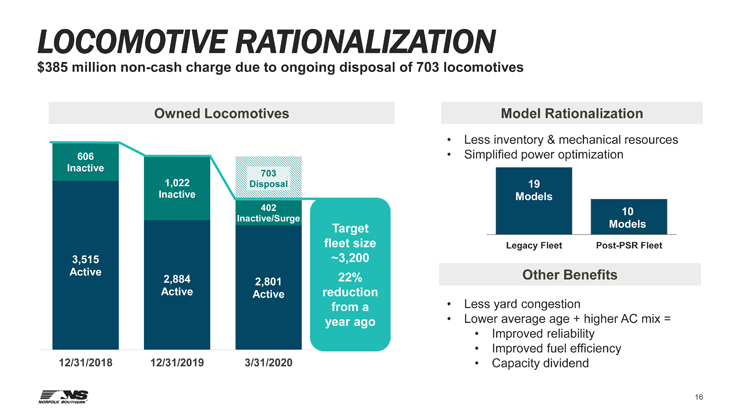
NS has removed 703 units from its fleet, topping the 500-unit target the railroad set during its investor day last year. The railroad’s TOP 21 operating plan includes blending different types of traffic — bulk, intermodal, and merchandise — into longer trains, which reduces locomotive requirements [see “NS plans to cull 500 locomotives,” Trains News Wire, Feb. 11, 2019].
The railroad’s active fleet has shrunk to 2,801 units as of March 31, a 20% reduction from the 3,515 in use at the end of 2018. Some 606 units were stored at the end of 2018, a figure that grew to 1,022 by the end of last year as operational changes were rolled out.
As it sells or scraps 703 older units, NS will retain 402 stored locomotives that will be available as a surge fleet, as well as being cycled into shops as part of the railroad’s ongoing DC-to-AC traction conversion program.
“Simply said, it’s a capacity dividend of our TOP 21 PSR implementation, which has resulted in the decongestion of our yards and road network, allowing cars to turn quicker in the terminals and trains to move faster on the network,” Chief Financial Officer Mark George said on the railroad’s earnings call Wednesday. “The blending of our discrete networks resulted in fewer but longer trains. Fewer trains, along with better balancing of our routes, require fewer locomotives.”
Nearly 300 units were sold in the first quarter, George says, with the remainder up for sale or scrapping by the end of the year.
“The team targeted removal of the oldest, least reliable, and least efficient of the locomotives and eliminated entire model lines, moving us to a more homogenous fleet of 10 models from 19,” George says.
NS did not immediately respond to an email seeking details on which locomotives models were purged.
The model reduction has allowed NS to reduce parts inventory and its mechanical shop forces.
NS will continue its DC-to-AC conversion program, which produces a like-new locomotive at about half the cost of buying new, officials have said.
“We’re committed to that revitalization,” Chief Operating Officer Mike Wheeler says, noting he’s been pleased with the reliability of the AC-traction locomotives.
Last year executives said they would accelerate the DC-to-AC conversion program this year. But due to the economic impact of the COVID-19 pandemic — and a 25% reduction in capital spending this year — NS will stick to its original DC-to-AC conversion schedule. That will push off until 2021 some conversions that had planned for this year, Wheeler says.
Also put off until next year: Rebuilds of the local unit fleet.
NS arrived at its decision to roster 3,200 locomotives by modeling how the PSR-based operating plan would handle traffic levels from 2018, George says.
The railroad’s revenue ton-miles were 6% higher in 2018 than in 2019.
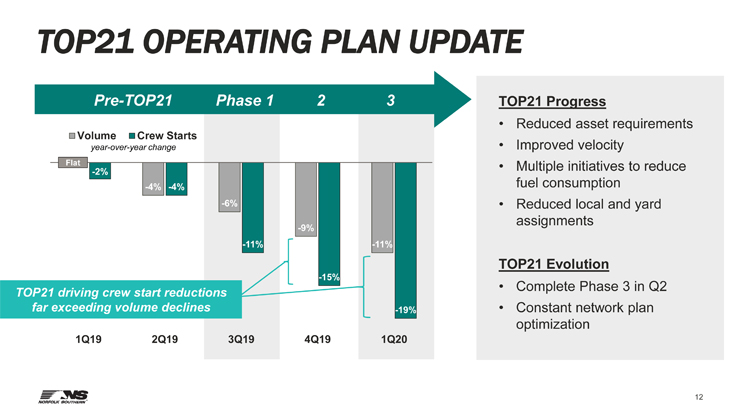
The number of train starts, meanwhile, dropped during all three phases of the implementation of the TOP 21 plan. Train starts were down 11% in the third quarter of 2019, 15% in the fourth quarter of 2019, and 19% in the first quarter of 2020, with each decline much deeper than the quarterly slump in traffic.