ATLANTA — Norfolk Southern will install more than a dozen digital train inspection portals across its network by the end of 2024 as part of its drive to improve safety.
The first portal – developed by NS and the Georgia Tech Research Institution – was activated Sept. 25 on the Fort Wayne Line in Leetonia, Ohio, NS said last week.
“We are a safe railroad, and we’re going above and beyond to become even safer,” NS CEO Alan Shaw said in a statement. “These new portals combine advanced technology with human expertise, giving our people and the public further confidence in Norfolk Southern’s safe operations. It’s all part of our promise to become the gold standard of safety in the rail industry.”
The Georgia Tech Research Institution engineered the hardware for the machine vision inspection system, while the railroad’s Data Science/Artificial Intelligence and Mechanical teams built the brains behind the technology.
Before deploying on the main line, a prototype was developed and tested at Inman Yard in Atlanta. The technology is in use at seven locations across the system, including portals that have been upgraded with the latest NS-Georgia Tech system.
NS is currently erecting six portals on its most heavily trafficked lanes. The next portal activation will be in Jackson, Ga.
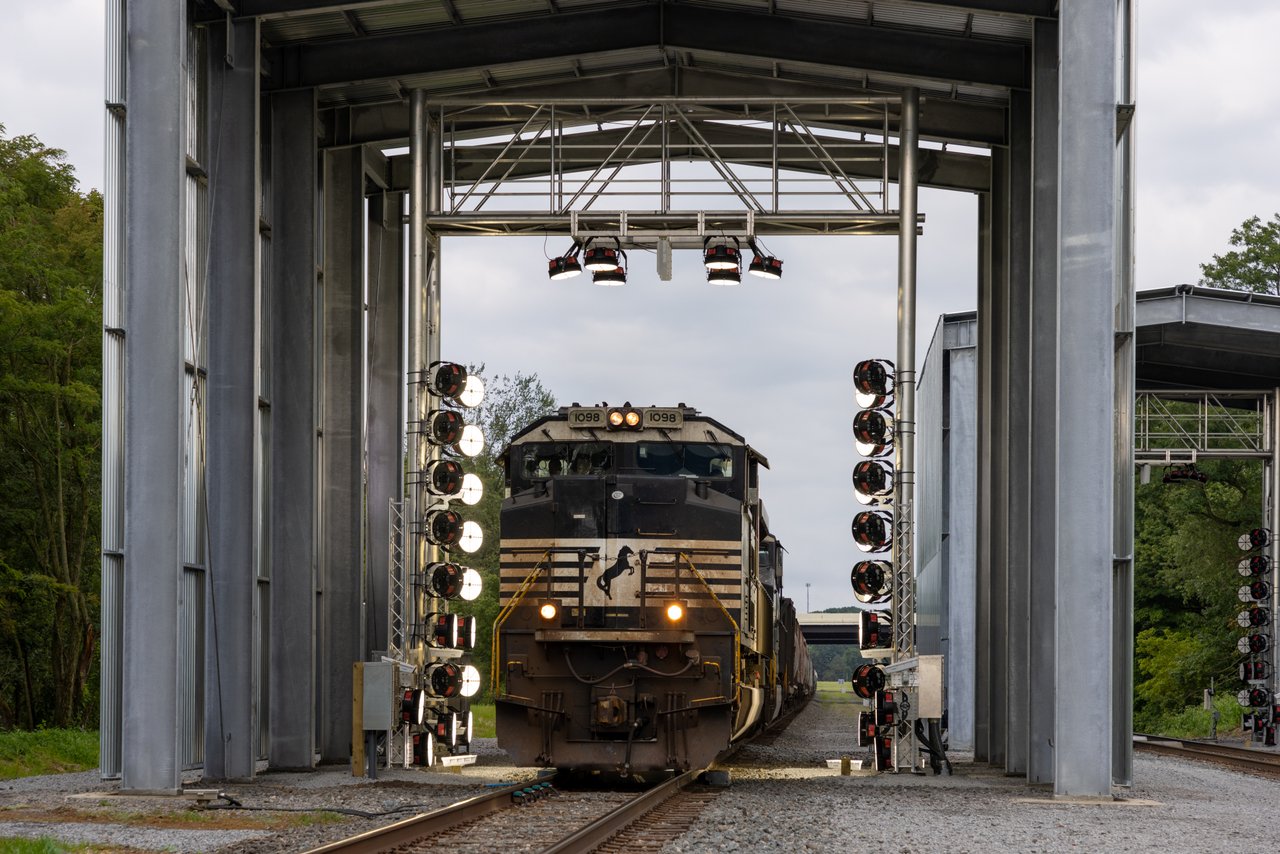
The inspection portals are equipped with an array of 24-megapixel trackside cameras and stadium lighting. The system captures ultra-high-resolution, 360-degree images of passing railcars. The cameras are synced to the microsecond, taking 1,000 images per rail car on average as they pass through the tunnel at speeds up to 70 mph.
The high-speed cameras are strategically placed at angles to capture things that are difficult to detect with the human eye during stationary inspections. In addition, capturing images while the train is moving provides an inspection for various defects that cannot be found while the train is stationary.
Artificial intelligence analyzes these images for potential defects using 38 advanced deep learning algorithms. NS says the algorithms have shown a combination of high accuracy levels and very low false-positives.
The AI transmits the information to the NS Network Operations Center in Atlanta, where the data is reviewed by subject-matter experts to identify and address issues to proactively ensure the safety of rail operations. Critical defects found are flagged for immediate handling.
Share this article