

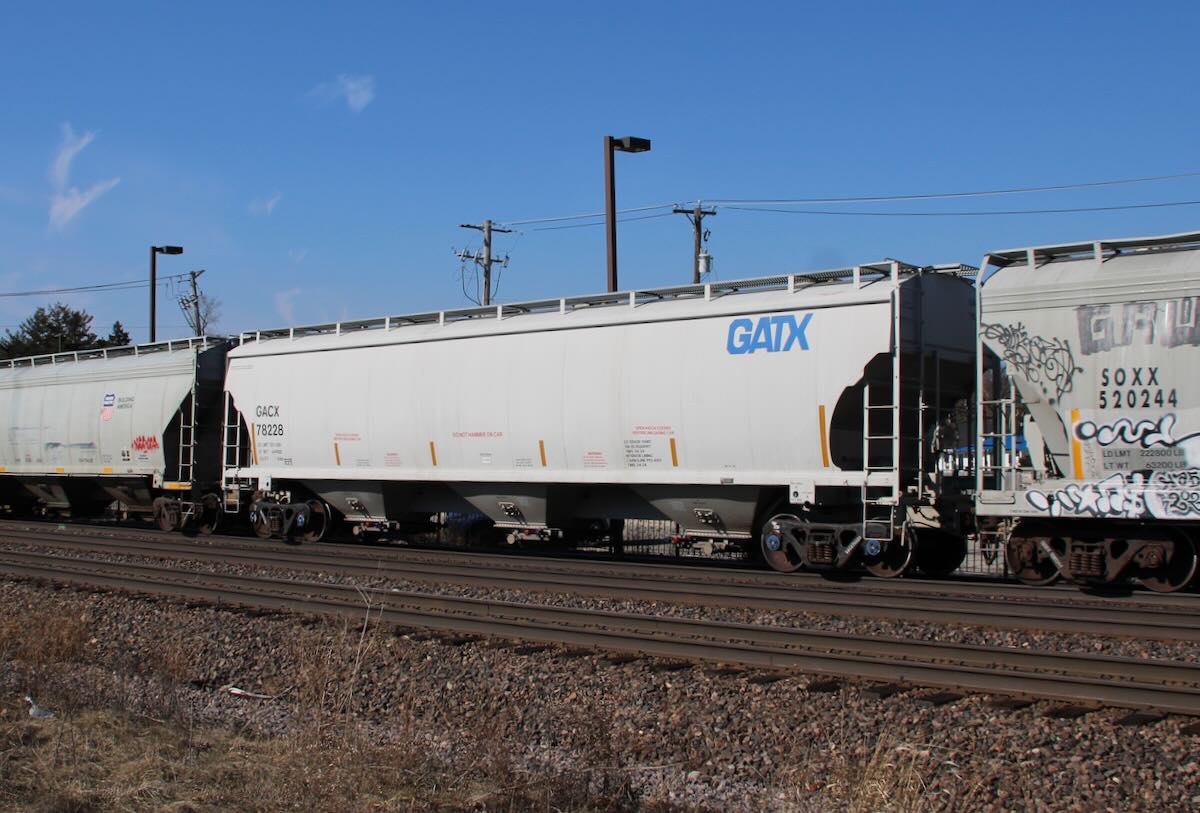
CHICAGO — GATX expects 98% to 99% utilization of its newly expanded railcar leasing fleet in North America by the end of 2026, with North America profits projected to jump by $55 million to $65 million to about $415 million, the company said on its quarterly earnings call last week.
The Feb. 13 investor call was the first since GATX virtually doubled the size of its lease fleet by acquiring the Wells Fargo rail lease fleet, a deal that closed on Jan. 1 [see “GATX, Brookfield complete acquisition …,” Trains.com, Jan. 5, 2026]. Including the assets acquired in a joint venture with Brookfield Infrastructure Partners — which will be managed by GATX — the company has gone from a fleet of 107,000 cars to about 208,000.
“While we added some new customers through the acquisition,” CEO Bob Lyons said, “by and large the biggest accounts are existing customers of GATX that we know very well. So all of the customer interaction right now is under one umbrella. And within an expanded fleet, we will have more customer interaction than we’ve ever had before, and we believe we can bring additional value to our customers.”
The Jan. 1 closing date saw the company complete an information technology cutover “that entailed hundreds of thousands of data points, car files, contract records, mechanical records, customer data, and myriad other supporting documents,” Lyons said. “The cutover went very well, and I’d like to take a second just to thank the Wells Fargo Rail team for all of their work and assisting with that effort.”
GATX also anticipates $160 million in revenue from its car repair business, up about $25 million from 2025, and expects gains from equipment disposition, including scrapping, to jump from $130 million to $200 million. “That’s a material increase,” Lyons said of the latter figure, “but keep in mind we now have a pool of cars to select from in terms of sale candidates that’s twice the size of our historical fleet. And we’re going to continue utilizing the strong demand to optimize and rebalance the entire portfolio.”
Lyons said it would “take a little bit of time to fully assess the Wells portfolio in terms of what we want to go to market with,” later adding, “the most liquid car type in the secondary market is freight cars versus tank. Tank, it’s not that you can’t sell cars in the secondary market, but there’s a limited buyer universe and it’s a more specialized asset. So the most active market by far is for freight cars, and the Wells Fargo fleet was 95% freight cars. So we have a lot to work with.”
The CEO noted that as a bank, Wells Fargo was not allowed to own its own shops, so car maintenance was handled by third parties, at an annual cost of about $135 million. “Given that the GATX shops are currently at full capacity, we’ll continue to utilize those third-party shops for maintenance of the acquired fleet,” he said. “Over time, based on investments we’re making in our shops and efficiency improvements, we will have an opportunity to move some of this work in-house.
“That does not mean that we can’t add value immediately in the maintenance process. For example, previously there were close to 80 shops providing service on the Wells Fargo fleet. In just seven weeks of ownership, we’ve already pared this down materially, and we’ll keep doing so as we transfer work to our preferred third-party providers. In the process, we will find cost efficiencies.”
For 2025, the company said in a press release, fourth-quarter net income was $97 million or $2.66 per diluted share; full-year net income was $333.3 million or $9.12 per diluted share, up from $294.2 million or $7.78 per diluted share in 2024.
“Our EPS actually increased 11% over 2024,” Lyons said. “Importantly, we achieved this strong EPS growth while posting another year of [return on investment] above 12%.”
International business was in line with expectations, the company said. It also expanded its international fleet, agreeing to acquire 6,000 freight cars from Germany’s DB Cargo and expanding its fleet in India by about 12,000 cars.
“Coming into the year, we were hopeful that the economic environment would improve as the year progressed, but it did not,” Lyons said. “Despite these challenges, the team at GATX Rail Europe did an outstanding job by raising lease rates on many car types and holding utilization at solid levels. … In India, the economic environment was very strong and our results showed it.”
For 2026, the company’s earnings guidance calls for $9.50 to $10.10 per diluted share.
— To report news or errors, contact trainsnewswire@firecrown.com.