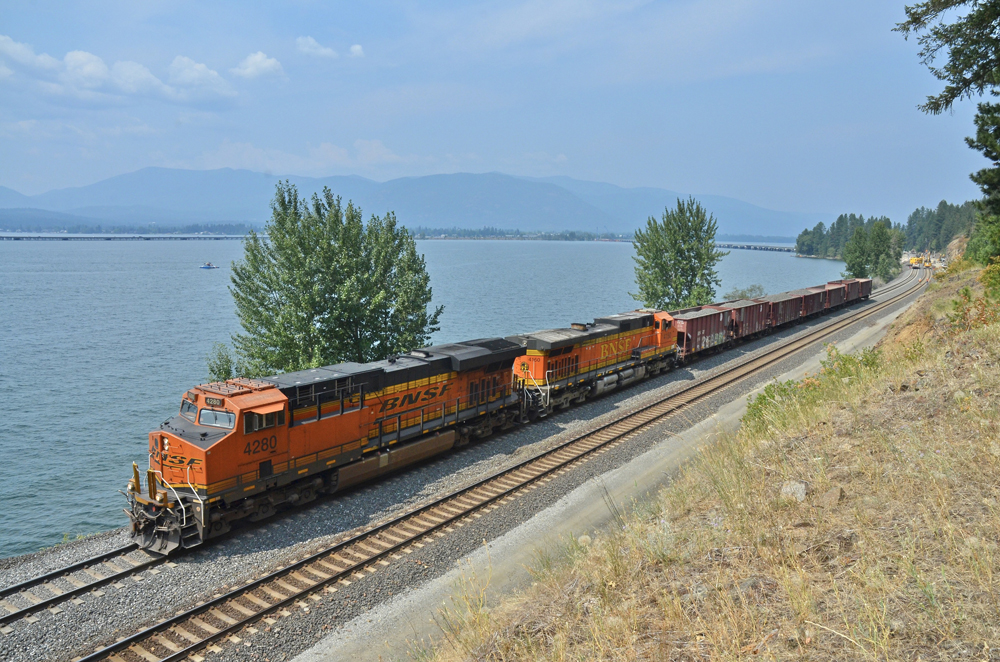


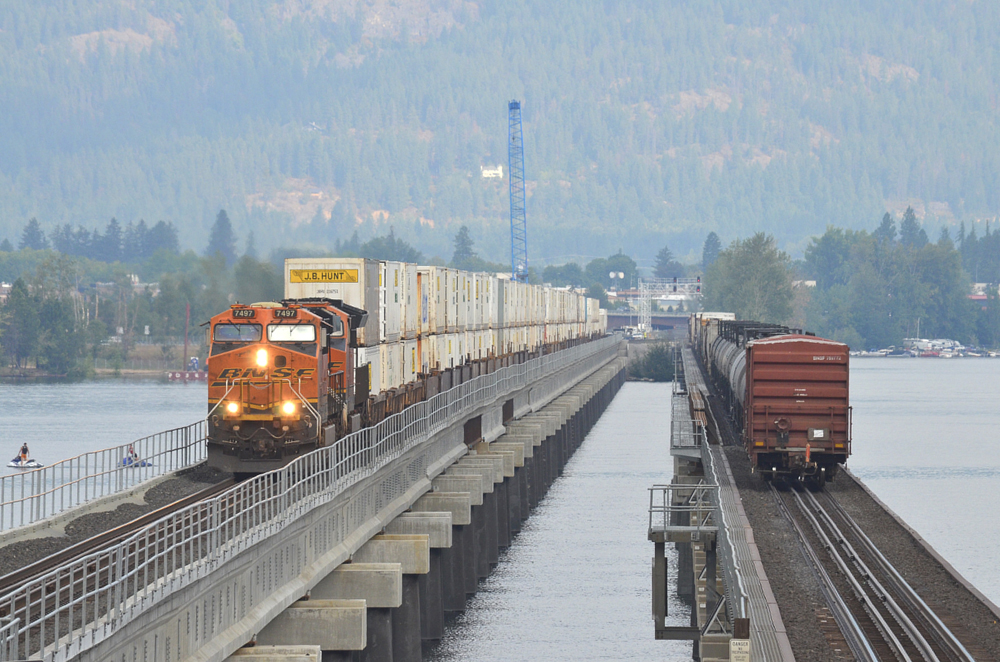
SANDPOINT, Idaho — Thanks to an all-day work window on Aug. 6, 2023, the final track segments have been put into place to complete BNSF Railway’s 2-mile double-tracking project at the east end of its busy “Funnel” between Spokane, Wash., and Sandpoint.
Completion of the new 4,873-foot bridge across Lake Pend Oreille in November 2022 — a project that began in 2019 — was followed by reconstruction of the adjacent Northern Pacific bridge dating to 1904 [see “Work in progress to upgrade BNSF’s old Sandpoint bridge,” Trains News Wire, May 23, 2023]. That laid the foundation for putting a second main into service between Sandpoint Junction — where BNSF and Montana Rail Link converge — and the previous end of double track at East Algoma.
Adding the second main also required construction of a pair of smaller bridges in Sandpoint, one over Sand Creek and the other over Bridge Street. At the ex-NP Sandpoint depot, served by Amtrak’s Empire Builder, addition of the second track required removal of most of the existing platform and relocation of a small structure which stores a wheelchair lift.
BNSF and MRL no longer make physical connection at what used to be Sandpoint Junction, just north (railroad east) of the depot. Instead, there’s now a control point with dual crossovers located just northwest of the two big bridges, adjacent to where Sand Creek empties into Lake Pend Oreille. During the Aug. 6 window, which suspended all train traffic on BNSF through Sandpoint, several high-priority BNSF trains were rerouted over Union Pacific between there and Spokane.
“The completion of this bridge is a big win for our customers and the community, especially before the start of the fall harvest season,” John Cech, vice president of engineering for BNSF, said in a press release. “This milestone is thanks to many team members spanning across multiple departments who collaborated to help improve the consistency of our service. This bridge will be critical moving forward to address our long-term growth and will allow us to meet customer expectations for the next century or more.”
More information on the project is available here.