As a major storm moved across the Midwest and East last week, railroads told customers they would alter train operations because of the conditions. RailState, the company that monitors operations through trackside sensors, has produced data showing what those changes looked like in Ohio, Pennsylvania, and Indiana.
RailState compared the storm period, Jan. 24-26, to a baseline from Nov. 26, 2025, to Jan. 23, 2026. It found that in Ohio, where sensors are on Norfolk Southern, the number of trains fell from an average of 35.2 trains to 27.3, a 22.5% drop, and that train length fell from 6,473 feet to 5,580 feet, a reduction of 13.8%. Eastbound trains declined in length from 6,225 to 5,663 feet (a drop of 9%) while westbounds were cut from 6,929 feet to 5,497 feet (a 20.7% reduction). Train-length reductions were similar for both intermodal and manifest freights, with intermodals down 20.8% (7,098 feet to 5,619) and manifests down 19.7% (6,637 to 5,327 feet).
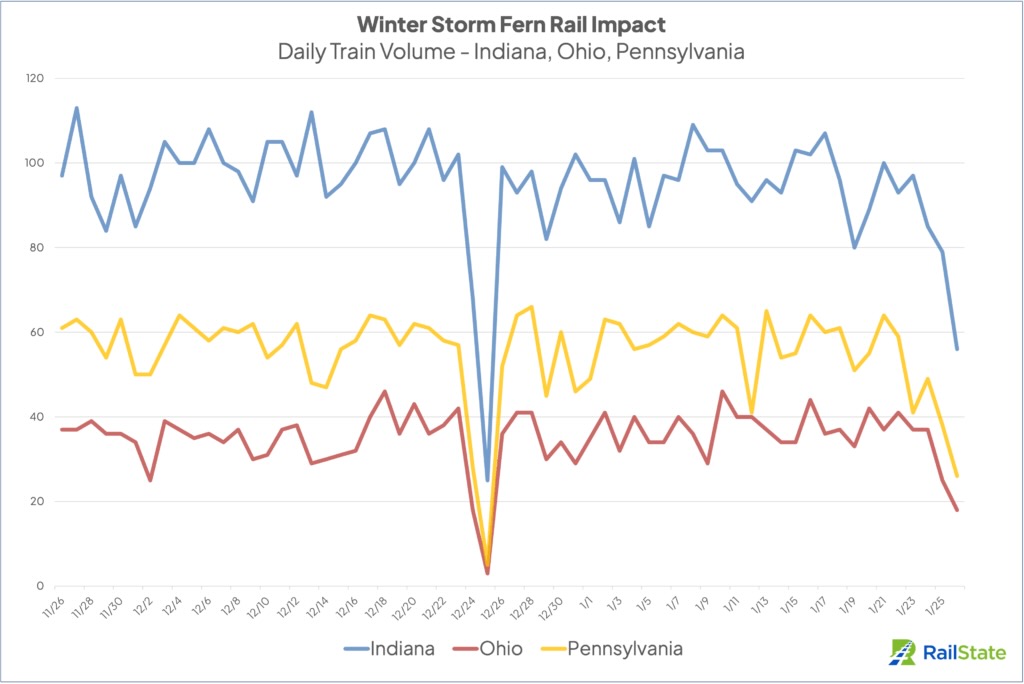
In Pennsylvania, train frequency decreased more sharply but train lengths saw less of a reduction. The average at RailState’s Pennsylvania sites fell from 50.5 trains a day to 36.7, a drop of 27.4%, while train lengths fell from 5,965 feet to 5,670, a 5% decline. The directional split saw eastbound trains decline from 5,930 to 5,308 feet, a decrease of 10.5%, while westbound trains actually saw a slight increase: 5,988 to 6,166 feet, up 2.1%. Intermodal lengths declined by 10.4%, from 6,040 to 5,414 feet, while manifests were down 7.6%, from 6,136 to 5,670 feet.
Finally, in Indiana, train volumes fell by about a fifth, but train lengths remained nearly the same. The baseline information for NS’s Chicago Line and CSX’s Garrett Subdivision show 95.1 trains per day; that fell to 74.3 trains per day during the storm window, a decline of 21.9%. Train lengths only declined by 1.6% (6,327 to 6,228 feet). Eastbound trains decreased by 4.8%, from 6,212 to 5,912 feet, while westbounds increased from 6,513 to 6,991 feet. By train type, intermodals dropped 1.4%, from 7,038 to 6,939 feet, and manifests by 5.6%, from 6,188 to 5,844 feet; automotive trains increased by 7.7%, from 7,413 to 7,987 feet.
RailState says the data — from its monitoring points on major corridors in the three states, rather than a full picture of those states — indicates that the impact of the storm was not uniform, and provides the ability to assess how well those corridors continued to move freight during extreme weather. More information on RailState is available at its website.
— To report news or errors, contact trainsnewswire@firecrown.com.