SCHAUMBURG, Ill. — If there’s a white whale that railroads have long hunted, it’s the goal of converting truck traffic to rail.
It’s a centerpiece of Union Pacific’s effort to show public benefits to its merger with Norfolk Southern, but the goal is hardly a new one. Janet Drysdale, Canadian National’s chief commercial officer, said during the Midwest Association of Rail Shippers winter meeting that in her 30 years in the rail industry, “truck-to-rail conversion has been the most overpromised, underdelivered opportunity.”
Which is why a presentation about a relatively small Michigan mining operation using autonomous railcars — which might have seemed more at home at a technology conference — had a place at MARS.
The operation is the world’s first commercial application of autonomous railcar technology, said presenters Katie Kloentrup, senior digital engineer at mining company Carmeuse Americas, and Alex Peiffer, chief operating officer of tech startup Intramotev. The project using Intramotev’s TugVolt self-powered railcars in six-car trains to move limestone from mine to port at a Carmeuse mine in Cedarville, on Michigan’s Upper Peninsula, was announced in 2024 [see “Michigan mine to use Intramotev …,” Trains.com, April 24, 2024]. And while it has immediate benefits for Carmeuse, Peiffer told the shippers at MARS that it could have much larger applications — like truck-to-rail conversion.
“I believe one of the things that can actually catalyze that, and result in that, is improving local train service, reducing dwell, and basically making short trains profitable,” Peiffer said.
“If you are a short line or a Class I that has two- or three-day-a-week service to your industries or customers, because you want to make sure you have enough volume to move that train profitably … now you don’t need that. Now you can use a TugVolt to pull one and do it profitably and safely. So now you can offer service every single day, and your customer’s a lot happier, and it’s more of a truck-like service.”
Trains without locomotives
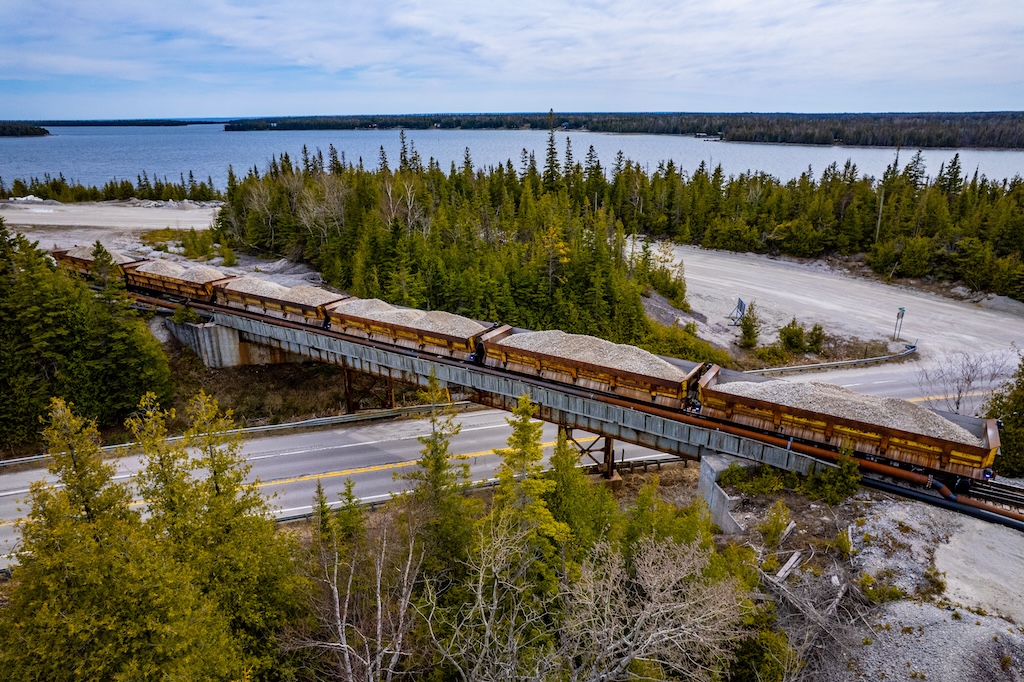
The Cedarville operation involved retrofitting DIFCO side-dump cars with battery-electric motors and related technology to allow locomotive-free trains of six cars — three powered and three unpowered — to move between mine and port; at the port, a remote operator dumps the cargo.
“We call it supervised autonomy,” Kloentrup said. “[Operators] sit in the cab of the loader or the cab of a pickup truck. They’ll send it down to the dump, and then they’ll select the car, and select on the tablet when to dump into each pocket [receiving the limestone]. So now we have operator comfort. We’re gaining efficiency by not having to walk along it … and it just works smoother overall.”
Peiffer said the cars include a “perception system which is a blend of cameras, LIDAR, radar to basically see the world around it and utilize intelligence to make good decisions, as far as stoping for obstacles and other things of that nature.” And while the operation is on a private route not connected to the U.S. rail network, which frees it from FRA regulation, it does include grade crossings, so the automated cars do meet AAR standards regarding lights, horns, and other safety features.
The mine runs 16 hours a day; during the other eight hours, the cars recharge using standard auto-type recharging stations. While the mine shuts down during the winter, avoiding operating issues with the harshest season on the Upper Peninsula, the cars are on pace to move 1 million tons in a year.
Kloentrup said Carmeuse is looking to expand the trainsets beyond their current six cars, and considering whether the operation can be expanded onto a longer, locomotive-powered line that shares some of the route with the current operation, or to other Carmeuse locations. In some places, the self-powered cars might be able to replace switch engines.
That latter point, Peiffer said, is another reason the TugVolt system could be of interest to shippers.
“When you think of the original points, origins and destinations, it’s shippers, it’s plants,” he said. At those locations, TugVolts could be used “in the independent, point-to-point movements that may happen for in-plant moves, like in a steel mill, or for captive moves — moving other cars around in a way that is more efficient, using it as a switcher because we keep the couplers, air brakes, and compressors that your locomotive would have.”
The Cedarville operation is currently the only TugVolt operation, but not for long; the company has an agreement with Watco to use TugVolt equipment at Watco’s Wood River, Ill., transload terminal [see “Intramotev announces commercial agreement …,” Sept. 16, 2025]. There’s also an operation in Pennsylvania using a different Intramotev product, ReVolt cars, which are also powered but used within a train consist [see “Intramotev battery-electric hopper debuts …,” April 3, 2024].
And more applications may be coming. Justin Broyles, CEO of the R.J. Corman Railroad Group, said during another MARS presentation that his company was talking with Intramotev. “There’s some interesting opportunities for us to potentially pilot that,” Broyles said.
— To report news or errors, contact trainsnewswire@firecrown.com.