





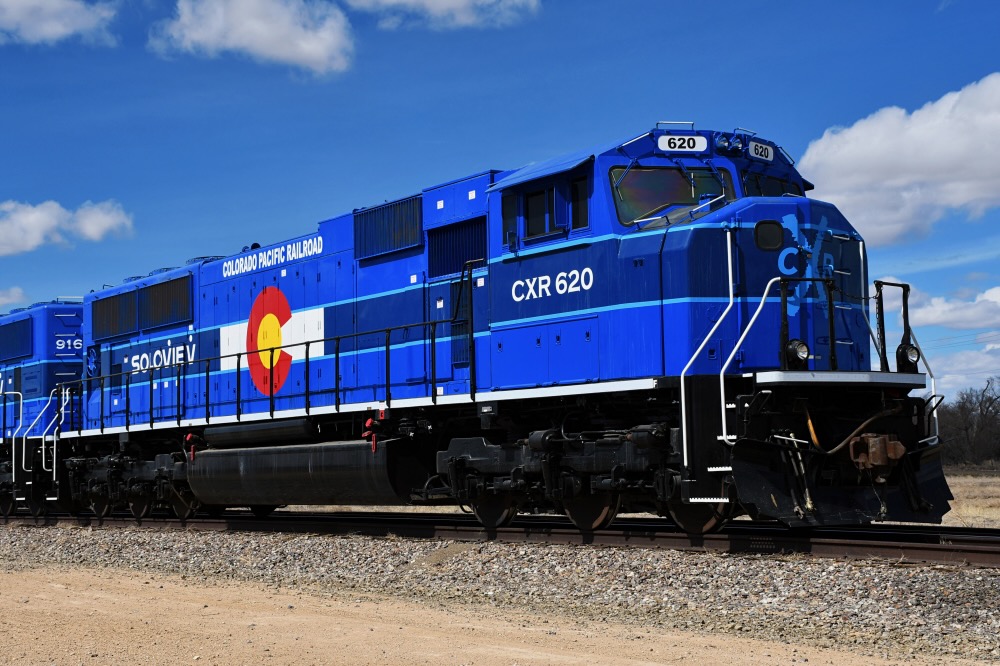
KANSAS CITY, Kan. — Colorado Pacific Railroad and Weskan Grain, two subsidiaries of the Soloviev Group, this week filed a federal court suit that alleges Union Pacific Railroad and regional railroad Kansas & Oklahoma have conspired to prevent westbound grain moves over Colorado Pacific.
The plaintiffs claimed that UP and Watco Cos.’ K&O are using a $500 per car interchange fee to effectively prevent farmers located on the K&O from shipping export grain west over Colorado Pacific to an interchange with UP and BNSF Railway at NA Junction in Colorado. The junction is near Boone, Colo., and about 25 miles east of Pueblo.
Both UP and K&O, one of Watco’s 30 regional and shortline railroads, denied the allegations.
Colorado Pacific bought 122 miles of track in 2018 from NA Junction to an interchange with the K&O at Towner, Colo., about 60 miles west of Scott City, Kansas. The railroad rebuilt the property it calls the Towner line, where no traffic had moved for more than two decades, seeking to move grain from elevators on K&O in the Scott City area, including two Weskan facilities.
The complaint filed in U.S. District Court in Kansas alleges that UP and K&O in 2019 altered a 1997 lease agreement to impose the interchange fee that made westbound moves from elevators on K&O too costly for farmers in the Scott City area. Grain from the Scott City area can move more than 140 eastbound miles over the K&O to interchange with UP at Great Bend, Kan., before it moves west.
“I’m a farmer wanting to get a market for my grain,” said Weskan and Colorado Pacific Chairman Stefan Soloviev in an interview. “We got into the rail business to provide competition so farmers could get competitive prices. They [UP and K&O] have given us no choice. We’ve been fighting this for three years. The lawsuit is the last thing we wanted to do.”
Jake Wahlenmaier, grain elevator manager at Weskan’s elevator in Sheridan Lake, Colo., says the potential for the Towner line is enormous, if the grain traffic could move that way.
“We’d turn that line into the busiest stretch of rail west of the Mississippi,” he said. “We’d be smoking the rail ties.”
Colorado Pacific also has filed at the Surface Transportation Board to contest the interchange fee and support its contention that the other two railroads illegally created a so-called “paper barrier” to block westbound grain moves from the K&O to Colorado Pacific.
“Union Pacific denies the allegations of the lawsuit and will present the facts to the court and Surface Transportation Board who handles these issues,” a UP representative said.
“We do not comment on litigation matters, but as a matter of course we will defend our commitment to the values that define us through the proper legal channels,” said spokeswoman for Watco, based in Pittsburg, Kan.
Soloviev said Colorado Pacific anticipates moving 5,000 carloads of grain this year. Weskan is at capacity at five rail and five truck facilities, and 20 unit trains have been booked for future moves, he added.
“We have to have that western outlet for our grain,” Steven Compton, a Scott City farmer, told Trains. “Transportation is vital. Feed and other costs have gone up, but grain prices are steady. Markets are being compressed. This is about more than money. It’s about the survivability of the farm economy.”
Weskan is part of Soloviev’s grain businesses that provide services such as seed, storage and transportation to farmers. More than a dozen farmers in the Scott City area joined in the suit.
Soloviev Group says it is the 14th largest landowner in the U.S. Its holdings are estimated at 350,000 acres. The New York-based entrepreneur also has businesses including real estate, wind farms, and a resort hotel on Long Island.
Soloviev also controls the Colorado Pacific Rio Grande, a 150-mile railroad in southern Colorado. Several years ago Soloviev sought to reopen the former Denver & Rio Grande’s route over Tennessee Pass to move westbound grain, an effort that included an unsuccessful bid to force UP to sell the line to Colorado Pacific [see “Regulators toss out effort to force UP to sell …,” Trains.com, March 18, 2020]. That effort ended in 2023 [see “News report says Colorado Pacific …,” May 9, 2023].
The suit alleges violations of the Sherman Act that govern anti-competitive practices, said Michael Hershman, CEO of Soloviev Group.
“The allegations are fairly standard for a Sherman Act case,” Hershman said. “What’s different here is that this is David vs. Goliath. It’s very difficult to go against a multi-billion dollar company [UP].”
Soloviev said Colorado Pacific was prevented from bidding on the property that UP owns and K&O operates under the lease that is being challenged in the federal court case. In the interview, Soloviev advanced another reason to seek the change, saying the ability to move traffic directly via Colorado Pacific would eliminate 25,000 moves currently made by truck to get grain from Scott City to where Colorado Pacific can handle it.
— Updated at 6:05 p.m. to clarify item on taking trucks off the road; updated Feb. 2 at 9:55 a.m. to correct title of Jake Wahlenmaier. To report news or errors, contact trainsnewswire@firecrown.com.



Stefan Soloviev is just a mosquito buzzing around Jim Vena’s head. He’s still mad because the STB and Courts threw out his suit trying to force UP to sell then their rail banked line over Tennessee Pass. Every chance he gets he tries to stick it to the UP again. He should have worked with UP in the beginning instead of against them and maybe something could have been worked out. But this Russian oligarch doesn’t understand that playing nice works out better that kicking your neighbor in the shins every time you see them… That only ends up with him having a bloody nose and no satisfaction. This is a K & O issue, they route the product the direction they want. Soloviev does have a couple of nice looking SD70M’s, however. The Blue paint scheme with the Colorado “sun in the C” emblem on their flanks is a nice touch…
It will be interesting to see how this plays out, in regards to grain being exported at the Port of Oakland I don’t think there is a grain terminal there.
This could be one of those Paul Harvey “The Rest Of The Story” things. While the information in the article makes the UP sound like the Bad Guy, it’s important to remember how patently ridiculous Colorado Pacific’s bid to haul grain over Tennessee Pass (albeit that the westbound grade is not as steep as the famed 3% eastbound) and then interchange that grain to UP or BNSF someplace (as their route would have terminated at least by Dotsero) was which would have then required lugging the whole train over Soldier Summit (2.4%) grade. That was pretty ridiculous in itself, so I’m a bit skeptical of any of Colorado Pacific’s claims of being harmed being the entire story. On the surface, it makes no sense, as loading on the Colorado Pacific and interchanging to UP could siphon grain away from BNSF shuttle facilities to the south at Coolidge and Holcomb, KS. I’m also curious really how much grain from this area goes to export on the “West Coast” which in this case would presumably be Oakland. A lot of BNSF grain in this area goes to Houston or Galveston, and this stuff UP might not be as interested in as it would involve circuity or using extensive BNSF trackage rights.
Agreed more hogwash, and Colorado is not a significant exporter of grains. In fact most of their product goes to Canada, Mexico, with miniscule amounts going to AisaPac..
Colorado only exports around ~2B USD worth of Ag goods.. Compare that with a state like Iowa that exports ~15B USD..
Seems hogwash. Every American loves the underdog (CXR) and hates the big guy (UPRR). Maybe CXR is a marginal, failing road (despite its glorious paint job on its huge locomotives), so it wants to shake down Union Pacific to stay afloat.
Having spent way too much time in eastern Colorado, I’m surprised there’s enough agriculture to feed one horse.
And I particularly liked this comment from the article: Jake Wahlenmaier, superintendent at Weskan’s elevator in Sheridan Lake, Colo., says the potential for the Towner line is enormous, if the grain traffic could move that way. “We’d turn that line into the busiest stretch of rail west of the Mississippi,” he said. “We’d be smoking the rail ties.”
Wow. That busy? Busier than North Platte or Belen, evidently. But in 2023, Colorado produced 74.6 million bushels of winter wheat. The Weskan elevator east of Sheridan Lake (they call it Stockton) is in Kiowa County. Kiowa County was the 5th-largest producer of winter wheat in Colorado at 4.7 million bushels, far behind Washington (12.4 million), Kit Carson (11.9 million), and Yuma (6.6 million) counties to the north. (Colorado ranks 9th in state wheat production.) The other closest shuttle facilities to Sheridan Lake are UP-served Cheyenne Wells (27 miles north), and BNSF-served Coolidge (KS), 46 miles to the southeast.
I do find it interesting that Kit Carson, the second-largest wheat producing county in Colorado, is served only by the shortline KYLE (ex-CRI&P trackage) which interchanges with UP at Limon, CO. According to the 2024 Colorado State Rail Plan, no KYLE trackage in Colorado can handle 286,000-pound cars (required for a shuttle train). So while it’s 37 miles from the Kit Carson county seat of Burlington to the nearest shuttle facility at Cheyenne Wells, that distance is not necessarily a deterrent to grain production in Kit Carson County.
$500. per car?? Ridiculous!! Even a small unit train would be extraordinary. Typical of UP even to stick it to their own lessors. You would think that UP would want to keep any of its tracks that it leases out in fair shape instead of going downhill?
Perfect PR for all those opposed to a Transcon merger. This might get settled quickly to keep the “noise” down.
The Colorado Pacific line referred to in this article is the former Missouri Pacific mainline Kansas City-Pueblo, route of the MoP’s “Colorado Eagle” streamliner.