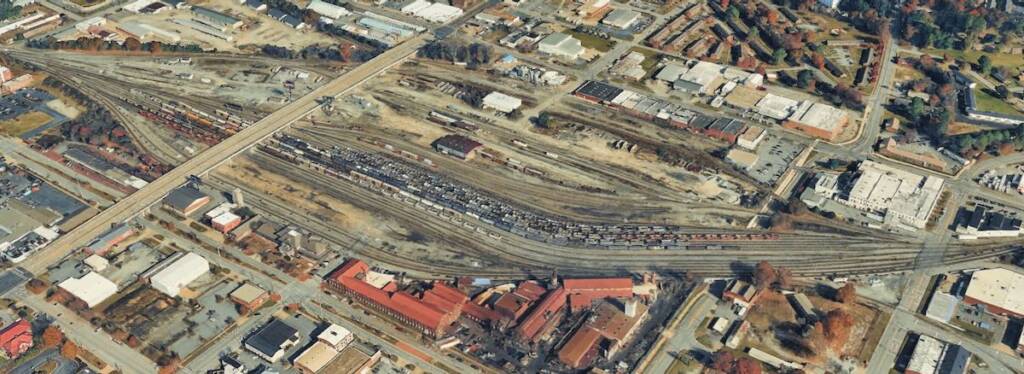
COLUMBUS, Ga. — A Georgia city’s lawsuit claiming ownership of most of a Norfolk Southern rail yard landed in federal court on Wednesday (Feb. 25), where a judge will now determine if that is the proper venue for the dispute.
Neither the railroad nor the City of Columbus believe it is.
WRBL-TV reports Judge Clay Land of U.S. District Court for the Middle District of Georgia held a 90-minute hearing on the case, in which Columbus asserts much of the land occupied by the yard reverted to city ownership in the 1970s with the end of passenger rail service. The city originally filed the suit claiming ownership last year in Muscogee County Superior Court and argues that is where it should remain. Norfolk Southern — a defendant along with Genesee & Wyoming — had the case transferred to federal court as a matter of interstate commerce, but argues that it is actually a matter for the Surface Transportation Board as the regulator of rail transportation.
Land took the case under advisement and will issue an order on the jurisdiction question at a later date.

The Consolidated Government of Columbus, or CCG, filed suit in Superior Court in August 2025, arguing that under an 1847 agreement with the Muscogee Railroad Co., it provided public land “for the purpose of locating a depot” in the city. No deed was involved; instead, the city government passed resolutions conveying the land subject to specific limitations, including a provision in which the land would revert to the city if it was no longer used for a depot.
“For more than a century, the railyards were used more or less as CCG and the Railroad intended with the benefits of that use flowing to the citizens of Columbus,” the suit says. “Then, the Railroad ceased passenger services in Columbus and sold and/or demolished its depots. This triggered the terms of reversion, and title to both railyards is now vested in CCG. However, the Railroad remains on the property and uses it for its own non-public purposes which do not include the operation of a depot.”
The Muscogee Railroad Co. was a predecessor of the Central of Georgia, which in turn is now part of NS. G&W is involved because two of its short lines, the Columbus & Chattahoochee Railroad and Georgia Southwestern Railroad, interchange with NS at the yard in Columbus and lease land from NS.
The suit, the city says, is to regain control of the land and “recover for the losses and damages CCG has suffered” from the railroads’ continued use of the property.
NS and G&W, in their filing to move the matter to federal court, note that the Columbus action acknowledges that the yard has been used for decades for interstate rail operations, and “thus is part of the national rail network. As a result, the federal Surface Transportation Board has exclusive jurisdiction over the ‘construction, acquisition, operation, abandonment, or discontinuance’ of these tracks and facilities.”
Court documents say the yard handles approximately 45,000 railcars annually, and is also the only rail access point to the U.S. Army’s base at Fort Benning, Ga., part of the federal Strategic Rail Corridor Network.
The filing moving the case to federal court and the original Columbus lawsuit are available here.
— To report news or errors, contact trainsnewswire@firecrown.com.
Share this article

Interesting question. Who can attest to the exact criteria agreed to, in a verbal agreement, 179 years ago? Muscogee County does not mind collecting property taxes for those 179 years, on a verbal agreement to which there is no objective proof of the terms. James brings another interesting point as well. Finally, NS could simply run a “Super Mixed” through Columbus, much as the Georgia RR did until the 80’s. Passenger service could be met with this, as by 1840’s standards, a bench on a flatcar was the standard! If the Supermixed is reinstated, what a boon for railfans.
I think the STB is the correct forum. And if Columbus doesn’t like that they can always appeal to the SCOTUS and see what they think. I still think they will lose because if there is no one living who can attest to a verbal agreement then the agreement is null and void. Columbus should have been codifying this agreement all along and now that the shoe may be on the other foot, it seems a little late to cry foul…
Naturally the city wants the case to remain in superior court. The love – hate relationship has many points of interest. After the civil war SAL also came to Columbus with secondary passenger service to savannah & Jacksonville. After that was dropped another service was the C of GA part of the city of Miami between CHI – BHM -JAX either once every 3 days then once every other day.
C of GA even had spur into what is now Fort Benning. Not sure if ever passenger service. Then C of GA dropped its Man of WAR to ATL in favor of the Nancy Hanks ATL SAV.
that left just the CITY service which ended on Amtrak day. Columbus kept hoping for at least ATL service but the C of GA route thru Ga to Newnan then on A&WP to ATL is mostly abandoned due to bridge wash out.
About ownership. Is NS paying property taxes on the rail yard or parts of yard? Columbus has pushed hard for passenger service now. The only ways to get to Columbus on rail now would be CSX to Opelika, Al then on C of GA to Columbus. Or CSX Manchester subs lines to NS intersection to Columbus
All this is maybe some POL thinking they can get passenger service back.
There was a similar situation in Alameda CA where there was a railroad yard (about 40 acres) that was owned by the Alameda Belt Railroad, which was jointly owned by the ATSF and one other railroad. When the Alameda Belt Railroad was abandoned BNSF tried to sell the rail yard. A Alameda resident found the paperwork from 1920 when the city sold the property to the original railroad and the paperwork stated that the city could buy the land back for the 1920 price plus improvements. The case went to court and the City of Alameda won and was able to buy the property back for the original agreement terms. The property is now a park named after the person who found the old records.
I think this will end up like the Palestine, Texas case where the RR was allowed to walk away from a long agreed to contract. Here there does not seem to even be a written contract.
I agree. Circumstances fundamentally change over time, such that honoring ancient legalities no longer makes sense.
This should be an interesting case, because at least according to Wikipedia, the word depot does not exclusively refer to passenger operations but also complete freight operations, including maintaining equipment and receiving and transporting freight.
As James put it, a depot can also include freight. I did a quick look with google maps and see that while not as much in the past, there are still a number of rail served industries in the city of Columbus. Those industries employee Columbus citizens and the rail yard facilitates deliver of shipments to those employers. I don’t think providing freight rail services should be considered “non-public purposes.”
Charles – I did a Google maps tour as well and noticed a couple things. The area on one side of the yard appears to be gentrifying and there is even a law firm located in what appears to be the old station building. The other side of the yard fits the bill of “other side of the tracks”, so I can see a push to consolidate the improvements by eliminating the yard. Also, though this may be completely unrelated, I did notice a spur in town that runs along the river bank with several public event spaces and other improvements being developed next to, or almost on top of the this apparently o/s spur. The spur is still in place and it makes me wonder if there is a long simmering tension on more then one front.