A stat in a Schneider news release caught my eye earlier this month: Overall cross-border intermodal volume between the U.S. and Mexico was up 17% last year. Impressive, yes. But what jumped off the screen was Schneider’s growth rate. Its cross-border traffic — which rides Canadian Pacific Kansas City’s flagship Mexico Midwest Express hotshots — grew twice as fast.
Schneider has been doing business in Mexico for more than three decades. How on earth, you ask, can the guys with the orange containers all of a sudden outperform the rest of the industry so significantly?
The answer is single-line service. Thanks to the 2023 merger of Canadian Pacific and Kansas City Southern, Schneider and its customers can use just one railroad between Chicago and points in Mexico, including Monterrey, San Luis Potosi, and Mexico City. The Schneider boxes previously relied on BNSF and KCS interline service.
“Schneider’s robust cross-border growth is driven by several converging factors. One of the most significant is the advantage of single-rail service with CPKC, which delivers exceptional speed, reliability, and security,” says Michael Baumgardt, Schneider’s senior vice president of intermodal. “These benefits have made it easier than ever for customers to shift freight from truck to intermodal.”
Also contributing: Schneider’s Mexico expertise and the ongoing near-shoring of production to Mexico, Baumgardt says. Yes, of course. But the real story here is single-line service that had not existed between the U.S. and Mexico aside from KCS’s limited reach to Houston and Kansas City. Now CPKC and Schneider can uniquely tap the big freight flows between Chicago and Mexico.
Schneider’s surging cross-border growth via single-line service is not a one-off. In fact, it’s another piece of evidence showing how much intermodal customers prefer a one-railroad move.
Consider that only one out of every seven intermodal loads runs in interline service. That’s right: More than 85% of intermodal loads originate and terminate on one railroad. No man is an island, but railroads practically are when it comes to intermodal.
A glance at the relationship involving Class I railroad maps, lengths of haul, and domestic intermodal market share tells the tale. Intermodal analyst Larry Gross, in his July Intermodal In Depth report, points out that intermodal market share peaks in two lengths of haul: 751 to 1,000 miles and 2,001 to 2,500 miles.
These mileage brackets match the maximum lengths of haul on the Big Four U.S. systems, with the shorter figures in the East (CSX, Norfolk Southern) and the longer in the West (BNSF, Union Pacific).
Domestic intermodal’s market share falls off a cliff when interchange is required, even though the long hauls should be in rail’s wheelhouse. Domestic share is 42% lower in the 1,001-2,000 mile range and 21% lower above 2,500 miles, Gross estimates.
The inescapable conclusion here is that intermodal customers prefer single-line service. This should not come as a surprise: In every end-to-end merger, railroads have argued that single-line service should lead to market share gains.
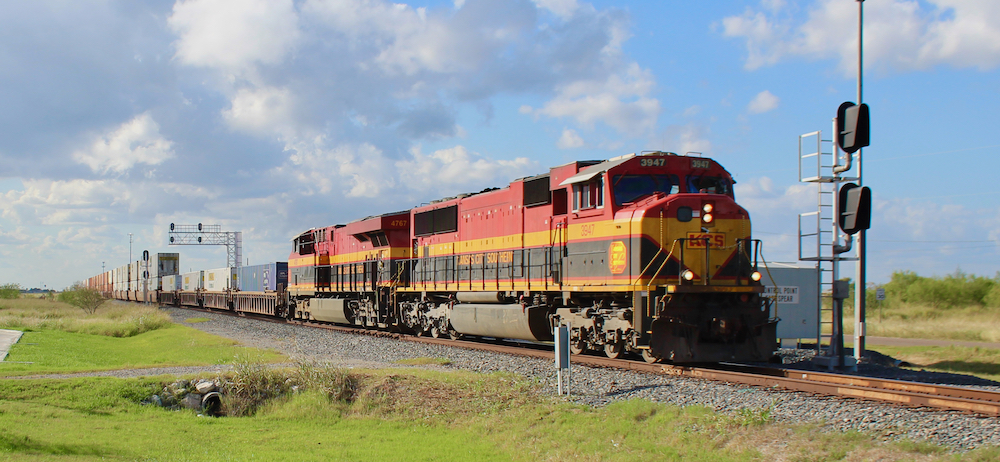
CPKC was no exception. Skeptics scoffed at CPKC’s cross-border route, which wanders all over the map on a curvy, hill-and-dale main line between Laredo, Texas, and Bensenville, Ill. And yet look at Schneider’s growth rate.

Now imagine that on a broader scale. UP CEO Jim Vena, who is in hot pursuit of a deal with NS, says a transcon merger would be a game-changer: “You change the whole paradigm discussion with trucks on the highway versus what comes to the railroad.” He’s right.
Gross estimates, based on market share data, that U.S. domestic intermodal volume would grow as much as 25%, or 3 million loads annually, with single-line service from coast to coast.
Some of the Class I CEOs contend that conventional partnerships can achieve the benefits of mergers but without the regulatory baggage. The dismal interline intermodal data suggests otherwise.
But Gross says there’s more than one way to skin a cat. An alternative to merger, he says, would be creating an intermodal company akin to Triple Crown, whose RoadRailer network once spanned the divide between East and West. Triple Crown sold the service and contracted with the railroads to handle its dedicated trains. All the Class I’s had to do was hook and haul.
This much is clear: If railroads want to see outsized intermodal growth, it won’t come from business as usual. It will require more single-line service.
You can reach Bill Stephens at bybillstephens@gmail.com and follow him on LinkedIn and X @bybillstephens
Share this article