





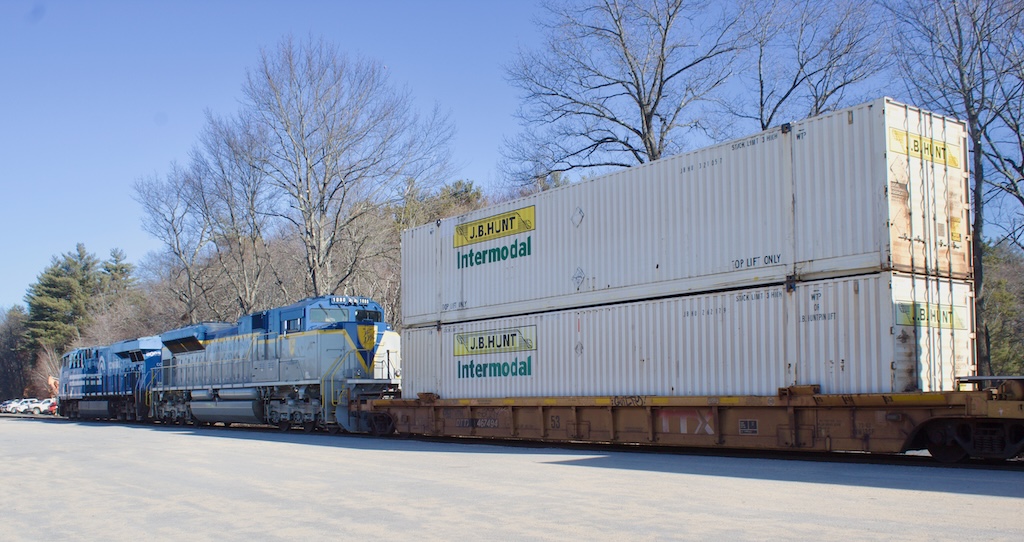
LOWELL, Ark. — J.B. Hunt executives are disappointed that the Union Pacific-Norfolk Southern merger application did not include more details about the railroads’ intermodal plans.
“We continue to digest the application and had expected more intermodal-specific questions to be addressed in the merger application than there were,” Darren Field, president of J.B. Hunt Intermodal, said on the company’s earnings call on Thursday. “So we continue to plan for a wide variety of scenarios.”
J.B. Hunt — the largest domestic intermodal operator — is BNSF Railway’s partner in the West and has relied on Norfolk Southern as its main partner in the East, with CSX picking up a larger share of J.B. Hunt’s eastern business last year as a result of the BNSF-CSX intermodal alliance that launched in August.
J.B. Hunt executives have previously said that they would continue to work with all of the Class I railroads in a post-merger world.
“We continue to have conversations with all Class I railroads, and those conversations are progressing. In our view, there remains a significant amount of industry risks and opportunities, and we continue to work on multiple options to ensure our customers and shareholders are well placed,” CEO Shelley Simpson said on the earnings call. “We have a strong brand and service product and offer tremendous value to our rail providers given our scale, technology capabilities, and how we go to market. Our ability to deliver seamless, differentiated service across the entire North American intermodal network is a competitive advantage.”
Given its size, J.B. Hunt should play a major role in discussions regarding the future of domestic intermodal, Field said.
“We continue to see a large opportunity to convert highway truckload shipments to intermodal and have been actively pursuing these shipments long before any merger discussion. We have offered seamless transcontinental intermodal service for decades, connecting BNSF to both eastern railroads,” Field said. “Our focus remains on engaging in discussions and executing a strategy that is in the best interests of our customers and our shareholders.”
For 2025, J.B. Hunt handled 2.13 million intermodal loads, up from 2.03 million in 2024, amid ongoing freight doldrums and excess truck capacity.
Fourth quarter volume declined 2% year-over-year, with volume down 1% in October, 3% in November, and flat in December. Transcontinental volume was down 6%, while eastern loads were up 5% — figures J.B. Hunt said suffered from comparisons to a strong fourth quarter in 2024.
“As we move into 2026, the freight market feels fragile,” Simpson said. “Capacity continues to exit the truckload market, and we are testing the elasticity of supply.”
J.B. Hunt Intermodal’s quarterly revenue — which accounts for half of the company’s overall revenue — declined 3%, to $1.5 billion. Operating income increased 16%, to $135.5 million, due to a combination of cost-cutting and successful efforts to balance its network and reduce the number of empty container moves.
More detail on J.B. Hunt’s financial results is available online.
— To report news or errors, contact trainsnewswire@firecrown.com.


J B Hunt opposing the UP/NS Transaction is rich! That is like the Airlines opposing Greyhound Bus expansion… JB Hunt is primarily the main partner of non-merger seeking partner BNSF. Very little of their container traffic is hauled by UP or NS by comparison. Of course, Schneider National, Hub Group, MMA, ONE and some of the other minor players are bigger customers with UP and NS so this nothing but an attempt to stall an improvement that could help its competition. It won’t necessarily be to JB Hunts disadvantage because they are so large. But when you are the “king” you don’t want to give up any advantage which diminishes your crown, which Schneider found out when they had to pay higher rates and get less service from BNSF in deference to JB HUNT.
As they say, OH WELL…
Based on the search results, the statement that “JB Hunt is owned by Berkshire Hathaway” is incorrect.
Here are the facts regarding the relationship and ownership:
Ownership: J.B. Hunt Transport Services, Inc. is a publicly traded company (NASDAQ: JBHT). As of late 2025, Johnelle Hunt, wife of founder J.B. Hunt, remains the largest individual shareholder with approximately 19% of the company.
Relationship to Berkshire: JB Hunt has a close strategic partnership with BNSF Railway, which is owned by Berkshire Hathaway. They work together closely on intermodal freight, but BNSF does not own J.B. Hunt.
Recent Transaction: In September 2023, J.B. Hunt agreed to acquire the brokerage operations of BNSF Logistics, which is an affiliate of the Berkshire Hathaway-owned BNSF Railway.
Therefore, while J.B. Hunt works closely with a Berkshire Hathaway subsidiary (BNSF), it is not a subsidiary of or owned by Berkshire Hathaway.
This is strike one against Union Pacific and also Norfolk Southern. This is reason number one why the NTSB rejected the merger and they have to submit a new proposal. JB Hunt is owned by Berkshire Hathaway corporation, the same company who owns BNSF The NTSB took up the rebuttal complaint from BNSF pertaining to the Union Pacific merger with Norfolk Southern because as part of the merger agreement between Southern Pacific and Southern Pacific and Santa Fe and Burlington Northern BNSF gets majority stock of JB Hunt and all JB Hunt containers either via trackage rights or via interchange must ride on a BNSF rail car to its final destination. On the East Coast these cars have to be sent as a block over to Norfolk Southern and over to Florida East Coast Railway to be delivered to their final destination which is Miami, Florida. Because this violates that merger agreement ntsb ruled with BNSF and said no. And good thing they said no. If you do not have an interchange partner, you do not propose a merger when it involves domestic and international freight. This is one of the reasons why the merger was rejected.
Mr. Peavler, you appear somewhat confused here. The letters ‘NTSB’ stand for the National Transportation Safety Board. The NTSB has no direct regulatory oversight on the subject of rail mergers and acquisitions.
That authority is reserved solely for the Surface Transportation board or STB. The ICC Termination Act of 1995 created the STB and made them the successor agency to the Interstate Commerce Commission.
I think Mr. Peavler is confused about a lot of things…