





Railroads proposing mergers inevitably make ambitious promises and projections, particularly about faster service and more competition. Not all of them become reality, despite the best intentions of railroaders who work at a feverish pace to develop the operating plans submitted to federal regulators.
A case in point: CSX, as part of its 1999 acquisition of 42% of Conrail, said it would trim the schedules of its Chicago-New Jersey premium intermodal trains in order to become more competitive with trucks.
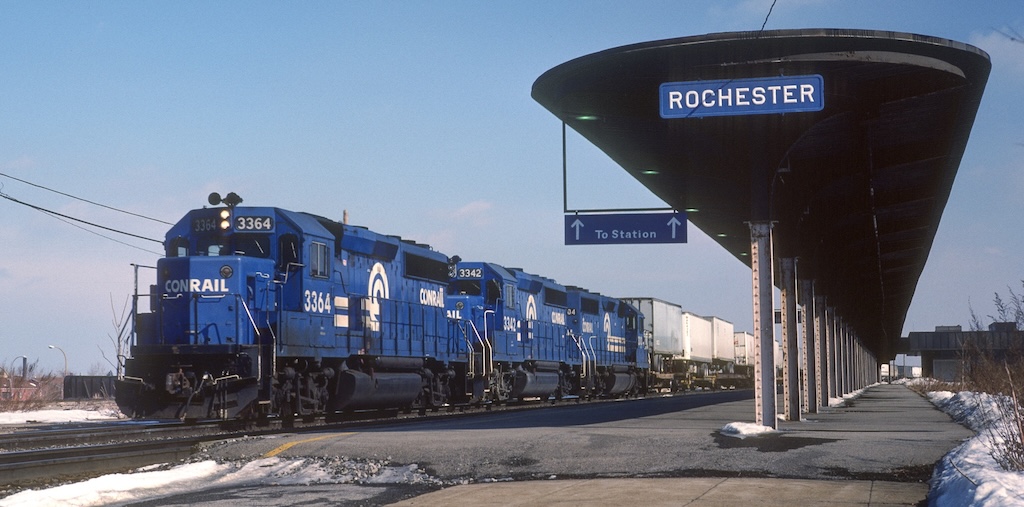
The railroad wanted to turn back the clock and nearly match the 24-hour schedules that the New York Central and Pennsylvania railroads offered three decades earlier. Conrail’s TrailVan trains averaged 30 to 32 hours between Chicago and the New York area due to the operation of longer trains, strict adherence to speed limits, and the concentration of traffic on fewer main lines.
CSX told regulators that four of its 12 planned Chicago-New Jersey intermodal trains would operate on 26½- to 28-hour schedules. To accomplish this, CSX said it would allow intermodal trains to run at 70 mph between Chicago and Selkirk, N.Y., up from 60 mph.
“When completed, CSX will have a quality, 70 mph line from Chicago to New York, which is essential for CSX to be competitive for the large volumes of traffic that will traverse that route,” CSX told the Surface Transportation Board. In the only sentence underlined in its operating plan, CSX said it would offer “intermodal service that will be two and one-half hours faster than the best service Conrail can offer today.”
Yet this never happened. CSX later said it couldn’t justify the extra fuel expense of running 70 mph, but was open to offering expedited schedules if there was demand for them.
Not to be outdone, Norfolk Southern also said it would reduce the schedules to 26 to 28 hours for four of its 17 planned Chicago-New Jersey intermodal trains once it began operating its 58% share of Conrail.
These hotshots would not run via what it then called the Penn Route, a combination of the former Lehigh Valley, Reading, Pennsylvania, and New York Central main lines. Rather, NS planned to send them over Conrail’s lightly trafficked Southern Tier route from New Jersey to Buffalo, then over its former Nickel Plate main from Buffalo to Cleveland, and from there over the former New York Central to Chicago.
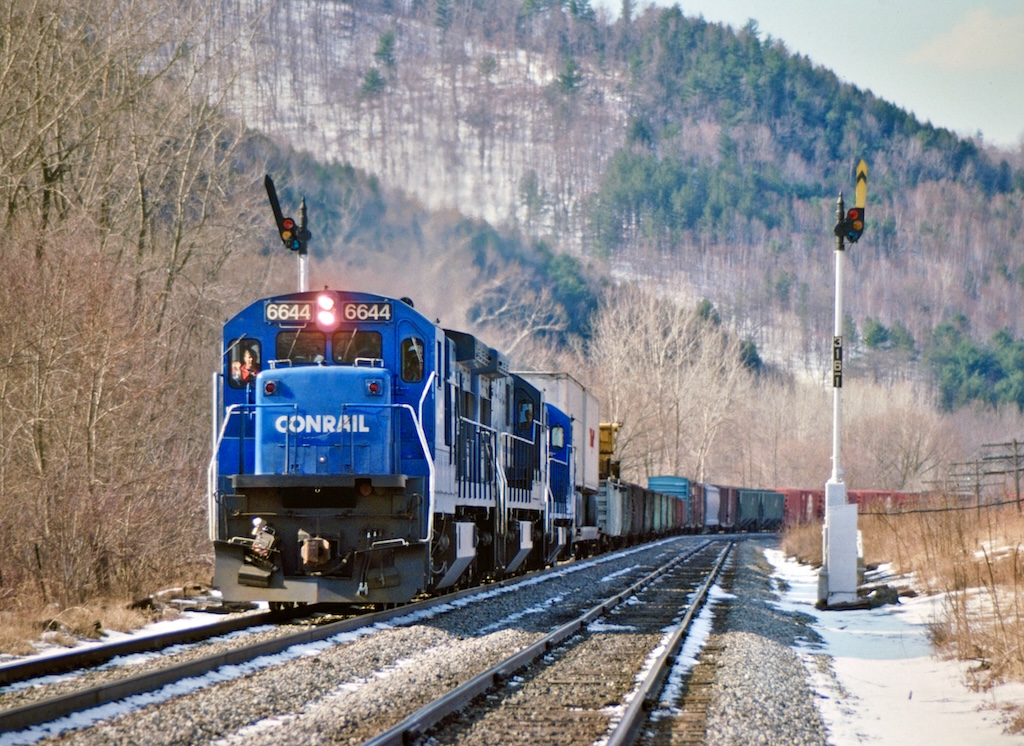
Conrail sporadically ran intermodal trains over the Southern Tier, but on schedules 3 hours slower than the Water Level Route between New Jersey and Buffalo. NS told regulators it would beef up the Southern Tier and boost track speeds to 60 mph from 50 mph.
You can put this in the Never Happened file, too. NS found that upgrading the Southern Tier — which still sported semaphores in some areas, along with stretches of jointed rail and spring switches on passing sidings east of Binghamton, N.Y. — would be an expensive proposition. Plus, NS wound up having ample capacity on the former Pennsy.
When Union Pacific sought to acquire Southern Pacific in 1996, as the natural response to the Burlington Northern-Santa Fe merger of a year earlier, UP and BNSF drew up a massive agreement covering trackage rights and competitive access to customers at locations served by both UP and SP. UP and BNSF officials assured the STB that BNSF’s 3,968 miles of trackage rights over UP-SP and UP’s 376 miles of rights over BNSF would guarantee vigorous rate and service competition.
Instead, the trackage rights have proven to be a flop, aside from routes to Mexican gateways. BNSF no longer uses UP-SP routes as a shortcut from the Gulf Coast to Memphis. And its trackage rights over the Central Corridor between Denver and Northern California, which a lowly merchandise train uses two or three times per week, offers only token competition.

There are plenty of similar examples from other mergers. Railroaders working on merger plans do the best they can with the information at hand, says a retired executive who helped plan the Conrail split. But the plans are often outdated or simply ignored by the time the merger is implemented. “The application derives its reported benefits from the proposed operating plan,” he says. “When the operating plan is not followed, the proposed downstream benefits dissolve.”
It’s a relevant lesson today. UP and NS are asking regulators to approve a merger backed by ambitious service and competition claims that echo those of prior Class I railroad combinations. The critical question is not whether railroaders believe in their operating plans, but if those plans will survive a collision with reality, changing circumstances, and ongoing cost pressures.
You can reach Bill Stephens at bill.stephens@firecrown.com and follow him on LinkedIn and X @bybillstephens
— To report news or errors, contact trainsnewswire@firecrown.com.



Vince you must not be aware that the government did exactly that. They did let Conrail go independent and run as a private entity through an IPO. It was independent for several years until it was split because CSX and NS argued over it. The last thing we needed was an even bigger monpoly, which is against the Sherman Act Law.
Vince Saunders says:
January 15, 2026 at 2:37 pm
The Best thing would have been for the Federal Government to let Conrail go independent and run as a private entity through an IPO. After years of operating from bankruptcy of the predecessor NE roads in 1976 to finally being solvent in 1981 under Stanley Crane and David Levan, Conrail was in prime condition to become a self-sustaining railroad devoid of Government meddling with successful operation all over the Northeast, Instead the government decided to privatize the road in 1986 with an offer to sell its 86% share to Norfolk Southern, Again government agencies proved their acumen at screwing up a sure thing and the inevitable delays and taxation changes and the typical fubar involved with government management of anything in those days ended up with NS later withdrawing its offer. That eventually led to the privatization of Conrail for 1.8 billion, far below its actual worth, with shares sold through Goldman Saks who acted as the holding company until 1997 when NS and CSX agreed to buy the company on a 58% to 42% sharing of assets. While that has worked out for the most part, I believe the stronger position would have been to make Conrail a totally private, stand-alone railroad which I believe would have been successful to this day. But alas, that didn’t happen, so as they say, “…if wishes and but’s were candy and nuts, we’d all have a Merry Christmas!”
Independence in the government’s mind is a fleeting thing, Otherwise NS would have gotten it in the first place and the whole CSX/NS split-up would have not needed to happen. True independence with the Government not involved AT ALL would have been far different that the situation that occurred after the minor stock offering of the Government allowed IPO which was mostly a fund raising scheme to forestall further government subsidies. The privatization run by Goldman Saxs was not what should have happened and was only a placeholder holding company until someone else would come along and take Conrail off their hands, which resulted in the CSX-NS split. A FULL private ownership of Conrail would have served customers in the northeast far better,
So it sounds like they “promise the moon” to get the merger approved, then moon you once it’s done?
Did I read that right?
After the Conrail split I ran CSX trains at 70mph west of Williard, Oh. The track wasn’t really good for that speed, and I soon got caught behind slower trains. As mentioned below it’s the overall average speed, not the maximum that matters.
I have lived near the NS former Southern Atl to Charlotte Main all of my life and its a pretty fast railroad. I have paced intermodals between Easley and Greenville and the Clemson area pushing close to 65+. Though it does seem that trains are moving slower than the were in the 90s. Those NS GP40-2 trailer trains would fly.
No sir. NS has no class 5 track that allows speeds over 60mph. The area through which you state is class 4 track which allows 60 max. You can check this out here:
https://openrailwaymap.app/#view=15/34.69121/-82.83234&style=speed
So in your mind, john, pacing a train with a car speedometer is not factual? Or maybe the engineers saw an “opportunity” and took it from time to time as is legendary throughout the history of railroads in North America. You are most likely both right although times and places can occasionally make all the difference in actualities.
One improvement to merger claims in a presentation would be to pick, say 6 claims, from the documents and require the merged company to prove that they actually achieved them after one year. If they have not, then significant CASH fines would be charged and collected from the CEO who made those claims. Fine the individual, not the company. For instance, let’s see them prove how many truck trips were actually removed from the roads due to the merger/takeover.
Only a Social Liberal would make a comment like that. What you suggest will not happen unless the Government pays for it to happen. That is a totally unnecessary action and fining a CEO is not allowed under the corporate by laws of most corporations except by civil lawsuits for malfeasance or committing a civil criminal act.
It’s strange. CSX currently runs I001 & 002 on schedules that are at or very near what is described in this article between CHI and NJ… but only 1x a week, and only carrying UPS. If one of the largest parcel carriers in the US can only garner that much pull, what chance does loose COFC/TOFC or even railroad-controlled containers have in accessing service like that right now?
Not to mention shareholders are obsessed with trying to fill a train out to 10,000ft, meaning there’s more focus on block-swapping en-route so the schedules are already programmed to be slower. There’s only 3 train pairs that even make the whole trip between CHI and NJ now. And no doubt UP wants to have its 2 new LA-NYC train pairs make numerous intermediate stops on a run of over 2,500 miles, you think there’s going to be any extra trains between LA or NYC those intermediate stops? I don’t think so.
Great photos Brian and Bill. Born and raised in Rochester, grandmother lived on the Southern Tier. I have many photos and memories of chasing trains (CR and D&H trackage rights) on the Southern Tier between Hornell and Gang Mills. The jointed rail and the ABS semaphores made it an operating museum and a Time Machine to earlier times.
Great photos Brian and Bill. Born and raised in Rochester, grandmother lived on the Southern Tier. I have many photos and memories of chasing trains (CR and D&H trackage rights) on the Southern Tier between Hornell and Gang Mills. The jointed rail and the ABS semaphores made it an operating museum and a Time Machine to earlier times.
UP will not really decrease the enroute time from NOL – ATL – Harrisburg unless it really spends the funds to make that route more fluid. All one has to do is look at the Amtrak times to realize there at really slow sections for freights on that route. What is needed is new higher speed sidings that become the main line with long stretches of 2 main tracks.
1. The 3 improvements NOL – Meridian not sure what that entails but Amtrak often takes delays around Hattiesburg.
2. the one hour slop northbound from TCL – BHM almost always allow #20 to arrive at BHM early.
3. The uphill grind out of BHM cannot imagine freight speeds all the way to Anniston.
4. 4 hours for Amtrak BHM ATL wonder what freights take.
5. The there is the CSX interference up to an hour at CP Howell although Amtrak has not taken that delay lately but UP???
6. It is 258 miles ATL – CLT scheduled for ~~5:30 abut the very crooked Toccoa – Greenville is 30 & 40 MPH for what freights will be able to do.
7. Now what will happen on the KCS from Shreveport – Meridian is another story.
UP’s practice of long intermodals might happen from Meridian – North which might end up with string lining of trains on the insides of the many curves mentioned above.
This analysis points up the need for enforceable merger stipulations rather than optimistic assurances of non-specific future improvements. I recall the requirement, part of the NS-CSX Conrail acquisition, that NS relocate its street-running ROW through Erie, PA as an example of concrete, measurable merger benefits.
The Best thing would have been for the Federal Government to let Conrail go independent and run as a private entity through an IPO. After years of operating from bankruptcy of the predecessor NE roads in 1976 to finally being solvent in 1981 under Stanley Crane and David Levan, Conrail was in prime condition to become a self-sustaining railroad devoid of Government meddling with successful operation all over the Northeast, Instead the government decided to privatize the road in 1986 with an offer to sell its 86% share to Norfolk Southern, Again government agencies proved their acumen at screwing up a sure thing and the inevitable delays and taxation changes and the typical fubar involved with government management of anything in those days ended up with NS later withdrawing its offer. That eventually led to the privatization of Conrail for 1.8 billion, far below its actual worth, with shares sold through Goldman Saks who acted as the holding company until 1997 when NS and CSX agreed to buy the company on a 58% to 42% sharing of assets. While that has worked out for the most part, I believe the stronger position would have been to make Conrail a totally private, stand-alone railroad which I believe would have been successful to this day. But alas, that didn’t happen, so as they say, “…if wishes and but’s were candy and nuts, we’d all have a Merry Christmas!”
So Bill, what about BN-Santa Fe? I would say not bad under the leadership of Rob Krebs. Two legendary franchises that together became one Super Franchise. And when Rob got tired of David Goode repeatedly turning him down, he got CN and Paul Tellier to agree to the “Mother of ALL Mergers”, which was so awesome it scared that crap out every other Class One on the North American continent. It also showed up Linda Morgan and the rest of the nitwits at the STB.
Then you create the trifecta of JB Hunt, Berkshire Hathaway and the Family Perot….as I have written in Classic Trains, they were both LUCKY and GOOD.
BN/SF had its share of problems just like everyone else. And if you ask the shippers who have had to defer to JB Hunt like their “you know what didn’t stink”, to them it hasn’t been all wine and roses. The best thing that ever happened to BNSF however. was the private purchase by Warren Buffet/Berkshire Hathaway which has kept BNSF out from under the thumbs of private equity firms which plague railroading today and allow BNSF to pretty much do whatever it wants as long as they can keep the STB off their backs… Time will tell if that continues when they continue to turn down shippers in deference to “all but actual partners.” JBH and now CMA-CGM.
Dear Mr. Saunders,
First, may I point out that domestic rail intermodal service has been totally deregulated since abut 1980. So, the STB is totally irrelevant here i.e. NO jurisdiction.
Second, the original JBHT-Santa Fe deal was the mother of all strategic partnerships, emphasis on the word “strategic”. Messrs. Hunt and Haverty took most of not ALL of the initial risk involved. So why would they and their successors be entitled to most if not ALL of the rewards? Isn’t that the essence of capitalism? DUH….
Third, for the record I was there and I can tell you most of us never in our wildest dreams imagined the Hunt-Santa Fe deal would work out as good as it did. It looks far better in hindsight than it ever did at the time.
As you say DUH. What might be considered deregulated in one sense is still regulated by the STB and if you don’t think so, then I suggest you ask the Chairman of the STB, Patrick Fuchs and I think he will tell you ALL Railroad functions are regulated by the STB as per their congressional charter.
To speed up schedules you don’t need to run at 70MPH. You need to increase average speed. A few things need to happen.. Ample capacity to overtake slower traffic, reduce the number of crew changes, eliminate slow orders, straighten some curves and higher speed turnouts at control points.. ECP would be a great average speed multiplier, moving block get rid of fixed blocks…It’s pretty pathetic, one of the new Z trains UP, is proposing in its merger application has 20 crew changes…. Can we get 400mi out of a crew?….
Hi Braden, What is ECP? I am not familiar with that term or abbreviation.
@David, Electronically Controlled Pnuematic Brakes. It allows for much improved braking. Brakes can. be released and applied simultaneously. ECP’s other attributes superior train handling.
The post 1990 mergers have been about building fortress monoploies and financial returns for hedgies and executives. Competition and reliable service is that last thing these monsters want. The class 1 operating margins of 40%, lack of capital investment and asset stripping says it all.
Agreed. Conrail was a great railroad that should never have been split up. UP-SP was an unmitigated disaster. CP is in the process of ruining the once-great KCS. This proposed merger will fare no better. I don’t believe the new merger rules will allow it (unless someone is paid off), and that’s a good thing,
As I have written David, I agree with you 100%
I should add, at least as far as Conrail add CP ruining KCS is concerned.
Most certainly Conrail’s course was always to be broken up, and rightfully so.. If it wasn’t for the incompetent ICC regulating the industry almost to the brink of extinction. Conrail would never had to be created..