





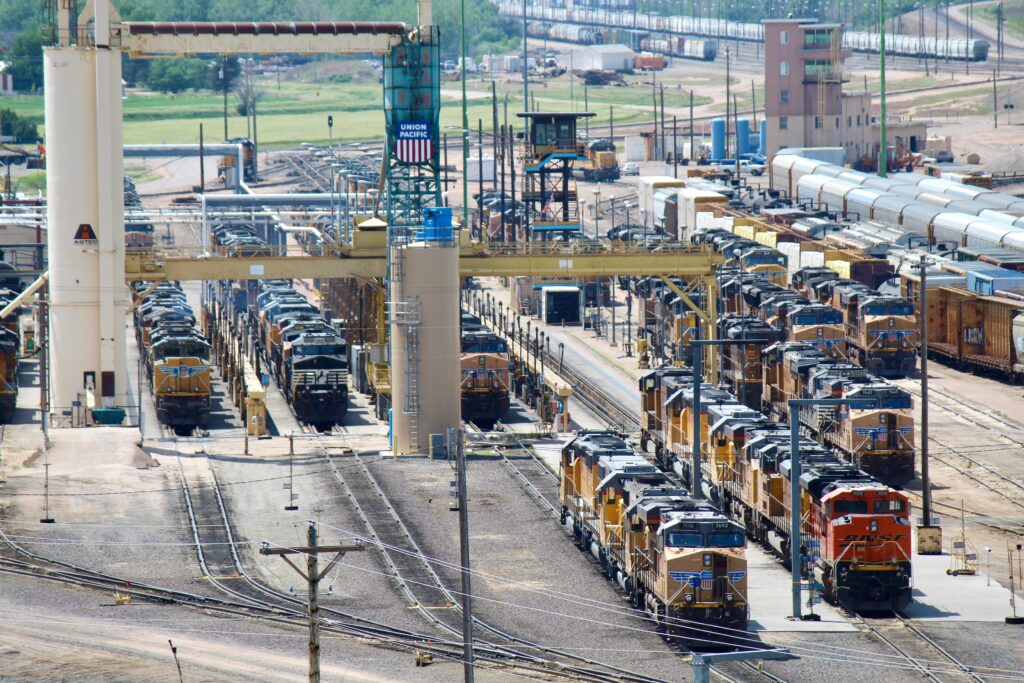
WASHINGTON — The head of the Federal Railroad Administration has questioned Union Pacific’s commitment to safety after the furloughs of shop workers who maintain the railroad’s freight cars and locomotives.
Meanwhile, the Transportation Trades Department of the AFL-CIO has asked the FRA to conduct random focused inspections at BNSF Railway in the wake of the furlough of 362 shop workers this week.
“It has come to the Federal Railroad Administration’s attention that UP has again chosen to prioritize cost-cutting measures over ensuring safe operations, jeopardizing the well-being of both UP’s workers and the public,” Administrator Amit Bose wrote in a Thursday letter to UP CEO Jim Vena.
According to Surface Transportation Board data, UP’s maintenance of equipment furloughs had been gradually trending down for more than a year, from 101 in April 2022 to just four in July 2023, Bose noted. But UP furloughed nearly 100 shop workers in August after Vena became chief executive. The number of furloughed shop workers rose to 145 in October.
“The data … demonstrates a disturbing trend that makes me question UP’s commitment to safety,” Bose wrote. “I will also note the furlough data does not include January 2024 due entirely to UP’s unprecedented decision to file a motion for a protective order on its … employment data submissions. Should that order be granted, UP will become the only Class I railroad where FRA cannot track furlough counts, further causing me to question UP’s priorities.”
The FRA has no regulatory authority over railroad employment levels. But Bose urged Vena to reconsider shop worker furloughs. In the fourth quarter, employment was up at all of the major railroads with the exception of UP.
In a written response to Bose today, Vena wrote that UP and FRA share the same goal: Ensuring that safety is always the railroad’s top priority. But Vena said there was no link between UP’s employment levels and its safety.
“I am concerned about the inaccurate correlation between natural workforce fluctuations and safety. Your letter combines different types of workers (Mechanical employees and Engineering employees) and work done on the railroad (equipment maintenance and capital projects), and therefore paints an incorrect and incomplete picture of the natural role workforce fluctuations play in operating a railroad year-round,” Vena said. “Numbers without accurate context can be misconstrued and misunderstood, and I know that is not the message you intend to send.”
Although UP’s engineering workforce declined by 700 seasonal positions in December, Vena said the railroad is confident it has enough people on hand to maintain equipment and infrastructure. As traffic demand has increased this year, UP has increased employment levels in January and February, Vena said.
The number of mechanical employees fluctuates with volume, Vena explained, while the engineering employment levels typically fall when track projects are completed. In both instances, furloughed employees are offered the opportunity to fill open positions elsewhere on the railroad, he said.
Through the first 11 months of 2023, UP’s train accident rate improved by 10% but remained the highest among the Class I systems, according to FRA data. The employee injury rate rose by 2.6%, however, and was the highest among the big railroads.
Vena said the railroad had no work-related fatalities in 2023, reduced the incidence of serious injuries by 15%, and the number of “serious derailments” declined 26% in 2023 compared to 2019 even as train length grew.
UP will continue to share monthly employment data with the FRA, Vena said.
On Thursday TTD President Greg Regan urged Bose to conduct unannounced, focused inspections of BNSF locomotives and freight cars that are at or en route to the railway’s locomotive maintenance inspection terminals.
“We have long-held concerns about numerous defects that are intentionally being ignored and neglected by BNSF because managers that are under pressure to perform work with an inadequate number of workers. These problems will only be exacerbated by the extreme Mechanical Department cuts that were callously carried out by BNSF on February 27, 2024,” Regan wrote.
Last month, in meetings with FRA officials, union leaders claimed that BNSF managers were instructing shop workers to not perform required safety inspections, to ignore the findings and reporting of defects, and to fabricate federally mandated inspection reports.
BNSF denied the unions’ claims. “We believe any presumption that BNSF is shifting its priority away from safety is inaccurate. We consider safety in every decision we make, and we strongly believe our record year in safety last year is proof of that,” spokeswoman Kendall Kirkham Sloan said. “In 2023, BNSF led the industry with the lowest number of injuries in the company’s 175-year history. Through our robust inspection processes with an emphasis on qualified training complemented by technology, we are confident operations will continue to be safer than ever as we work toward our safety vision of zero accidents and injuries.”
While BNSF’s personal injury rate improved by 23% through the first 11 months of 2023, the railway’s train accident rate increased 7.5%, according to FRA data. BNSF’s train accident rate remained the lowest of the big four U.S. systems, however.
BNSF said the voluntary furloughs announced this week were part of an effort to rebalance shop employees to locations where the railroad is seeing growth and needs more mechanical workers. The railway offered affected employees incentives to transfer to shop locations where there are several hundred open mechanical and engineering positions.



You can almost always tell who didn’t read past the headline before bigfooting into the comments. Pertaining to BNSF, it says the following:
“ BNSF said the VOLUNTARY furloughs announced this week were part of an effort to rebalance shop employees to locations where the railroad is seeing growth and needs more mechanical workers. The railway OFFERED AFFECTED EMPLOYEES INCENTIVES TO TRANSFER to shop locations where there are several hundred open mechanical and engineering positions.”
Big shot needs a pay raise. In America, its all about the money.
In Big Sandy Tx UP started changing out signals and mounted many new ones where the UP (x-T&P crosses the old x-Cotton Belt). Those signal masts have been there for about 2 years with nothing else being done to them and not operating. Looks to me they have had work waiting for someone for those 2 years and you gotta wonder if things like this are numerous. But, UP keeps laying off non train people. So, Mr. Vena here is some work just begging to be done.
Did BNSF get any of the inspection waivers that Bill Stephens was advocating for a few weeks ago? Are the layoffs related to that issue in any way? The FRA is taking note, but is only toothless hand waving to do anything about it (by design!).
We need strict federal legislation and regulations to level the playing field WRT to manning, inspection and performance standards. Wall Street has been in charge for too long and the public suffers with poor safety, abandonmens, high rates and unreliable service.
Where is Mayo Pete and Amtrak Joe? Out to lunch…
Maybe write to your Congressional Representative and Senators Gregg with your ideas? The people you’re singling out don’t have the control to do what you want. Though good luck with your Representative since the House seems to be out to lunch by proxy of the dysfunctional GOP lack of leadership.
UP’s glory days are over. That outfit has been declining for several years. Now they have Jim Vena in charge. That scoundrel will cut everything to the bone. The railroad gods can’t even help that bunch. Re-regulation is coming, I’m afraid. And maybe that is needed.
I get adjusting staff based on the market conditions, however, when your business has slowed down, isn’t that the *PERFECT* time to be doing detailed inspections? Check your fleet, check your ROW’s, check rolling stock. All can be increased to displace the reduction in traffic across the system.
Then when the business returns, you are ready to go. No waiting on rehires or return from furloughs, the system stands ready to support the needs.
Also, perhaps send your staff to training while things are slow. Improve their skills and awareness. Test them for currency and responsiveness.
I would think that would save money in the long run…..oops, I said a bad word. That is long term thinking.
“While BNSF’s personal injury rate improved by 23% through the first 11 months of 2023, the railway’s train accident rate increased 7.5%, according to FRA data. ”
This is what happens when you have to employ employees who belong to a union who hates you.
A preview of what will happen if Ancora is successful in it’s quest to restructure NS’s board and top management.
I absolutely agree. UP is afraid they are in Ancora’s sights if NSC falls through. Here we go again; Harrison’s ghost lurks from below!