





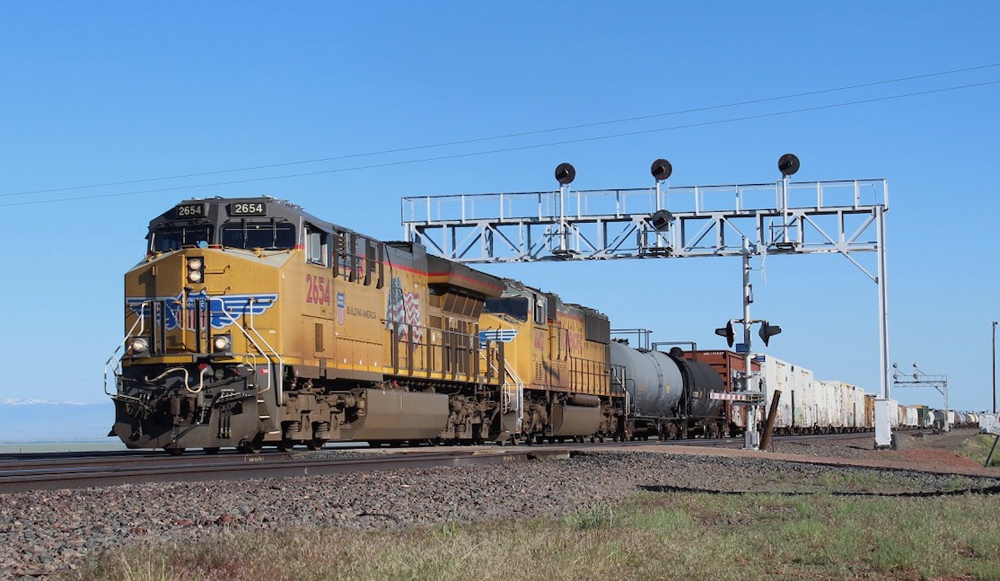
OMAHA, Neb. — Union Pacific expects to file its revised Norfolk Southern merger application in March, CEO Jim Vena said on the railroad’s earnings call on Tuesday.
The Surface Transportation Board on Jan. 16 rejected the railroads’ 6,692-page merger application as incomplete. The application, filed on Dec. 19, didn’t include enough information on post-merger market share, failed to provide the full merger agreement, and improperly addressed control of the Terminal Railroad Association of St. Louis, the board said.
“We are disappointed that the STB determined we needed to provide more information after providing close to 7,000 pages and working with them and listening to them if they needed more information,” Vena said. “But this [is a] procedural step that we’ve seen in previous acquisitions, which were ultimately approved. Let’s be clear: This does not reflect the value our combined railroad will provide America and our customers. We are confident that we will demonstrate our merger enhances competition and is in the best interest of the public.”
The railroads will file the revised application as soon as possible, Vena said, adding that he still expects the transaction to close in early 2027, assuming the board approves the $85 billion deal.
Vena also addressed the STB’s rulemaking proposal, released earlier this month, that would make it easier for sole-served carload and bulk shippers to access a second railroad through reciprocal switching [see “STB proposal…,” Trains.com, Jan. 7, 2025].
UP has the industry’s largest carload network and a dominant position in the Gulf Coast petrochemical region. But Vena says he’s not afraid of competition.
Vena spent four decades at Canadian National, which is subject to interswitching rules that allow many rail customers in Canada to access either CN or Canadian Pacific. The U.S. Class I railroads have historically opposed regulatory efforts to open sole-served customer locations to a second railroad.
“If we’re not providing service on what we agreed to, then they should be able to go to somebody else,” Vena said in an interview with Trains on Tuesday.
But he adds that reciprocal switching adds time and cost due to interchange, extra switching, and the longer transit times that require shippers to use more freight cars and have more inventory in transit. “At the end of the day, that’s a big cost,” Vena says.
UP would love to compete for traffic at locations that are only served by BNSF and CPKC, as well as locations on CSX should the UP-NS merger be approved, Vena says.
“I told the STB chair way before we got into the merger discussions that I’m not afraid of interswitching or reciprocal switching. Not at all. You have to open it up for everybody,” Vena says.
The STB has said it would take a case-by-case approach to shipper requests for access to a second railroad. But it’s not yet entirely clear how the regulatory process would work.
Vena says the devil will be in the details.
“Our regulators here in the United States, they sometimes try to make things so freaking complicated that it’s not easy to manage,” he told Trains.
“Let’s make sure that whatever happens actually improves the customer experience,” he said on the earnings call. “The worst thing you can do is have a system in place that is complicated. No one understands how the customer could win.”
— To report news or errors, contact trainsnewswire@firecrown.com.

“I told the STB chair way before we got into the merger discussions that I’m not afraid of interswitching or reciprocal switching. Not at all. You have to open it up for everybody,” Vena says.
His acceptance and understanding of reciprocal switching will make customer opposition vanish.
Well good luck with that UP. This time you better have all your paperwork because if one piece of paperwork is missing the deal is off. Do not go into merger court without missing paperwork. That’s how mergers fail.
Aaron, the deal will not be off. The STB isn’t a dictatorial organization. This is not “merger court” this is a transaction review by a federal agency. It will take as long as it takes. It took the ICC 8 years to approve the UP-Rock Island Merger and by the time they finally did that, the UP didn’t want the run-down, broken Rock Island. I don’t foresee this being an eight year review but it will take as long as the STB thinks they need and UP and NS will just have to be patient. Maybe in the meantime Ancora will become impatient and sell their NS stock and everybody can shout HURRAY! But don’t bet on it! 🙁
The first deal was rejected because they went in there without their paperwork. He must have your paperwork with you before you go in there because if anything is missing it is a deal-breaker. That is why they rejected the application.
“If we’re not providing service on what we agreed to, then they should be able to go to somebody else,” Vena said in an interview with Trains on Tuesday.”
As I see it, that is a problem. If UP chooses not to come to a reasonable agreement with a shipper, does that leave the shipper with no rail option? We know that the Class Ones wish that the smaller shippers would just go away. They may be profitable but a nuisance when the MBAs would much rather be playing with excel sheets than actually doing the work to manage a railroad.
Not just UP but ANY railroad. Including, for instance BNSF who dodn’t want to move a coal mine extra business in Wyoming because it would inconvenience the railroad. The STB and the two parties worked out an agreement but had that failed, under this concept, UP could have petitioned the STB to allow them to use the line in the Powder River to do the job. But it never came to that and that is what is important to the customer.