





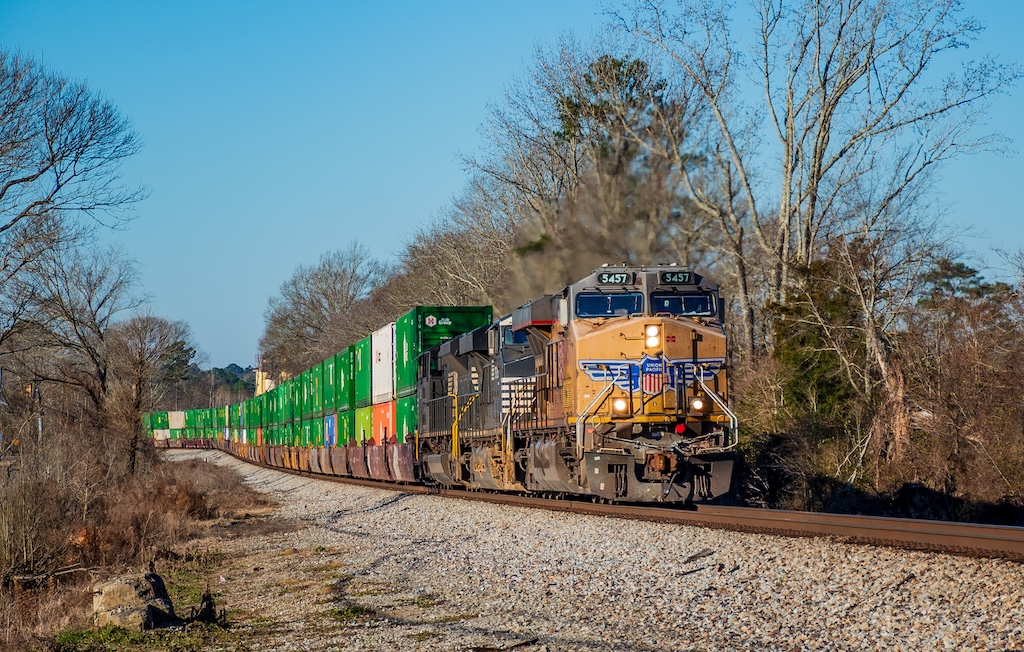
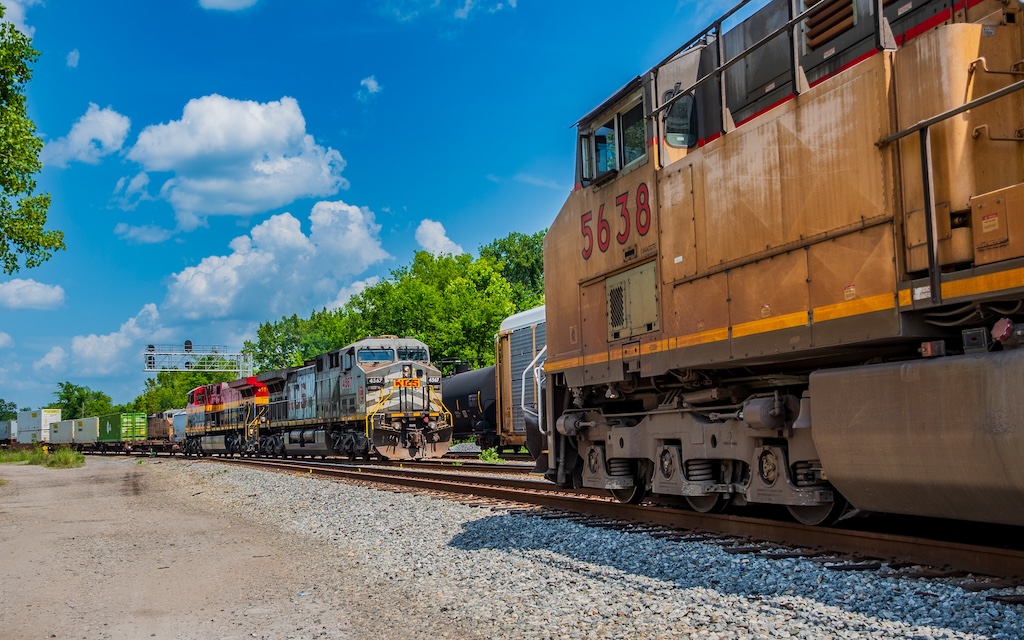
WASHINGTON — Union Pacific has repeated its call for federal regulators to open an investigation into Canadian Pacific Kansas City’s operation of the Meridian Speedway, claiming that CPKC’s handling of UP-Norfolk Southern domestic intermodal trains has deteriorated.
In a letter to the Surface Transportation Board, UP said that dwell time for its eastbound intermodal hotshot has risen at the Shreveport, La., gateway since CPKC reimposed an 8,500-foot train length restriction for traffic moving over the Meridian Speedway.
Prior to CP’s 2023 acquisition of Kansas City Southern, UP routinely handed 11,000-foot stack trains to KCS at Shreveport, which forwarded them on to NS at the Speedway’s eastern end at Meridian, Miss.
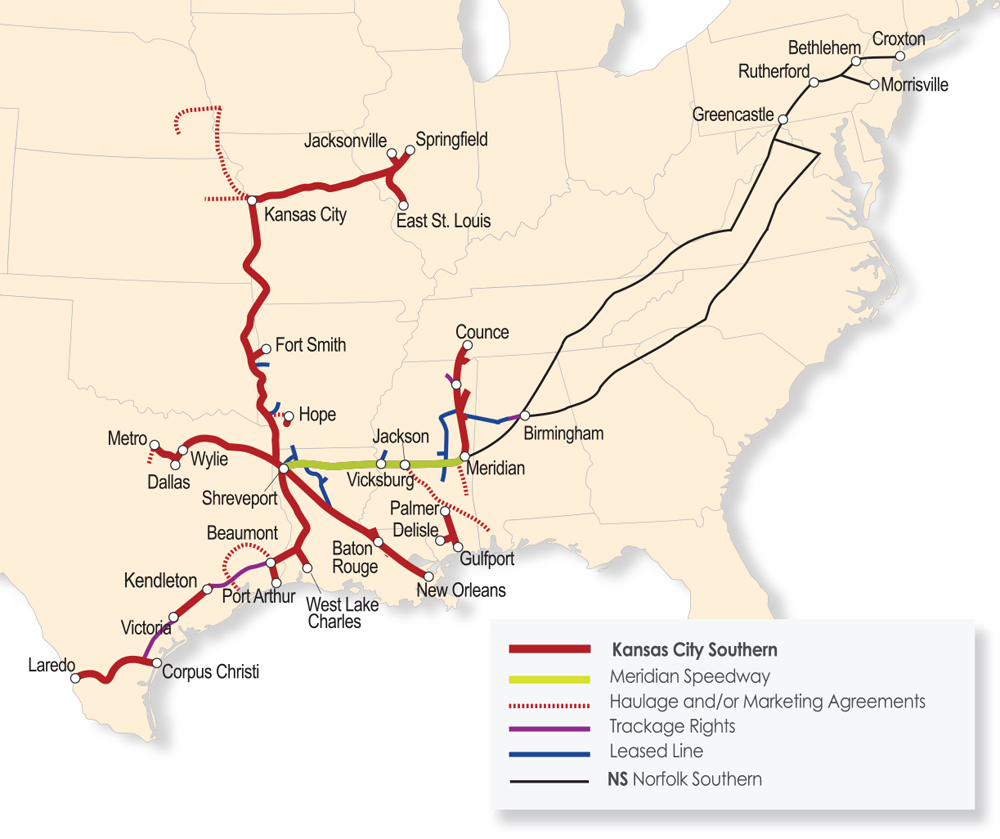
Only three passing sidings on the 320-mile Speedway can handle trains longer than 8,500 feet, which means westbound trains must hold in sidings to make way for UP’s overlength trains. CPKC CEO Keith Creel has said that his railroad’s customers should not experience delays simply because UP and NS do not want to run their train to siding length [See “CPKC disputes NS and UP complaints…,” Trains.com, Nov. 26, 2025].
“After CPKC initially imposed the 8,500-foot restriction on August 25, Union Pacific train dwell times increased from 3.5 hours to 12.5 hours. CPKC lifted the restriction on September 27, and dwell times returned to normal,” UP said in its Feb. 6 filing. “However, CPKC reimposed the restriction on November 17, and Union Pacific’s train dwell has once again increased to an average of 5.2 hours, with train dwell for the second train averaging 8.4 hours.”
But CPKC says the increased dwell is merely a reflection of UP’s decision to operate 11,000-foot trains all the way to Shreveport, where they must be separated into shorter trains before entering the Speedway. CPKC also says the trains continue to run across the Speedway on transit times that are nearly three hours faster than required under contracts.
CPKC reimposed the train length restriction on Nov. 17 after hiring additional crews to handle a second section of the West Coast-Atlanta intermodal train.
As part of its bid to acquire KCS, CP told regulators that it would continue to maintain service levels at existing gateways. “CPKC has not been meeting that commitment,” UP claims.
“CPKC’s failures have caused Union Pacific and its customers to suffer significant delays,” UP added. The railroad said that only an STB investigation could determine the full extent and causes of what it says is a decline in CPKC’s service.
CPKC disputes this and says it continues to operate trains in accordance with the Meridian Speedway agreement that NS and KCS signed in 2006. CPKC has a 70% stake in the joint venture, while NS holds the balance.
“UP’s letter is transparently designed to use Board processes to coerce a change in CPKC’s operating rules governing train length on the Meridian Speedway to further UP’s self-serving desire to send very long trains over infrastructure that was not built to accommodate them,” CPKC told the board in a filing today.
“UP’s new grievances about dwell at Shreveport reflect nothing more than UP’s unhappiness with the fact that cannot bend MSLLC [Meridian Speedway LLC] to its will. Having decided that it will continue to run very long trains all the way to Shreveport for its own operating convenience, UP is upset that it must take some time shortening those trains before they can move east across the Speedway,” CPKC told the board. “Respectfully, that is UP’s problem, not a CP/KCS merger issue, and not an issue of ‘deteriorated service’ over the Speedway. The Board should decline UP’s request to intervene here.”
CPKC says the dwell figures UP reported to the STB reflect the work UP must do to shorten its trains in Shreveport. The dwell times, CPKC argues, say nothing about the level of CPKC service across the Speedway.
“UP makes much of the longer dwell experienced by UP’s ‘second train’ (i.e., the one created when UP’s overlength train is reduced in length). This dwell similarly does not reflect any CPKC service deterioration,” CPKC told the board. “To the contrary, it is fully explained by the fact that NS agreed with CPKC that the second eastbound NS haulage train would be scheduled to depart four hours and 40 minutes after the first. UP’s supposed ‘gotcha’ — reflected in ‘dwell’ of its second train that averaged 3.2 hours longer than that of the first train — in fact simply reflects the design UP’s interchange partner implemented to handle an additional eastbound train on the Speedway.”
CPKC’s response also provided data showing that CPKC “promptly and efficiently” handles the UP trains when it receives them. “CPKC almost always departed these trains well ahead of schedule … allowing UP’s customers to benefit from more-rapid-than-planned transit times,” CPKC said.
Last fall NS and UP asked the board to probe CPKC operations on the Meridian Speedway, which had bogged down for a period after CPKC on May 3 cut over to a new computer system in former KCS territory in the U.S.
— To report news or errors, contact trainsnewswire@firecrown.com.



Why should CPKC foot the whole bill. People forget that NS bought only a 30% interest in the Meridian Speedway. With UP wanting to merge with NS, they need to pony up some bucks for improvements they want. They also should increase the stake in this route to 50% and make it a 50-50 proposition.
Don’t see this happening any time soon. If merger goes though, major portions of the NS side from Meridian through Birmingham to Atlanta need more and longer sidings and/or double tracking.
In other words, put back much of what was ripped out over the last 50 years. If memory serves me correctly Atlanta to Birmingham was mostly, if not entirely double tracked, and Birmingham to Meridian had many more sidings.
No, Keith Creel needs to make improvements to the Speedway. They Knew it was capacity constrained when they purchased KCS and basically have done the same thing there that they have done every where else: Force someone else to pay for the upgrades because frankly, after paying 32 Billion for a KCS that was in much worse shape than they anticipated, CP doesn’t have the money to upgrade the line the way it needs to be, nor will they as long “Po Boy” Creel is at the helm of CP. (Lets just call it what it is…)
The blame probably goes back to the NS only paying for 8500 foot sidings. Have to wonder about that 8500 length. One possibility is that the SOU (NS) line from BHM to Anniston has that restriction as well. The reasoning behind that is the UP take over document listed 4 or 5 major infrastructure projects on that piece of track.
Now if that is so, are the sidings BHM – ATN 8500 feet in length? Another possibility is that the track profiles are such that NS considered 8500 trains a reasonable max to prevent string lining?
Why and when did NS agree to the 4 hour 40 minute delay to dispatch the back half of the long trains. I would imagine the front half could just pullup enough to allow an EOT to be applied and brake tested. Then as soon as front section pulled away a loco(s) then attached to back section and necessary brake test. Maybe CPKC wanted to spread out crew starts?
Another problem is where interchange takes place. Maybe UP has to pull the back section to the crew exchange location? Last time I checked the track on the UP connection to KCS is 10 MPH non signaled industrial trackage which UP would want to stay clear as much as possible.
That track section will be a real hinderance for any future passenger train DFW – Meridian.
Siding lengths in the future may be a problem for both CPKC now and UP after the take over of NS? At least 2 new Schneider trains from Fairburn (ATL) to the M&B line were over 8500 feet apparently going to the Speedway. Although not part of the UP application both RRs may need to make further improvements to the Speedway???