





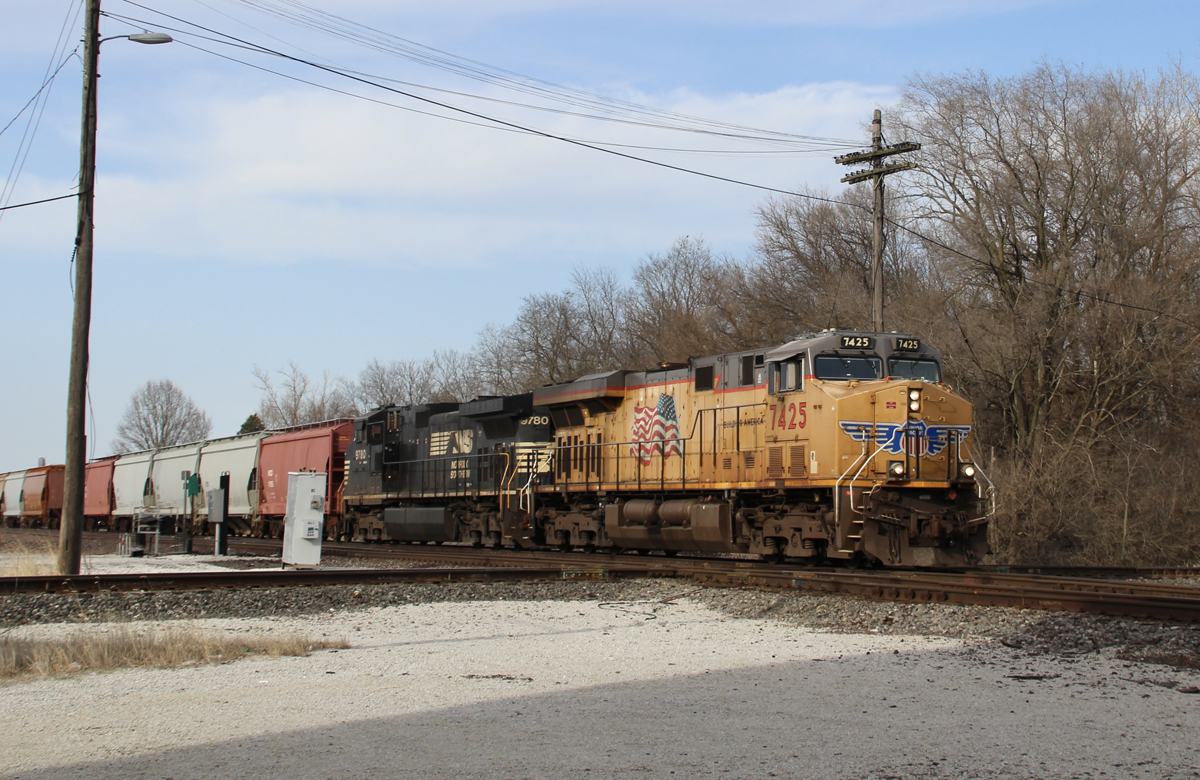
OMAHA, Neb. — A Union Pacific-Norfolk Southern merger will lead to higher daily train counts on some key corridors as the railroads tie their networks together, eliminate interchanges, and take shortcuts to avoid Chicago and other gateways.
The railroads’ merger application, filed with the Surface Transportation Board on Dec. 19, details projected traffic increases on UP and NS routes that link California with the Ohio Valley and Northeast, as well as routes connecting California, Texas, and Mexico with the Southeast.
To support projected overall volume growth of nearly 12%, UP will invest $507 million in mainline capacity projects that add short sections of double track, extend passing sidings, and install new turnouts that permit faster speeds in and out of sidings.
The winners for new traffic?
On Norfolk Southern, the former Southern Railway main line from New Orleans to Atlanta, the former Wabash from Kansas City to Detroit, and the former Lehigh Valley across New Jersey will see the biggest gains. On Union Pacific, the former Southern Pacific Sunset Route and the former SP/Rock Island Golden State Route from Southern California to Kansas City will see the most meaningful increases in average daily train counts.
Should the merger gain regulatory approval, UP aims to launch six new pairs of daily premium intermodal trains — which will carry much of the projected merger-related traffic growth — plus new merchandise trains that will originate and terminate deep within the UP and NS networks so that they can run through traditional gateways like Chicago, St. Louis, and New Orleans.
New Orleans—Atlanta—Northeast
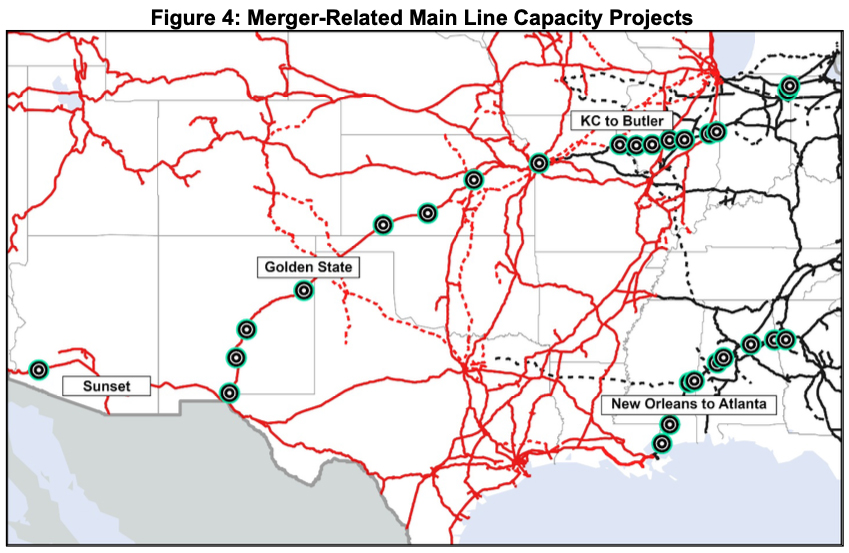
At New Orleans, UP and NS will tie together the Sunset Route and the former Southern Railway main line, creating a single-line route linking Southern California, the Gulf Coast, and points in Mexico with the Southeast and Northeast.
New trains on the Southern will flow from UP origins toward Atlanta through both New Orleans and Meridian, Miss., the eastern end of the CPKC-NS Meridian Speedway joint venture. The 302-mile Speedway, which CPKC operates, connects with UP at Shreveport, La., and is the shortest route linking the Southwest and Southeast.
Among the new trains: Three pairs of intermodal hotshots. They include the Southern California-Southeast pair ZIEJX/ZCTLB via the Meridian Speedway; ZMXCX/ZCSMX linking Port Laredo, Texas, with Croxton, N.J., via New Orleans and Atlanta; and Houston-Atlanta ZHOAT/ZATHO, which will run via New Orleans.
The Southern California-Atlanta traffic currently runs via the Memphis gateway. Sending the ZIEJX/ZCTLB trains via the Meridian Speedway will shave 123 miles and 70 to 95 hours of transit time, according to the application.
A new pair of merchandise trains also will run in the Southeast-Gulf Coast corridor to bridge the current east-west divide. The first is Livonia, La.-Chattanooga, Tenn., MLINSC, which will carry freight from the Gulf Coast to DeButts Yard in Chattanooga, where the traffic will be classified for points in the Ohio Valley and Northeast. The second, MBHEW, will link Birmingham, Ala., with Englewood Yard in Houston.
The average number of daily trains on the single-track Southern will rise to 12 from the current nine between New Orleans and Meridian; to 25 from 16 between Meridian and Burstall, Ala.; to 36 from 26 between Burstall and Birmingham, Ala.; and to 25 from 14 between Birmingham and Austell, Ga., which is on the outskirts of Atlanta and is home to one of Norfolk Southern’s busiest intermodal terminals.
A wild card in the Meridian-Austell train count is whether CPKC will continue to limit trains to 8,500 feet, which matches the prevailing siding length on the Meridian Speedway. If so, UP will split eastbound trains into two sections at Shreveport for the trip to Atlanta, and combine westbound trains at Shreveport for the trip to the West Coast.
UP plans on making $172.3 million worth of capacity improvements on the former Southern from New Orleans to Atlanta, including eight siding extensions as well as a stretch of second main track around Meridian.
L.A.—Kansas City—Northeast
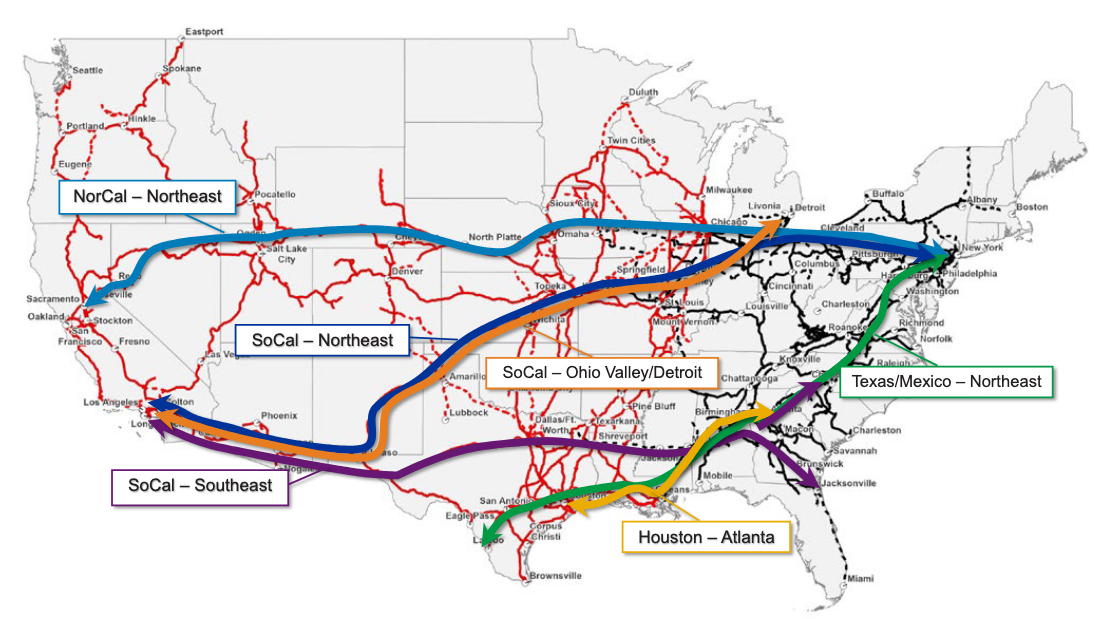
UP and NS aim to create a shorter, faster single-line route from Southern California to the Ohio Valley and Northeast via Kansas City. The railroads will join UP’s Los Angeles-El Paso, Texas, Sunset Route and the El Paso-Kansas City Golden State Route at Kansas City with Norfolk Southern’s former Wabash line to Detroit. In Indiana the Wabash connects with a pair of NS routes to the Northeast: The single-track former Nickel Plate at Fort Wayne and the double-track former New York Central at Butler.
The result: A route that bypasses Chicago, the busiest gateway between the Eastern and Western railroads. The Wabash, via a connection with UP’s former Missouri Pacific at Sidney, Ill., also will become a route for Gulf Coast traffic that originates on UP and is destined for points in the Ohio Valley and Northeast.
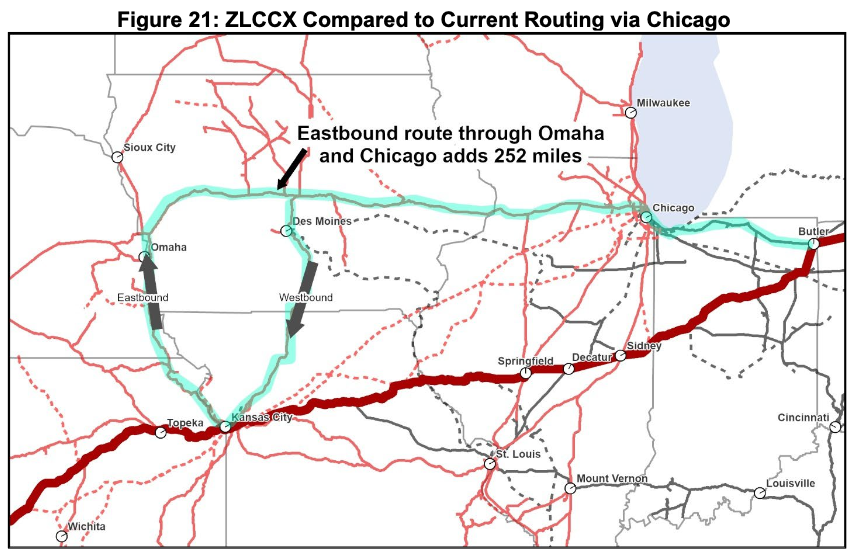
UP plans to launch new premium intermodal train pair ZCICX/ZCXCI linking Southern California and the Northeast via Kansas City. This traffic currently moves via Chicago — and some of the containers make crosstown rubber-tire moves between UP and NS intermodal terminals in the Windy City.
“The new routes will be as much as 252 miles shorter than the current interline routing and will save approximately 17 hours of transit time eastbound and 19 hours westbound for approximately 435 containers per day,” according to the application.
The Sunset/Golden State/Wabash route also will gain a Z-train linking Southern California and Detroit, ZLCDT/ZDTLC. The Motor City, which is a roughly 280 mile drive from Chicago, currently is a major drayage lane for intermodal shipments originating or terminating at points west of Chicago.
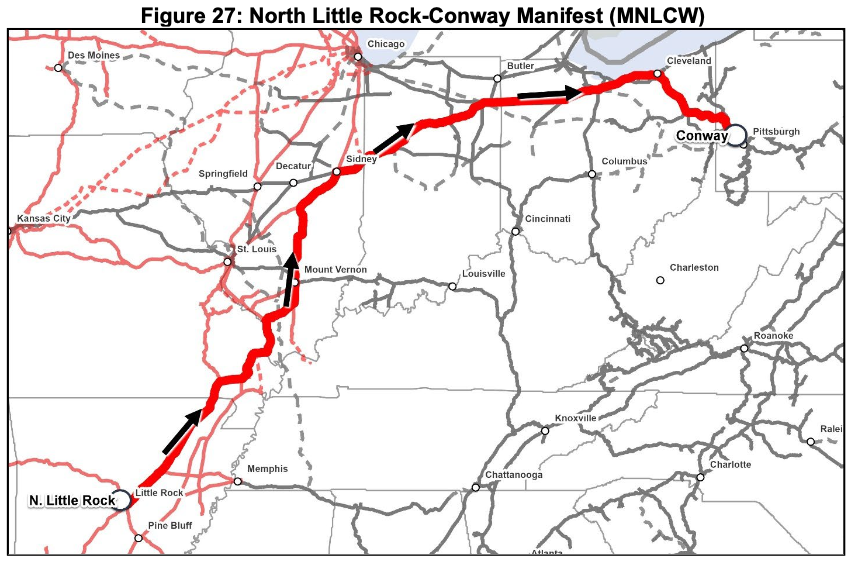
UP also will launch a manifest train linking North Little Rock, Ark., with Conway, Pa., carrying traffic for Detroit; Bellevue, Ohio; and Conway, which is just west of Pittsburgh. The train will use UP’s line via Salem, Ill., and the NS line via Sidney, Ill. From Sidney it will run to East Wayne, Ind., junction with the former Nickel Plate, then on to Conway via Cleveland.
“The new route will be approximately 41 miles shorter than the current interline route from North Little Rock to Conway through East St. Louis and, each day, reduce one or two handlings on approximately 80 cars launched out of North Little Rock,” UP and NS say. “In addition, the new train will eliminate multiple car touches in the St. Louis gateway. In total, the North Little Rock-Conway train will help reduce approximately 144 daily handlings for traffic moving from Texas, Louisiana, and Arkansas to Michigan, Ohio, Pennsylvania, and New Jersey for traffic that UP and NS currently interchange in East St. Louis.”
UP has earmarked $127 million for capacity improvements on the Sunset and Golden State routes.
Between West Colton, Calif., and El Paso, the Sunset Route will see 36 trains per day, up from 30. In Arizona, UP will add 3.9 miles of second main track to link Mohawk and Stoval sidings on the Gila Subdivision.
The Golden State Route will receive six siding extensions along with a yard bypass track at Herington, Kan. Although UP envisions boosting the daily train count modestly, to 17 from 14, train length will balloon. The number of 14,000-foot trains will jump to 14, up from nine, as existing trains absorb traffic growth.
Portions of the Wabash will see up to seven additional trains per day. The average number of daily trains will rise to 19 from the current 15 between Kansas City and Moberly, Mo.; to 13 from 10 between Moberly and Decatur, Ill.; to 29 from 22 between Decatur and Bement, Ill.; to 25 from 19 Bement-Lafayette, Ind.; to 23 from 17 between Lafayette and Peru, Ind.; to 20 from 15 between Peru and Fort Wayne, Ind.; and to 14 from 10 between Fort Wayne and Butler, Ind., junction with the NS former New York Central Chicago Line; and to 13 from 11 between Butler and Detroit.
To handle the additional traffic, UP will invest $136.6 million in capacity projects between Kansas City and Butler. The Wabash will receive a new connection in the Kansas City area, five passing siding extensions, a second main track through the Decatur terminal, speed improvements at the Mississippi River bridge at Hannibal, Mo., new crossovers, some short sections of centralized traffic control, plus positive train control between Bluffs, Ill., and the Kansas City area.
The flow of traffic from the West Coast and Mexico will boost train counts on the NS Lehigh Line across New Jersey to two dozen per day, up from the current 17.
Gateway Bypass Trains
UP says it also aims to add four other merchandise trains that will run through current gateways. They include an Elkhart, Ind.-Boone, Iowa train pair that will reduce handlings in Chicago and a Chattanooga-North Little Rock, Ark., train pair that will run through Memphis.
In addition, a new premium intermodal train pair will link Northern California and the Northeast via Chicago. The ZLTCX/ZCXLT will run between Lathrop, Calif., and Croxton, N.J., via Ogden, Utah, North Platte, Neb.; Toledo, Ohio; and Harrisburg, Pa.
The rationale for the merger is to provide seamless service from coast to coast, which will eliminate the friction, delays, and costs associated with interchange — which, in turn, will lead to traffic growth.
“UP and NS currently interchange traffic at the mid-continent gateways of Chicago, St. Louis, Kansas City, Memphis, Shreveport, and New Orleans. In 2023, the two railroads interchanged approximately 1,637 cars of manifest traffic, 1,648 containers of intermodal traffic, and 122 cars of bulk shipments per day,” the application says.
UP and NS assume that 40% of the combined system’s traffic gains will be realized by the first full year after merger implementation, reaching 70% by year two, and 100% by year three.
— To report news or errors, contact trainsnewswire@firecrown.com.



UP does seem to know that NOL – ATL will need much work as count of 9 improvements on that segment alone. Still look for ATL north.
One more problem for UP is the NS Whitaker yard. It is located north of Austell, Ga. on the line to Chattanooga. At present any traffic to/from BHM will require a backup move to/ from the yard instead as there is no direct connection with a wye. A wye will require a lot of expensive real estate.
Some up grades not really mentioned are at the Shreveport UP’s connection to KCS. That excepted track that has many spurs to business. Then there is the CPKC track from there to Meridian. That joint owned track will take tough negotiations with CPKC for who pays what to fund the necessary additional siding and expansions to existing sidings to at least 15k feet. The Jackson, MS crossing of CN definitely will need some work to enable the long freights to pass quickly. Vicksburg have no idea with some track 20 MPH.
Then there is the at grade 2 NS crossing of CSX mainlines in Birmingham and CP Howell in ATL. Amtrak lately has not taken many delays but the great increase in freights may be another problem for both UP and Amtrak.
No where does it talk about accommodating more passenger trains if requested by the states or Amtrak. This merger should be approved only if UP/NS agrees to allow passenger trains on their tracks without asking for a kings ransom to fund whatever additional work needs to be done to accommodate these trains. This additional work should allow for passenger trains if requested.
Restoration of a portion of the National Limited and direct Texas to east coast service along with Lehigh Valley service to NY should part of this merger approval.
If the new trains are so great, why don’t they run them right now? Oh yeah, agreements between railroads don’t work well but takeovers do!
The NS route from NOL ATL is going to need a lot of work. Right now the Crescent takes very few totaling delays south of ATL. So, usually arriving NOL and ATL on time. However, there will be some major glitches once UP initiates this plan.
Laurel, MS northbound, Tuscaloosa southbound. Northbound to TCL almost an hour make up times is available. The BHM Anniston route is slow and many delays there. Anniston to Austell for IMs that will go north to the NS IM yard will need a lot of work. Then again, the CP Howell crossing CSX at grade can cause a lot of delays for NS freight now and delaying Amtrak as well.
From the GA – SC border to south of CLT is another slow sections with 30 & 40 mile track speeds that can really tie up everything due to slow speeds between present siding and future ones as well. Oltmann has posted the speeds but with as much potential traffic no way for high value freight or Amtrak to be delayed.
Actually it may be said that Stuart Saunders’s (president of the Norfolk and Western and later Chairman of the Pennsylvania) idea keeps looking better every day. He had initiated a proposed merger of the N&W (then majority-owned by PRR) and the Nickel Plate. However the N&W didn’t connect with the NKP, and the N&W+NKP merger would put the Wabash (another PRR majority-owned railroad) at an extreme disadvantage. In the background was the prospective merger of the PRR and the New York Central. The solution was to add the WAB to the N&W+NKP combination which cleared the way for PRR+NYC.
A merchandise train to Boone, IA? Boone is a division and crew change point on the former CNW Overland route, and it does have a yard, but otherwise, it’s very isolated. Just trek on down the Spine Line to Des Moines and use Short Line Yard, which is bigger, not to mention significantly more populous. I guess they have their reasons.
Needless to say, banking on more trains becoming 14,000 ft in length will be a losing strategy. At best, it slows everything down enough that predicted traffic gains don’t materialize. At worst, it strains crew bases to the point of meltdown or becomes a public safety hazard (think more large derailments). Either way, it casts some doubt on whether UP is really serious about adding value against trucks as a single-line carrier.
I’m still hoping enough noise to set a maximum train length is made at the state level to get the feds to act.
The long-term goal for freight trains has always been longer trains, faster trains, fewer trains. Of late the ersatz PSR club has achieved longer and fewer. Faster cannot be achieved without investment and ideally significant investment. Slower trains leads to declining service. Declining service leads to fewer customers, and so on. Ultimately the adult in the room has to call out the railroads and pin their ears to the wall: “Explain to me how what you’re doing is in the National Interest.”
The Nickel Plate acquisition of the Wabash keeps looking better every day. That said, there is nothing here requiring a merger. Back in the days of the ICC rates were set according to mileage (amongst other things). As such railroads prioritized minimizing the distance. We got away from that with Stagger’s and thus lost efficiency in favor of line rationalization. You can only tear out so much track and still run a railroad.
Now we’re starting to see some sensible comments out of Omaha. (1) The Wabash is a key route. (2) Traffic needs to bypass south of Chicago. and (3) — as noted by other people commenting on these pages —– the Southern Railway main New Orleans to the northeast isn’t up to the task and needs an upgrade.
What is missing from this map (because the tracks are missing). (A) Columbus to Conway via Newark, Ohio. (B) The former Rock Island east from Oklahoma. (C) Routes through Lima, Ohio, Erie and NKP.
Now, to continue.
Lots-o-east-west talk. The only north-south proposal involves the twin black holes of Houston and New Orleans. CPKC should be screaming bloody murder about anything involving Houston. Fixing Houston and New Orleans to make them bulletproof fluid will be expensive. Is the juice worth the squeeze?