





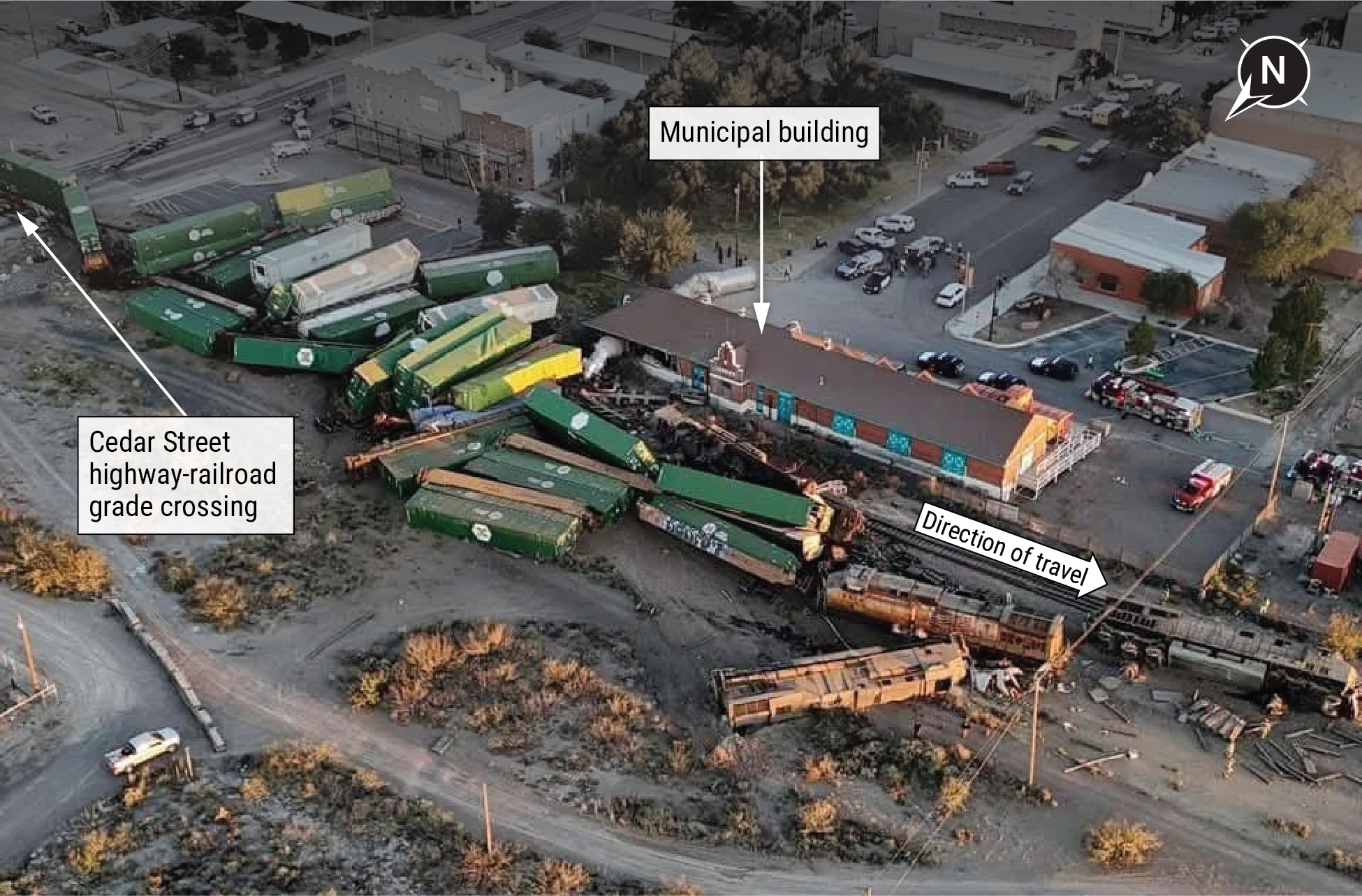
PECOS, Texas — The heavy haul trucking company whose rig was stopped on a grade crossing and struck by a Union Pacific Z-train a year ago, killing the train crew, has filed a lawsuit against the railroad.
The countersuit, filed last week by Boss Heavy Haul and Optimized Process Designs in Reeves County District Court in Pecos, blames UP and the train crew for the Dec. 18 collision.
“Union Pacific is responsible for the disastrous December 2024 train crash at the Cedar Street grade crossing in downtown Pecos … that underlies this action. Among other wrongful conduct, Union Pacific recklessly maintained the Crossing as a dangerous ‘humped crossing’ with steep inclines, while knowing that the Crossing daily experiences heavy industrial traffic and was the site of a 2019 crash between a Union Pacific train and a truck-trailer,” the countersuit claims. “And in the moments leading up to the December 2024 crash, the Union Pacific train crew inexplicably failed to take any measures to stop or slow the train until it was only one-quarter of a mile away from the Crossing, even though the crew had a clear view from over a mile away of a specific and individualized hazard: BOSS’s oversized load that was over 15 feet in height and flanked by a police escort and two pilot cars with flashing emergency lights.”
The load, a demethanizer tower used in the oil and gas industry, was being transported from Houston to Mentone, Texas, a town in the Permian Basin oil patch 23 miles north of Pecos. The tower was 12 feet wide, 116 feet long, and weighed 91,000 pounds, according to the National Transportation Safety Board’s preliminary report.
The truck was stopped on the crossing for one minute before train ZAILA-18, a Shreveport, La.-Los Angeles hotshot, struck the 2015 Peterbilt truck-tractor in combination with a 2016 Scheuerle hydraulic platform semitrailer that was carrying an oversized load, the NTSB said.
Engineer Clay Burt and conductor Phillip Araujo were killed in the wreck. A review of one of the locomotive data recorders showed the train had been moving at 68 mph before the crew initiated an emergency brake application shortly before the collision. The train was moving at 64 mph when it collided with the truck. The maximum authorized track speed in the area is 70 mph.
“At Union Pacific, we take both safety and federal regulations seriously. The speed of our train, along with the timing of the crossing signal, was in full compliance with federal regulations. The crossing, which handles a high volume of truck traffic daily without incident, was also safe,” railroad spokeswoman Kristen South said in an email. “The tragic incident that claimed the lives of two Union Pacific employees could have been prevented if the trucking company had taken the necessary precautions to coordinate the route and the movement of its oversized load and notified Union Pacific in advance. They also should have planned and scouted the route and the attributes of the particular crossing prior to the trip to determine if its oversized load could safely negotiate the crossing.”
The trucking company said that neither the truck driver nor the police escort or front and rear pilot drivers saw or heard any indication of an approaching train when the truck proceeded slowly through the crossing to avoid getting hung up on the hump, according to the countersuit.
The suit alleges that the UP crew was negligent when it failed “to stop or slow down,” and claims that positive train control data logs “appear to demonstrate that the train was provided a ‘restricted proceed’ signal during the 73 seconds leading up to the accident, beginning when the train was approximately 1.5 miles away from the crossing.”
A restricted proceed indication would have required the crew to not exceed 20 mph while being able to stop within one-half the range of vision.
The grade crossing, the countersuit says, lacks signage warning of low ground clearance despite the presence of gouge marks from vehicles that had struck the inclined pavement.
The trucking company also argues that the crew would have survived if they had taken refuge in the nose of their GE C45AH locomotive.
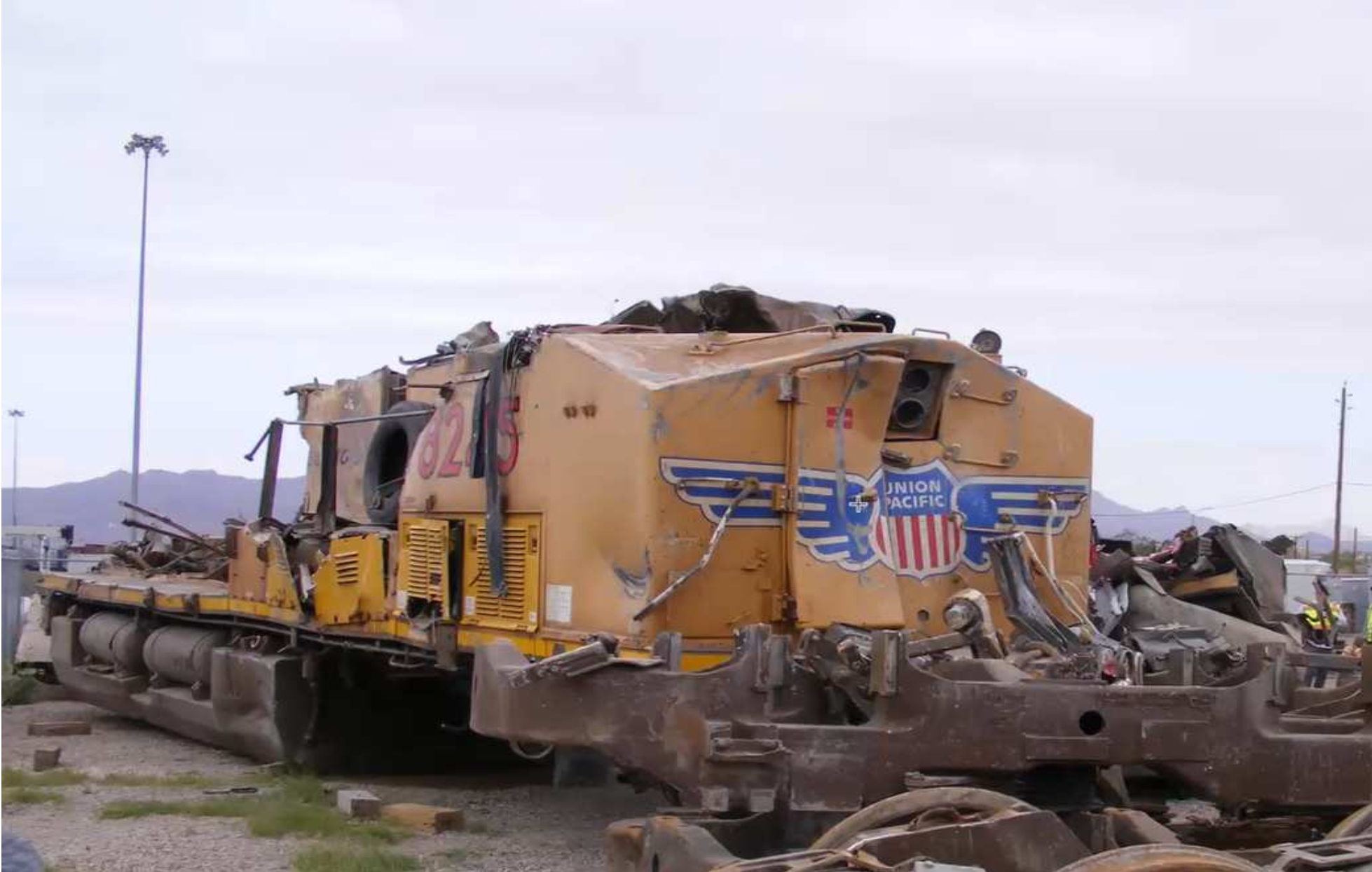
“Post-accident analysis of the nose found that it was intact, including the collision posts installed to help maintain its structure in the event of a collision,” the trucking company alleges. “This analysis is confirmed by the following picture of the nose after the Collision, which demonstrates that it absorbed the impact of the Collision remarkably well, whereas the locomotive’s cab (where the engineer and conductor remained) was entirely destroyed.”
The trucking company also alleges that UP took no action to alter the crossing after a 2019 collision between a train and a tractor-trailer.
The NTSB said its investigation is focused on “site modeling, accident data analysis, highway railroad grade crossing safety, locomotive cab survivability and crashworthiness, and carrier requirements for traversing grade crossings while transporting oversize loads.”
The agency’s final report has not yet been released.
Union Pacific and the crew’s families have filed suit against Boss Heavy Haul, Bennett On-Site Services, Cowboy Services, Bennett International Group, and Bennett Motor Express, as well as the driver of the truck, Jason Wayne Melius.
— To report news or errors, contact trainsnewswire@firecrown.com.



BOSS is just trying to save face instead of accepting responsibility for not notifying the railroad per the signs at the crossings and per the permit they had to secure to move the load by the State which details how it would cross all train tracks and operate in those areas. Had they kept UP dispatchers informed via the hot-line this accident would have most likely been avoided and the two trainmen would still be alive…
A lawyer will say anything in the world if you pay him to do it even if he knows its a bunch of crap.. And his thought is “gee we might get lucky” and find some jury to place 60% negligence on the railroad which would knock down 40% of a unfavorable verdict. But you never know about juries. If my memory is worth a flip I think verdicts on these crossings with lights go against trucking companies..
“The oversized deceased permit officer” would imply the officer was oversized, but “The deceased oversized permit officer” to me reads that the officer was responsible for issuing permits for oversized loads although there is some ambiguity. Also devout Lutheran could be ELCA, LCMS, WELS or LCMC.
PTC will not allow a train to run on a restricting signal at track speed for 73 seconds. PTC would have gone into braking around five seconds after the restricting indication was displayed. Someone isn’t doing their homework.
You would think that a professional organization would preview the route to identify hazards. The fact that the load was escorted by police, begs the question of the professionalism of the trucking company. Even I know many crossing are elevated and prone to “High centred” loads.
I think there is insurance issues at hand, a professional trucking company specializing in oversized loads should have previewed the route to identify hazards and provide data gap analysis.
The picture of loco after the crash, sure demo’s the crash safety cab effectiveness. endmrw1212251335
“Among other wrongful conduct, Union Pacific recklessly maintained the Crossing as a dangerous ‘humped crossing’ with steep inclines”
Well if they knew the crossing was dangerous and had a hump, then why did the a$$holes from BOSS continue to cross? That’s reckless.
I hope they go under.
Andy: Please reread the article (I just did). Can we believe the statement regarding PTC? (ppg 9 and 10) endmrw1212251337
So do the countersuit lawyers not understand that the crossing flashers don’t come on till 20-25 seconds before? Yes, the crew likely saw the truck, but they knew the crossing flashers aren’t on yet so wouldn’t expect it to be moving out of the way till 15 seconds before.
That is a correct assessment of how the crew would have seen it. However, you have to remember that it’s the job of an attorney to put doubt into the minds of the jury. I’m sure they’ll be questioning whether the 20-25 second activation time is sufficient.
Remember: they don’t need to be right…they just need to be persuasive.
Texas….pretty much explains the cause.
I understand that a countersuit is a legal tactic, but it seems particularly harsh to go after the crew like the trucking firm’s lawyers are in this case. It is horrible to think the crew had just a little over a minute to figure out if there is anything they could do to save themselves and others. Now, some lawyer with all the time in the world second guesses those horrible last moments from the comfort of their office and litigates it in front of the world so the families can relive the pain.
Peter: You are “dead on”. Just like a police officer has a split second to make a decision, while the court and lawyers can take hours, days, months,……years? To decide what the officer should have done. Sad, and these poor folks are just doing their job the best they can to protect us. endmrw1212251338
If the trucking company is correct and the PTC recorder displayed “restricted speed,” why didn’t PTC apply the braking immediately?
James: 12/9/25 Very interesting question. Wonder what the answer is? Considering there is no “perfect” answer to safety. BUT, there was a lotta money spent and if the article reporting is correct…..da….PTC said 20mph, be on visual lookout forward. SO, what’s the deal? Who can answer James? Most excellent question James. endmrw1212251339
While federal rules, regs and law certainly play their role, grade crossings are also subject to state law. I have no idea how Texas law works, but in New York the railroad is responsible for maintaining the crossing surface itself extending only a few feet to either side of the track. The railroad has no responsibility for the geometry of the highway beyond that very limited distance; the responsibility lies with the highway agency, be it state, county or municipality.
There is one way in which the railroad can cause a problem: when the railroad comes through with track maintenance work, the track level is often raised, up to several inches sometimes, and that can create a hump profile for the highway; this would be the only case where the railroad would have any responsibility and that would be not to feather out the highway approach but to notify the road agency that they need to take care of it.
Every state DOT should have on the permit saying must call the number on the blue plate before crossing any RR crossig. As well any low boy that has to cross humped crossing.
Crossing has been there for 100+ years, but yeah suddenly it’s a problem. Most likely the trucking knows they are the liable party and is trying to sue to avoid paying damages themselves.
This is a case of murderers suing their victims.
Why do we even need to comment? The article itself raises all the points which are in favor of UPRR and in opposition to the trucking company.
First off, as has been pointed out on these pages, training for a CDL includes training for spotting humped railroad crossings.
Secondly, the trucking company moving this sort of equipment is supposed to scout the route in advance, as UPRR pointed out in its response.
Thirdly, the police escort and the highway permitting authority for the oversized movement both had their heads straight up their bums with their eyes closed in addition.
May he rest in peace, the deceased oversized permit officer for Wisconsin DOT Waukesha District (Metro Milwaukee) was a serious railfan, a volunteer motorman at East Troy Electric Museum, and a devout Lutheran. He must be vomiting in his coffin.
Charles: As a devout commentor, Charles, could I suggest a better wording of your postscript, reference 12/8/25 …….The oversized permit officer in WI. DOT, may he rest in peace. Due to his……… He must be……
As it is, the insulation (I’m positive, NOT intended) of the deceased was that he was very rotund. endmrw1212251340