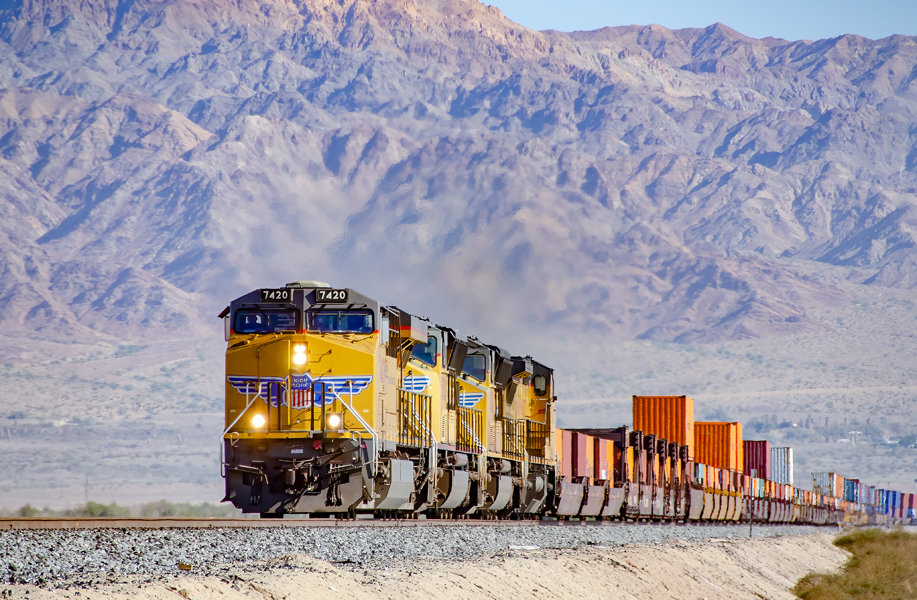
QUINCY, Mass. – RailState, which tabulates rail traffic using a network of sensors placed on public property along main lines, last week provided a snapshot of long trains rolling along BNSF Railway and Union Pacific in the Southwest.
The longest train RailState spotted over a 10-day period this month: A five-locomotive UP stack train carrying 506 containers in its 280 well cars. It was estimated to be 20,000 feet long, or 3.7 miles, when it passed the RailState camera at Wellton, Ariz., on the Sunset Route’s Gila Subdivision.
BNSF’s longest — a stack train with six locomotives, 229 wells and 440 containers — came in at an estimated 16,800 feet. RailState spotted the train roll by its camera at Getz, Ariz., on the Southern Transcon’s Seligman Sub.
Train length has become a hot button issue as Class I railroads move their freight on fewer but longer trains. Rail labor leaders claim long trains are inherently unsafe, while railroads say they’ve been running long trains safely for years. Not much data has been available on train length and derailments, however, and a National Academies of Sciences, Engineering and Medicine study on trains longer than 7,500 feet is due out soon.
“We believe that better data on all train movements will provide policy makers and researchers with better tools to evaluate risks and make more informed decisions to ensure a safe and efficient freight rail system,” RailState wrote in a blog post last week.
A recent study, by researchers from Brigham Young University, Georgetown University, and Virginia Tech, analyzed Federal Railroad Administration rail equipment accident data from 2013 through 2022 and concluded that a 200-car train is 24% more likely to derail than a 50-car train, even when factoring in the impact of the reduced overall risk that comes from moving freight on fewer but longer trains.
Rail safety experts questioned the study’s novel methodology, as well as the fact that it did not screen out derailments where train length was not a factor, such as those involving wheel bearing failures.
In RailState’s tally, UP also ran at least nine trains that were over 18,000 feet long. All of them were intermodal trains, with the exception of one stack train that also included a block of auto racks and flat cars. The longest UP manifest train RailState spotted contained 223 cars, five locomotives, and was estimated to be 14,000 feet long.
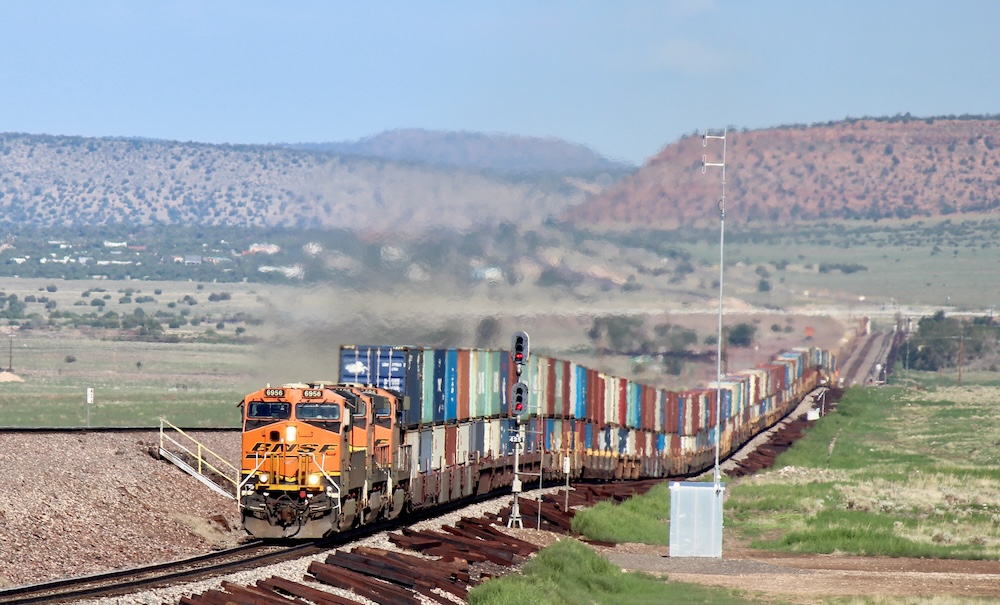
BNSF also ran several intermodal trains that were between 11,000 feet and 15,800 feet, according to RailState data. The longest BNSF manifest train, which combined a unit train of tank cars with a merchandise consist, came in at 201 cars.
“These are just some examples of real trains moving across the U.S. rail network every day. Long trains are increasingly common and if policy makers want to get serious about understanding the risks, they need to get serious about having real data on what kinds of trains are moving,” RailState wrote.
Based on data released in quarterly earnings reports, UP has the industry’s longest average train length. “Union Pacific must be able to serve its customers, moving their products and goods in a timely manner and, most importantly, do so safely,” spokeswoman Robynn Tysver says. “Trains with more rail cars result in fewer trains operating on the system at any given time, reducing the potential for employee injuries and derailments, as well as the opportunity for train-vehicle collisions and blocked crossings.”
RailState also offered statistics on train counts on the Sunset Route and Southern Transcon, and broke down the traffic by type.
UP averaged 14 trains per day in each direction, with 61% intermodal, 26% manifest, 6% automotive trains, and the remainder a mix of grain unit trains and Amtrak’s triweekly Sunset Limited.
BNSF averaged 31 trains per day in each direction. The train volume was 70% intermodal, 15% manifest, 5% automotive trains, and the remainder a mix of grain unit, tank car unit, and Amtrak’s daily Southwest Chief.
Share this article