





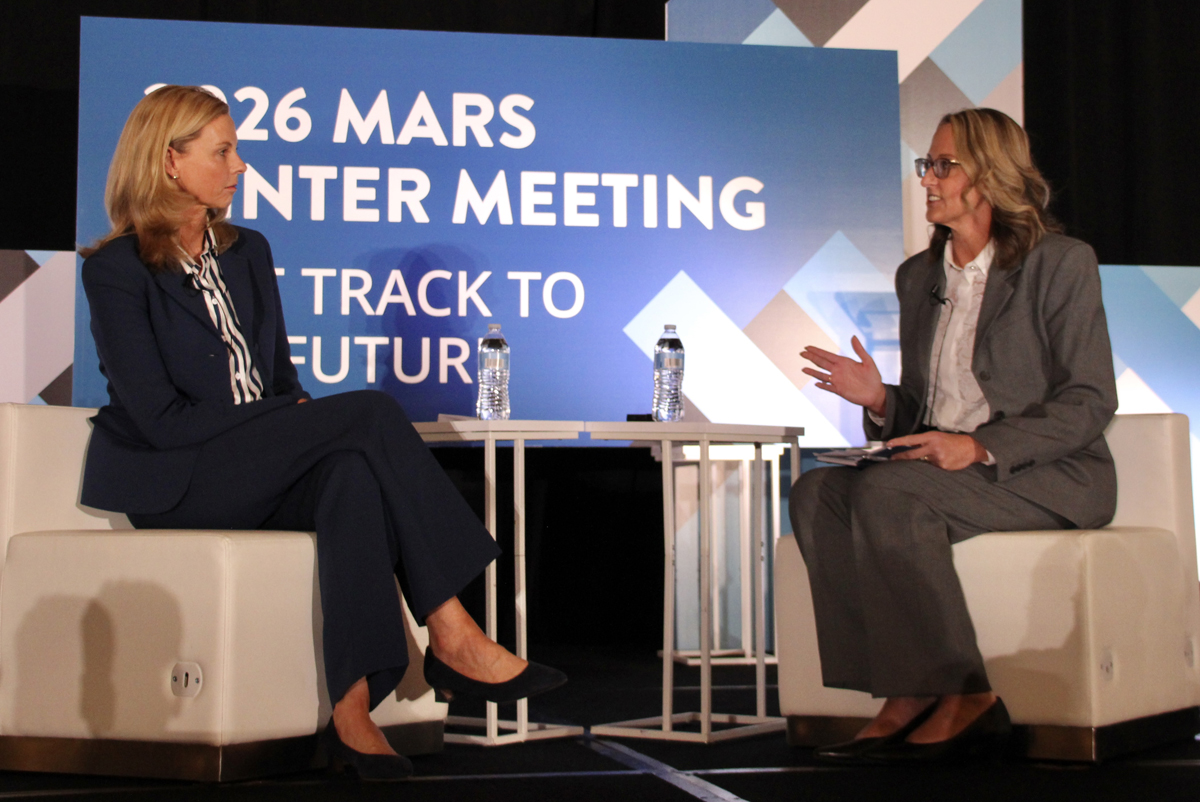
SCHAUMBURG, Ill. — BNSF Railway CEO Katie Farmer still doesn’t see further rail industry consolidation as inevitable if a Union Pacific-Norfolk Southern merger is approved.
Just the fact that the topic keeps being discussed could be taken as an argument against the merger, Farmer said in a conversation with Trains prior to her appearance today (Jan. 14) at the Midwest Association of Rail Shippers winter meeting.
“I can only tell you from BNSF’s perspective that our owner has been very clear that we have no interest in acquiring another railroad,” Farmer said of Berkshire Hathaway. “And I also think that what’s really important is why customers are asking that question. They’re asking that question because they see the market imbalance that would happen if this were allowed to go through. And BNSF shouldn’t be viewed as having an obligation to correct an anticompetitive transaction.”
Farmer also referenced the fact that the UP-NS merger application does not specifically address the impact on rail-to-rail competition. Other Class I railroads made this point in filings urging the Surface Transportation Board to reject the application as incomplete [see “Competing railroads say UP-NS merger application omits …,” Trains.com, Dec. 20, 2025].
“With the new merger rules that were contemplated in 2000, it’s important to know that they were contemplated for rail customers,” she said. “It doesn’t pass the giggle test to say that back in 2001, after we were coming out of mergers that caused chaos in the rail industry, that we were setting new merger standards for customers who weren’t even rail customers.”
“So we’re conflating the idea that public interest and enhanced competition, that those two have different standards. Do I agree that driving efficiency is a good thing? Of course I do. But our intermodal trains spend less than an hour in interchange. That’s not why freight is not converting from over the road.”
During Farmer’s “fireside chat” with Monica Freeman, director of rail transportation for agribusiness company CHS Inc., the BNSF CEO did touch on topics other than the merger. Among them:
Cross-border crews: Farmer said she believes BNSF, CPKC, and Union Pacific are in agreement that using crews from Mexican railroads to bring trains into the U.S. “is more effective from a throughput standpoint,” although BNSF is not currently doing so at the Eagle Pass and El Paso, Texas, gateways, due to Federal Railroad Administration regulations.
“The reason we’re not doing it today is unfortunately our yard falls just outside the 10 miles” allowed for such cross-border crews, she said. “So we are working closely with the FRA to try to get a waiver to allow international crews to come over the bridge. I think that’s a really effective thing that we should all want in a supply chain.”
The FRA increased enforcement of rules regarding cross-border crews in December after inspections found that some crews lacked sufficient proficiency in English [see “FRA steps up enforcement …,” Trains.com, Dec. 19, 2025]. CPKC and UP both received warning letters about possible government action as a result.
“Obviously, given the parameters, we all need to do it the right way, in a safe way,” Farmer said. “But from an efficiency perspective, we are focused on that as well. … It’s interchanging on the bridge and going forward, nobody wants to consume that capacity.”
Capital spending: While BNSF has not yet released its 2026 capital plan, Farmer said it will “look a lot like last year,” when BNSF spent $3.8 billion, mostly on maintenance of infrastructure.
“It takes several billion dollars to maintain a railroad our size,” she said. “You’re going to see us continue to invest in making it easier to do business with us. We’re going to continue to invest in safety. We’re going to continue to invest in transparency for the customer as far as really addressing … being more responsive, figuring out how to give a better, more reliable product.”
Thursday at MARS
The MARS winter meeting concludes on Thursday morning with a session kicked off by Union Pacific CEO Jim Vena, who likely will look to counter comments made on Wednesday by Farmer and CPKC CEO Keith Creel. Also on the agenda is a talk by Canadian National Chief Commercial Officer Janet Drysdale and a panel discussion on short lines featuring R.J. Corman CEO Justin Broyles; Jon Carnes, CEO of Transtar and the Wheeling & Lake Erie Railway; Michael Miller, CEO at Genesee & Wyoming; and Joe Parsons, CEO at Iowa Interstate.
— To report news or errors, contact trainsnewswire@firecrown.com.



Does BNSF not believe that a transcontinental merger like UP-NS will bring significant additional profitable traffic over from trucking, as UP claims in their merger proposal? Seems that they are saying that either this traffic won’t appear or it won’t be profitable.
Alternatively, they could believe that two half-continental carriers are more profitable than one coast to coast one, so they are trying to stop the merger. If UP-NS goes through they will flip and merge with CSX. I guess which is likely is for the STB to figure out.
NO THE WON’T. Warren Buffett is not in favor of a BNSF merger with ANYBODY and neither are those has put in his succession plan. Berkshire Hathaway, having worked for them, is about two things: Maximizing revenues and maintaining strict avoidance of government interference in its operations in any aspect, not just the rail aspect. The BH company I worked for was prohibited from buying from other BH entities. Why? Because “The Oracle of Omaha” wanted no reason for government investigation into any of his corporate actions. Plus his extreme loyalty to his customer contracts (Like BNSF;s JB HUNT and CMS-CGM contracts) are paramount to business and threatening them by a merger application that would possibly weaken the overall organization is not to be tolerated, as is the concept of willingly opening up his corporate books for all to see. That is why BH never merges, it acquires. So when BNSF says there will be no mergers, BELIEVE IT. THERE WILL BE NO MERGERS!!!
“Do I agree that driving efficiency is a good thing? Of course I do. But our intermodal trains spend less than an hour in interchange. That’s not why freight is not converting from over the road.”
She’s entirely missing the point… It’s about increasing length of haul.. The proposed acquisition is not about growing intermodal..
Braden, then what am I missing here? It seems like every time Jim Vean opens his big mouth he says the proposed merger is about taking trucks off the road. Does that not translate into “growing intermodal”?
@Jim Giblin, doing is not what their application mentioned… Sure showing pretty maps with a new coast-2-coast service is cute, yet no substance to how they will take 2M loads off the road…
Its Vena, Mr Giblin. And his mouth is no “bigger” than anyone else’s, including Katie Farmer’s or that eternal great God of the railroads you are always touting, Rob Krebs. He was a very good CEO. So was Al Perlman. So was Graham Claytor, John W Barriger, John Kenefick, even Wick Moorman, though his time at Amtrak was not commensurate with his time at Norfolk Southern.
Vena is the salesman of UP to the Nation. That is what he is paid to do, the same as ALL Railroad CEO’s. That and solve his railroad problems which it seems Vena has done very well at UP. Taking “trucks off the road” is what EVERY RR CEO should be promoting, even Ms. Farmer if she wants to keep her job, although keeping JB Hunt and CMA-CGM happy seems to be her primary responsibility. And Vena is talking about LONG HAUL trucks off of the road. There will always be trucks associated intermodal but they don’t travel across the country or even outside the ports which they serve. So that comment you made is non-sequitur.
The shippers have always complained that a “Pig can cross the country without changing trains…” but their freight can’t and they can’t afford the delays and so they prefer trucks they control. Well, Vena is offering them what they asked for. DOES THAT NOT TRANSLATE INTO GROWING INTERMODAL? If its doesn’t then they were just bitching to bitch and nothing the railroads do will change that self imposed inefficiency. NOTHING!
Isn’t it odd that the US class 1s aren’t arguing to have US crews take the cross border trains into Mexico? Why not? Wouldn’t that improve throughput, if that was this supposedly is about? The real issue is the same as all outsourcing – ship high paying US jobs to foreign workers.
Gregg, I beg to differ with you. The traditional handoff was made on the border. However that meant the northbound train was setting in Mexico. Many locations in that area have come under the thumb of organized criminal groups that used the opportunity to steal, or plant drugs on the cars. Letting the Mexican crew keep the train moving until it is across the border in a secure location is the goal. Anyway, I would not want to run a freight train a couple of miles into Mexico at 3:00 AM, would you?