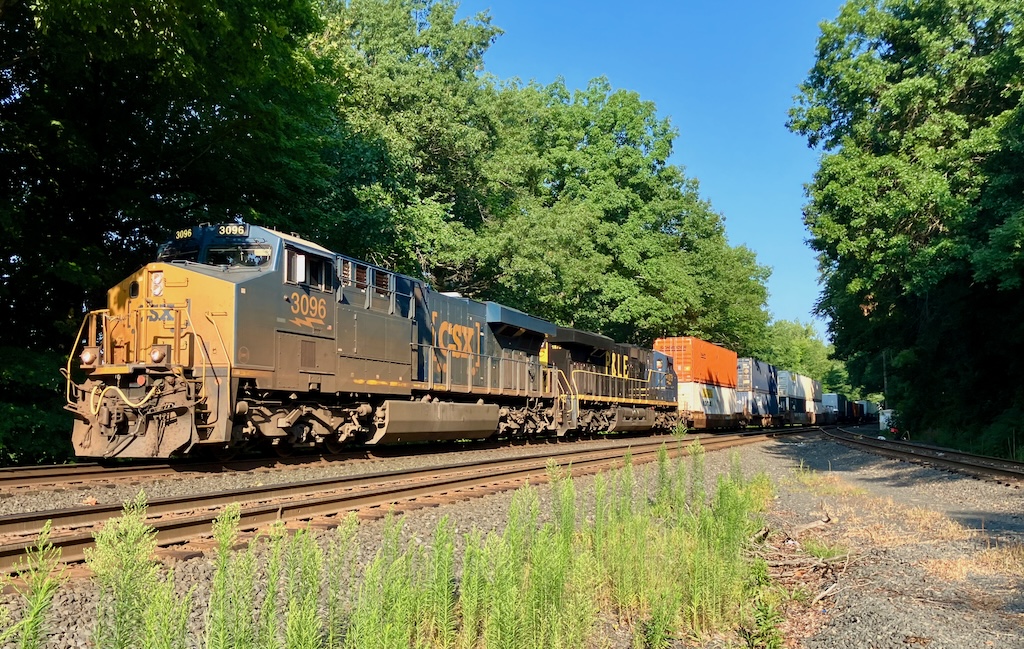
JACKSONVILLE, Fla. — CSX said today that its fourth quarter profits were weighed down by ongoing freight doldrums that the railroad doesn’t expect to turn around anytime soon.
“Our quarterly results reflect the subdued industrial demand environment and actions taken to adjust our cost structure,” CEO Steve Angel said in a statement on Thursday afternoon. “CSX has a strong operational foundation, and we are positioned to deliver improved financial performance in 2026 as we focus on driving productivity, cost control, and capital discipline while continuing to provide safe and reliable service.”
Quarterly operating income was flat at $1.11 billion, while revenue declined 1%, to $3.5 billion. Expenses declined 1%, to $2.39 billion. The operating ratio was 68.4%, a 0.3-point improvement compared to a year ago. Earnings per share grew 3%, to 39 cents.
Adjusted for $50 million in one-time items, including costs related to management cutbacks and expenses related to rationalization of technology investments, operating income declined 9% and earnings per share declined by 7%.
Overall volume was up 1% in the fourth quarter, with intermodal up 5%, coal up 1%, and merchandise down 2%.
Intermodal was buoyed by domestic traffic wins, including the BNSF-CSX alliance that links the West Coast and Southwest with the Midwest, Northeast, and Southeast.
Forest products, chemicals, and automotive declines were a drag on the quarter’s merchandise volume.
Export coal volume declined 3% due to the impact of a derailment on its main route to the Newport News, Va., terminal. Domestic coal volume increased 6% thanks to higher shipments to power plants.
Overall volume was flat for the year, with intermodal up 4% and merchandise and coal both down 2%.
CSX executives do not expect meaningful economic improvement this year. The railroad will focus on its growth initiatives, including nearly 600 industrial development projects, and will continue its efforts to control costs.
“We have identified meaningful opportunities to reduce non-labor spending, with well over 100 diverse savings initiatives across the company,” Chief Financial Officer Kevin Boone said on the company’s earnings call, “including cutting outside and professional service spend, improving asset utilization and maintenance efficiencies as well as enhancing controls around all sources of discretionary spend.” Boone later said those initiatives included “everything from vehicle spend to overtime.”
The railroad’s financial outlook for the year includes revenue growth of 1% to 3%, a 2- to 3-point improvement in profit margin, and a 50% increase in free cash flow. The railroad’s capital budget will be below $2.4 billion.
Angel said on the earnings call that he was replacing the multi-year targets for 2025 to 2027, as outlined at CSX’s 2024 investor day, with 2026 guidance only. “When we execute on the core fundamentals of service, cost discipline, operating efficiency, and prudent capital deployment, we will create shareholder value over the long term,” Angel said. “That said, the macroeconomic environment and the industry dynamics were meaningfully different than compared to today.”
Key operating metrics improved or were flat for the quarter. Train speed increased 7%, terminal dwell declined 13%, and on-time originations and arrivals both increased 10%. Carload trip-plan compliance improved 7 points, to 83%, while intermodal trip-plan compliance rose 7 points, to 92%.
The railroad’s safety performance improved for the year, with the personal injury rate down 24% and the train accident rate down by 13%. Both figures also improved for the quarter.
— Senior editor David Lassen contributed to this report. To report news or errors, contact trainsnewswire@firecrown.com.