





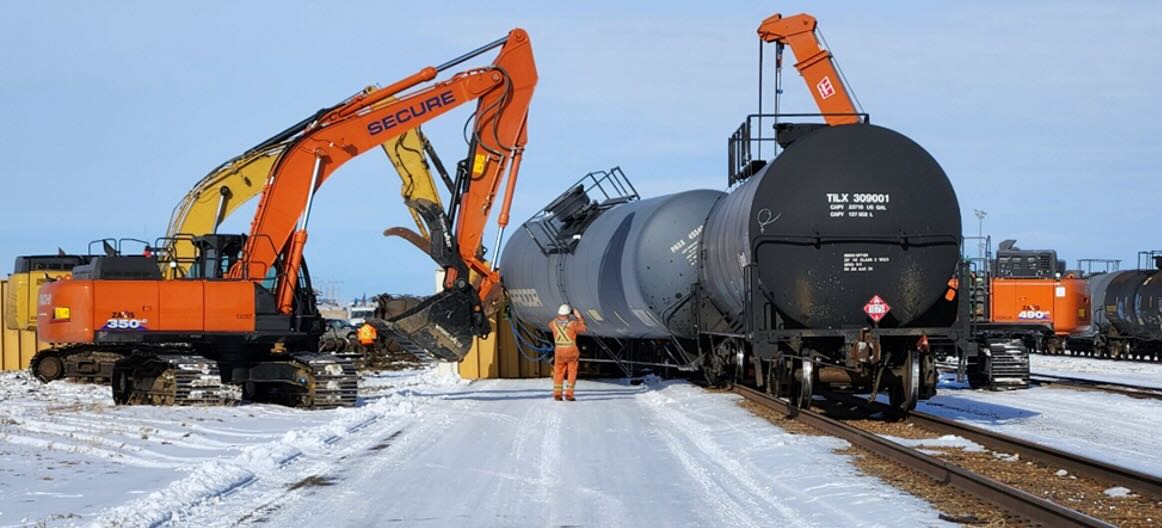
CALGARY, Alberta — A switch crew’s “adaptations” of written rules contributed to a CPKC collision and derailment in a yard at Coalhurst, Alberta, on Feb. 11, 2024, the Transportation Safety Board of Canada said in an investigation report issued today (March 11, 2026).
Also contributing, the TSB said, was that a utility employee providing switching instructions was doing so while driving a vehicle at night, “reducing his ability to provide accurate distance estimations.” Crew inexperience was also a factor, the report indicates.
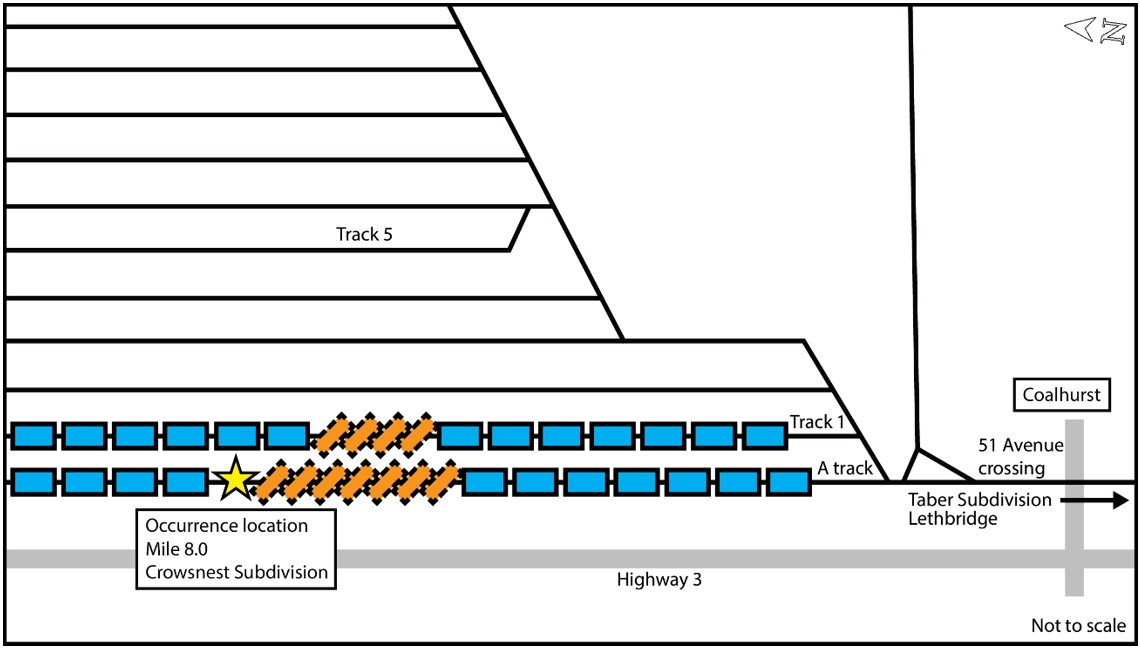
The incident involved a cut of 66 cars being reversed to be coupled to a cut of 79 stationary cars at Kipp Yard in Coalhurst, near Lethbridge, about 1:56 a.m. on Feb. 11. Because of an inaccurate estimate of the distances involved, the cars being moved struck the stationary cars at 13 mph, resulting in the derailment of 11 cars — seven on the cut of cars being moved and four on an adjacent track. Seven of these were carrying, or had previously carried, hazardous materials, but no leaks occurred. There were no injuries.
The TSB report describes adaptations as “decisions to deviate from formalized, written rules, procedures or other written directions. They are intentionally performed, with the individual being aware that such actions are contrary to the written directions. … In years past, system safety science used to define adaptations as ‘violations’ or ‘transgressions,’ implying that if people just followed the written directions, things would be safe.”
The report notes four such adaptations in this incident. These included requirements that a crew member be on the leading piece of equipment or on the ground during a shove move; and the ability to stop within one-half the range of the vision of equipment. The utility employee in the truck was required to be on the leading car of the shove move or to be issuing radio instructions from a position on the ground. As it was, he lost view of the lead car in the reverse move while driving. When he reversed his vehicle and regained sight of the movement, he provided an inaccurate estimate of the distance to the stationary cars. He quickly provided a warning that the speed was too high, but the train was not able to stop in time to avoid the collision.
The three crew members involved in this incident had five months to a year of experience. The report notes that crew inexperience often plays a part in adaptations and in the ability to recover from decisions that result in unsafe adaptations. This was the sixth investigation since 2007, the TSB said, involving inexperienced crew members working together on yard assignments.
Following the incident, Transport Canada conducted an inspection at Kipp Yard and issued a letter of non-compliance with four rules. CPKC responded with a formal investigation, during which employees were coached on the rules, job briefings were conducted, and a safety blitz was undertaken to educate local crews. Transport Canada subsequently acknowledged the railroad had taken sufficient action. CPKC also issued an operating bulletin requiring an employee to ride the lead piece of equipment during shove moves.
— To report news or errors, contact trainsnewswire@firecrown.com.
Share this article


Very informative article. Strand jack systems are becoming essential in large bridge construction projects.
Excellent 👌 perspective shared
Very informative article. Strand jack systems are becoming essential in large bridge construction projects.
Your voice brings clarity to confusion and hope to discouragement
Great technical depth. High-pressure hydraulic systems are essential for critical applications.
Konular mükemmel olduğu gibi site teması da içeriğe müthiş uyum sağlamış. Tebrikler
Highly relevant content for refinery maintenance operations.
websitem için çok işime yaradı teşekkür ederim
Your message is articulated with confidence and strong reasoning.
I’m often to blogging and i really appreciate your content. The article has actually peaks my interest. I’m going to bookmark your web site and maintain checking for brand spanking new information.
Helpful guidance for companies targeting Western economies
Your note presents a strong, contextually relevant observation.
Great information shared.. really enjoyed reading this post thank you author for sharing this post .. appreciated
Pretty! This has been a really wonderful post. Many thanks for providing these details.
Your posts always leave me feeling more hopeful ❤️
Your posts always give me fresh new ideas to think about 🚀
Love your perspective
Thank you for being such a positive force online
Love how you bring out the best in people through your incredible work 💕
Love how you turn simple moments into profound lessons for all readers
This post perfectly explains what I struggled to understand