





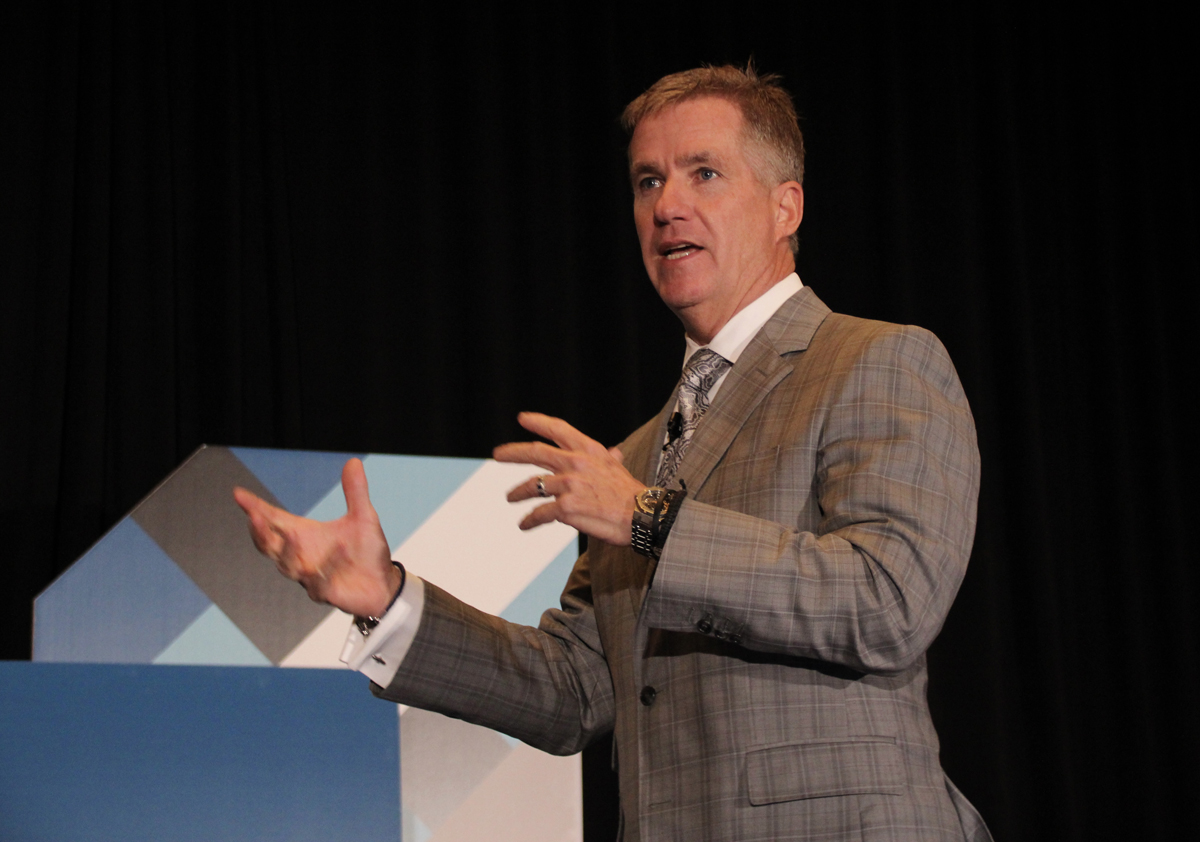
SCHAUMBURG, Ill. — The CEOs of Canadian Pacific Kansas City and BNSF Railway took aim at the proposed Union Pacific-Norfolk Southern merger during the first day of the Midwest Association of Rail Shippers winter meeting — and urged the rail customers in attendance to voice any concerns they may have to federal regulators.
CPKC CEO Keith Creel — the day’s first speaker with a scheduled 45-minute address that stretched to 70 minutes — and BNSF’s Katie Farmer, in a more wide-ranging “fireside chat,” raised similar issues regarding the accuracy of some projections in the UP-NS merger application, and the potential impacts on customers.
“If I were a customer and a senior level transportation person,” Farmer said, “what I’d be asking is, does this consolidation give me more optionality? Does it give me more competitive rates? And I’d just start there.”
Creel expressed concerns about the completeness of the merger application to the Surface Transportation Board, saying that when he heard the application was almost 7,000 pages, his first thought was, “Is that all?”
The application for the Canadian Pacific-Kansas City Southern merger was about 4,000 pages, he said, but this application is the first under the STB’s more demanding 2001 merger rules, which require showing that a merger is in the public interest and would enhance, rather than just maintain, competition.
Likening the application to a book, he said, “To me, that’s kind of like the first half of the book, not the second half. …
“I’m going to give Jim [Vena, UP’s CEO] credit, and UP credit, and Mark [George, NS CEO] and NS credit. It’s a good story. … But I don’t think it’s a complete story.”
Among Creel’s issues with the application was its contention that a combined UP and NS would convert some 2 million truckloads of freight to rail traffic.
“I’m thinking, man, that’s pretty good,” he said. “But is that achievable? … If you’re going to the public-interest test and you’re filling up that benefits box, are they real, or are they achievable?”
He said those 2 million truckloads would be the equivalent of 14 additional 10,000-foot intermodal trains every day of the year. For context, he said, CPKC handled 1.8 million container loads on its three-nation network all of last year. “So I would argue, is it achieving, or is it aspiration?”
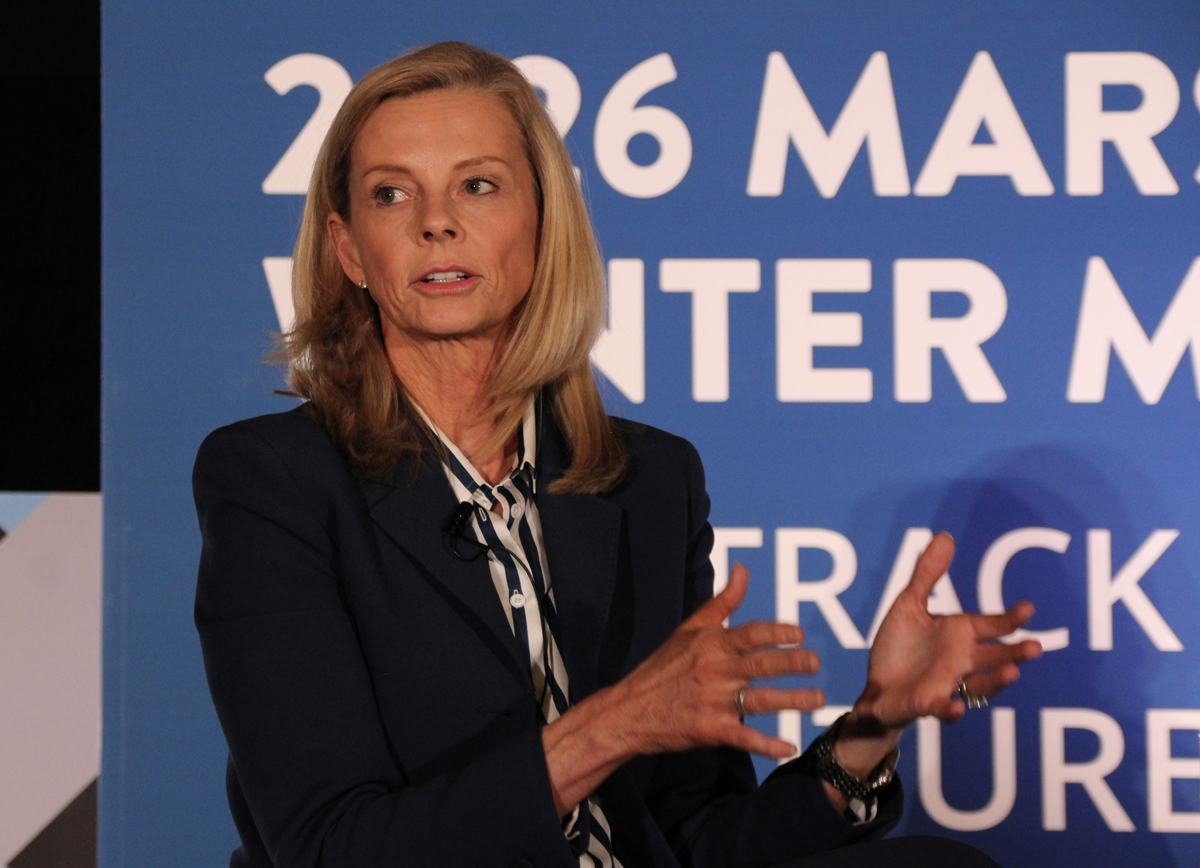
Farmer said that in her 34 years in the rail industry, “I’ve lived through three mergers and one failed merger. And so I think what we have to do when we talk about any future mergers is frankly look back at history and say, how does history inform what we think might happen in this consolidation?”
With that in mind, she focused on another projection in the application, that the combined railroad could see growth of 12% or more in its first three years.
“History says that if you take the Union Pacific and the Norfolk Southern, you look back 10 years, a decade, their volumes have actually shrunk,” she said. So the idea that we’re going to grow volume by double digits in three years, I think we have to at least question, is that an accurate premise?”
Both CEOs also have issues with the UP promise for “committed gateway pricing,” which will streamline pricing for some moves that might not otherwise benefit from the merger [see “UP and NS say their merger …,” Trains.com, Dec. 19, 2025]. Creel contended only about 20% of customers would benefit from that program, which would extend through the five or more years that the STB provides merger oversight.
“By default, if 20% are better off, that means 80% — which happens by my math to be the majority — either got the same or higher rate,” Creel said.
Farmer said the number of customers who would benefit was even smaller, based on the work of a BNSF consultant.
“The people who actually get to use it was less than 1%,” she said. “Now I know Keith says 20%, and I think part of that is how you interpret some of this … but the majority of people don’t get to use it, and a very small percentage get to use it.”
Farmer also was skeptical of UP’s commitment to keep all its gateways open, citing experiences with the CPKC merger at the Laredo, Texas, international gateway.
“Prior to the CP-KCS merger, we handled 10,000 units a month over Laredo for our customers,” she said. “Today we don’t handle a single unit over Laredo.”
In urging shippers to file an “intent to participate” notice with the STB, which would allow them to take part in the proceeding, Creel said he had heard some companies are concerned about retaliation if they speak out against the merger.
“And I’m telling you, you’ve got to get uncomfortable,” Creel said. “Got to get educated on the facts. You’ve got to think about your legacy and your role. … You’ve got to go back and have conversations with your leaders … and you’ve got to raise your voice.”
While a number of trade groups have spoken out against the merger, Creel said, few individual shippers have done so.
“The association’s not enough,” Creel said. “And I’ll tell you why: because Mr. Vena said it’s not, because his customers are not at the association. And I would agree with him. … I deal with the individual customers.
“But if Jim’s view is formed by your conversations and your views, you’ve got to give them to him.”
Farmer made a similar point.
“Is taking a couple hours out of the interchange worth risking what has happened after every single merger, which is really a meltdown on a much bigger scale than we’ve ever seen?” she said. “My opinion is not important, but I’m sure gonna make sure that you guys all have the facts in front of you. And I would encourage you now is the time to make your voices heard.”
And Creel cautioned that if a UP-NS merger is approved, it is not likely to be the last, and that further consolidation would be necessary to restore balance in the industry.
“And if you don’t like the thought of fewer options today,” he said, “you [would then] get to two companies to deal with. And I hope you enjoy dealing with them.”
— To report news or errors, contact trainsnewswire@firecrown.com.



Oh BNSF and CPkc want the shippers to cover their lack of desire to truly compete… Give our cake and let us eat it too. WAAAHHHH!
I have to ask, “what did these two tell shippers during their merger applications?”
Tha’s easy: OPPOSE, OPPOSE, OPPOSE!