





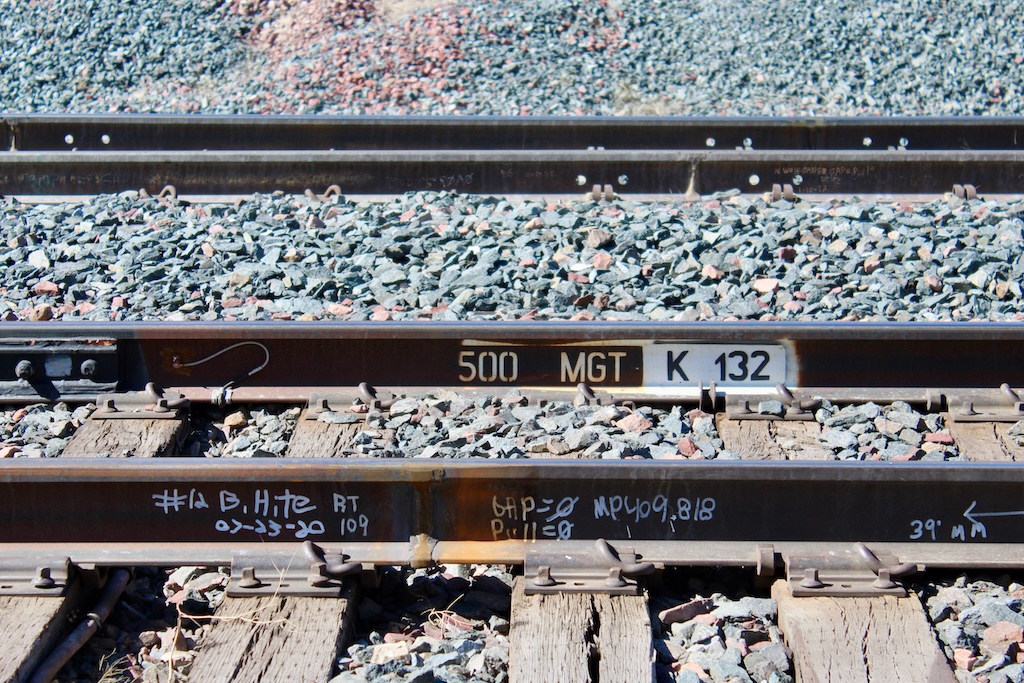
BNSF Railway and Union Pacific have filed lawsuits against North America’s largest producer of rail, arguing that Orion Steel’s Rocky Mountain Steel Mills broke long-term supply deals by refusing to ship more rail unless the railroads agree to price increases of more than 50%.
The railroads say Rocky Mountain’s halt in rail shipments threatens safety and service because no other domestic rail manufacturer can supply enough rail — and mills in Japan and China require long lead times and their rails are subject to U.S. tariffs and anti-dumping policies.
Rocky Mountain Steel says a long-overdue adjustment to market pricing will keep its Pueblo, Colo., facility churning out rail.
UP filed suit against the steelmaker in the District Court of Douglas County in Nebraska on Nov. 25. The suit also names Atlas Holdings, a Connecticut-based private equity firm that acquired the mill from Evraz Group on July 31, 2025. Evraz, whose largest single investor was Russian oligarch Roman Abramovich, sold its North American operations in the wake of sanctions imposed after Russia’s invasion of Ukraine.
Four days after Atlas acquired the mill, its executives told UP that it would not deliver rail unless UP paid a price 61% higher than specified in the contract. “Atlas representatives further threatened to force Evraz into bankruptcy if Union Pacific refused to pay the increased price, claiming Atlas was the largest secured creditor and therefore Union Pacific would have no remedy against Evraz under the law,” according to the UP lawsuit.
The mill stopped shipping rail to UP in September, which the railroad said would have a significant impact on its track renewal and maintenance program — and, by extension, UP’s safety and service.
UP told the steelmaker in October that it would “incur significant financial and operational implications due to being forced to secure alternative sourcing for its rail supply and the shutdown or disruption of the Union Pacific’s gangs and rail installation schedules,” according to the lawsuit.
UP says its contract with the steelmaker includes monthly adjustments to account for fluctuations in the price of scrap steel used to make rail, as well as annually for changes to manufacturing costs.
UP also alleges that the steelmaker missed several milestones related to its new $500 million rail production facility, which can supply 320-foot rails that are welded into longer sections of continuous welded rail.
BNSF’s suit against Rocky Mountain Steel, filed Nov. 12 in the Business Court of Texas, says that under a May 1, 2024 contract, it agreed to purchase at least 80% of its rail from the Pueblo mill. Rocky Mountain agreed to fulfill BNSF’s purchase orders, which exceed $50 million annually, according to the suit.
Rocky Mountain informed BNSF in September 2025 that it would no longer sell rail to BNSF’s suppliers at the agreed upon price. Instead, Rocky Mountain sought a price increase of more than 50%, BNSF said.
When the railroad refused, Rocky Mountain stopped shipping rail to BNSF in October, leaving unfulfilled orders from August and September. “BNSF’s reserve rail supply is limited, and there exists a lack of immediate, alternative domestic supply sources,” the railroad’s suit says.
Rocky Mountain Steel says the railroads’ suits have no legal merit.
“As the largest supplier of steel rail in the U.S., Rocky Mountain Steel is an essential part of the domestic steel industry. We’ve already seen the closure of Steelton in Pennsylvania this year, the only other fully dedicated rail mill in the country, and the loss of hundreds of United Steelworker jobs there,” a Rocky Mountain spokesman said. “We requested a reasonable, years-overdue price adjustment to avoid the same result in Colorado. We hope the railroads will choose to reject cheap imported steel and ensure the viability of domestic steel production by paying market prices.”
Cleveland Cliffs idled its Steelton, Pa., in June 2025 and later said it would permanently close the facility in January.
The only other major U.S. rail manufacturer — the Steel Dynamics mill in Columbia City, Ind. — lacks the production capacity to replace the output of Rocky Mountain Steel, the railroads say.
Spokespeople for CSX and Norfolk Southern declined to say what manufacturers supply their new rail.
The Pueblo mill was founded in 1881 as Colorado Fuel and Iron Co. UP has been a longtime customer — and purchased CF&I’s first rail. Evraz acquired the mill in 2007.
In 2015, UP began importing most of its rail from Nippon Steel & Sumitomo Metal Corp., which could make 480-foot-long sections of rail. The Evraz facility’s rails maxed out at 80 feet.
“But this wasn’t as simple as Nippon making something Evraz Pueblo didn’t,” according to the Alliance for American Manufacturing. “The Colorado facility had long been battered by unfairly traded steel imports, which severely undercut American workers and companies. That meant Evraz couldn’t make the plant upgrades it needed to compete.”
In 2018, the U.S. imposed a 25% tariff on foreign-made steel, which prompted UP to once again source most of its rail purchases from Evraz. And that allowed Evraz to invest in the new solar-powered production facility that can make 320-foot rails.
— To report news or errors, contact trainsnewswire@firecrown.com.


This report must be false. We are told that prices are going down not up. heh heh heh
Could be wrong but I believe that as of August 19, 2025, the tariff on imported steel (and aluminum) was raised from 25% to 50%.
“Atlas Holdings, a Connecticut-based private equity firm…” That is all you need to know to see why there is a problem. Both UP and BNSF should file a joint complaint with the Department of Commerce and get the government involved in this attempt to blackmail to companies, both who are integral to the prosecution of the national defense and economic supply chain. This can not stand! Sounds like more business for USS Steel/Sumitomo if Rocky Mountain Steel isn’t interested in keeping the contracts THEY SIGNED…
Too bad USS Steel doesn’t have a North American mill that can roll rail anymore. UP and BNSF have the money to pay a fair price.
Yes, but a 61% increase is not a fair price. Sounds like Sumitomo/USS Steel should buy Cleveland Cliff’s idled plant and make their rail here in the US, tariff free… Atlas Holdings must be taking their cues from Ancora Holdings and other predatory private equity firms who don’t care how they make a buck or who they hurt,,,
Private Equity is a pox on civilization. They have destroyed more businesses than you can think of.
railroads are no different
Rising prices..welcome to our world!!
The biggest price rises were when Biden (Democrat) was president. Had Harris (Democrat) been elected prices would have continued to soar due to the Democrat policy for high energy prices.
Looks to me like an opportunity for others to consider restarting their rail mills.
Sad that we have reached a point like this. And a lot of car parts are now imported.