





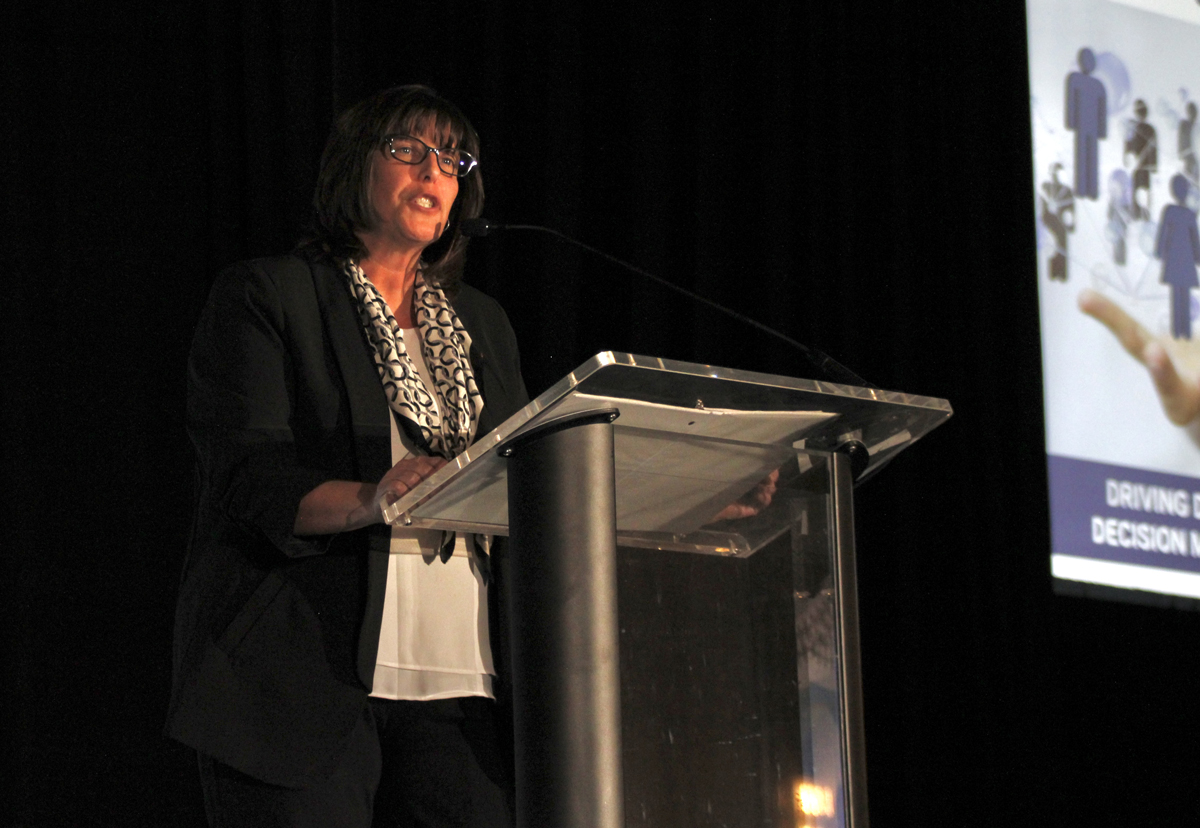
SCHAUMBURG, Ill. — While the CEOs of BNSF, CPKC, and Union Pacific squared off on the pros and cons of the UP-Norfolk Southern merger at the Midwest Association of Rail Shippers winter meeting, the fourth Class I representative on the agenda — Janet Drysdale, Canadian National chief commercial officer, took another path. Mostly.
“I will not find myself falling into the trap of being between Jim (Vena of UP) and Keith (Creel of CPKC),” she said during her talk on Thursday (Jan. 15). “… I’m going to go my own way and talk about what I want to talk about.”
Inevitably, though — after providing an overview of CN operations on a number of fronts — she did take some time to address the elephant in the railyard.
“The merged entity would have a market dominant position,” Drysdale said. “There are a lot of numbers floating around; I’m not sure which one to pick anymore, but it seems to be close to half of U.S. rail tonnage. In any other industry, that level of concentration alone would give rise to serious concerns. In an industry that is the backbone of the U.S. economy, getting it wrong can have devastating consequences for shippers: Reduced rail options at certain facilities, changes in how your traffic’s routed, increased congestion on key corridors.”
Noting the Surface Transportation Board requirement that a major merger must enhance competition, she said: “And the lens by which enhanced competition must be judged is the current context of all of you rail shippers, not truck-to-rail conversion.” That being the case, she — like the other Class I speakers before her — urged shippers to file a notice of intent to participate in merger proceedings with the STB. (Her comments were made before the STB rejected the UP-NS merger application as incomplete; the railroads say they will provide the additional information the board seeks.)
“Last words regarding CN’s position on the merger. We’re not anti-merger, we’re pro competition. We believe the only way the impacts of the proposed transaction are fully considered is if the applicants provide all the information required and that the largest number of stakeholders participate in the process. We believe the applicants are failing in their obligation to provide complete information … And that is why earlier this week we filed a motion to the STB to compel the disclosure of additional information that is critical to assessing the merged entities’ ability to enhance rail-to-rail competition.”
Cooperation, and its limits
Before directly addressing the merger, Drysdale had highlighted two new joint-line operations to serve customers, one from the Southeast to Duplainville, Wis., which helped a shipper open a new transload operation, and one enabling unit-train service to move scrap steel from the Midwest to the Southeast.
“I hope you don’t think these are random examples,” she said. “Joint line service. Crossing the Mississippi. Working.”
One of the key arguments UP and NS are making for their merger, of course, is that the combined railroad can tap traffic in the watershed region surrounding the Mississippi, which the railroads argue is underserved in part because of the difficulties involved for shippers who need to deal with more than one railroad to cross that boundary. Other Class I railroads argue cooperative efforts can provide similar benefits without the risks they say the merger entails.
Drysdale elaborated further in response to a question.
“They can work really well,” Drysdale said of interline partnerships. “You know, I would say in my early career they worked better when they were on the operating side, and we have some great examples of operating agreements in Canada. Many of you know we do have a co-production agreement with CP that’s been around for years and it works really, really well. There was a period of time where we embarked on more kind of commercial agreements and for a while I will say those were harder to do. I think we’ve pivoted past that point, and what I see in the industry now is a very strong willingness to collaborate and to create services that are comparable with single-line.”
But such cooperation does have its limits, she believes, most notably in another focal point of the UP-NS merger effort.
“Truck-to-rail conversion has been the most overpromised, underdelivered opportunity” in her 30 years in the industry, she said. “I don’t believe it will be solved with joint line service. … My view is the biggest challenge we have is ease of doing business, and that’s what we have to figure out if we actually want to meaningfully convert truck to rail.”
— To report news or errors, contact trainsnewswire@firecrown.com.


If cooperative short hauls near the interchanges can work (as the merger foes say), why haven’t the Class Is done it already? Because they know it won’t and self-fulfilling prophesy makes sure it won’t. No one agrees willingly on the short-haul.
Charles, Of course in the UK owns the infrastructure.
Nathaniel has an interesting idea.
Intermodal should be a separate nationwide network. That can be done even without mergers.
NATHANIEL — When you have time, please expand on your idea. If I understand what you are proposing, there certainly is successful precedent overseas in countries like UK.