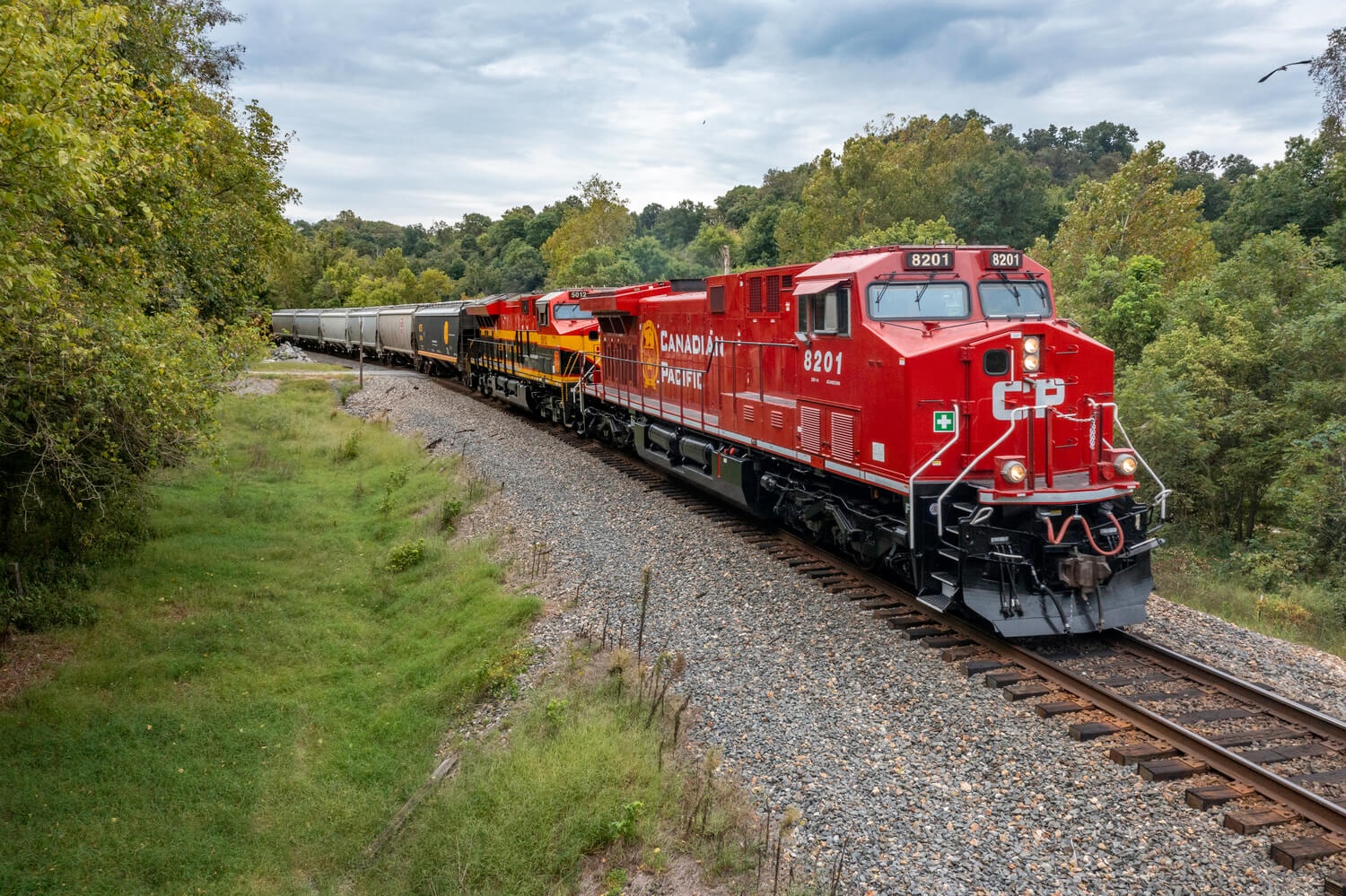



Any way you look at it, Canadian Pacific’s proposed acquisition of Kansas City Southern is a blockbuster deal. It creates the first railroad to link the U.S., Mexico, and Canada. It gives shippers from both railroads more single-line service options. And it will boost competition – with other railroads and, more importantly, trucks – in the busy corridor linking the Midwest and Chicago with Texas and Mexico.
But it’s also a giant leap forward for CP, which has played second fiddle to rival Canadian National for more than two decades.
CN has run circles around CP by extending its reach through a series of acquisitions that began with the Illinois Central in 1999. That created the first railroad to touch the Atlantic, Pacific, and Gulf coasts. CN wasn’t done: By acquiring Wisconsin Central, Great Lakes Transportation, and the Elgin, Joliet & Eastern, CN neatly tied its system together through Chicago. And along the way it gobbled up 10 short lines, including regional BC Rail.
Canadian Pacific trailed Canadian National for years
CP’s response? In 2007 it paid too much for 2,500-mile regional Dakota, Minnesota & Eastern as part of an ill-fated plan to be the third railroad to reach the Powder River Basin coal fields of Wyoming. In 2012, less than six months into his stint as CP’s chief executive, E. Hunter Harrison killed the Powder River dreams and sold off the DM&E’s westernmost 700 miles.
All this left CP as a 12,500-mile system outflanked by the 20,000-mile CN. Now in short order CEO Keith Creel has built CP into a faster-growing and much stronger competitor – and one with a network that nearly mirrors CN’s, but with access deep into the major consuming and manufacturing regions of Mexico.
Last June CP acquired 481-mile regional Central Maine & Quebec, part of its historic shortcut across Maine that links Montreal with the Atlantic at Saint John, New Brunswick. In December CP for the first time gained full ownership of its Detroit River Rail Tunnel, a key in its route linking Chicago with Toronto, Montreal, and Eastern Canada. And last month, of course, the $29 billion KCS merger was announced. CPKC will total 19,700 miles, a tally that will exceed CN’s after CN completes the sale of 650 miles of branch lines to Watco in Wisconsin, Michigan, and Ontario.
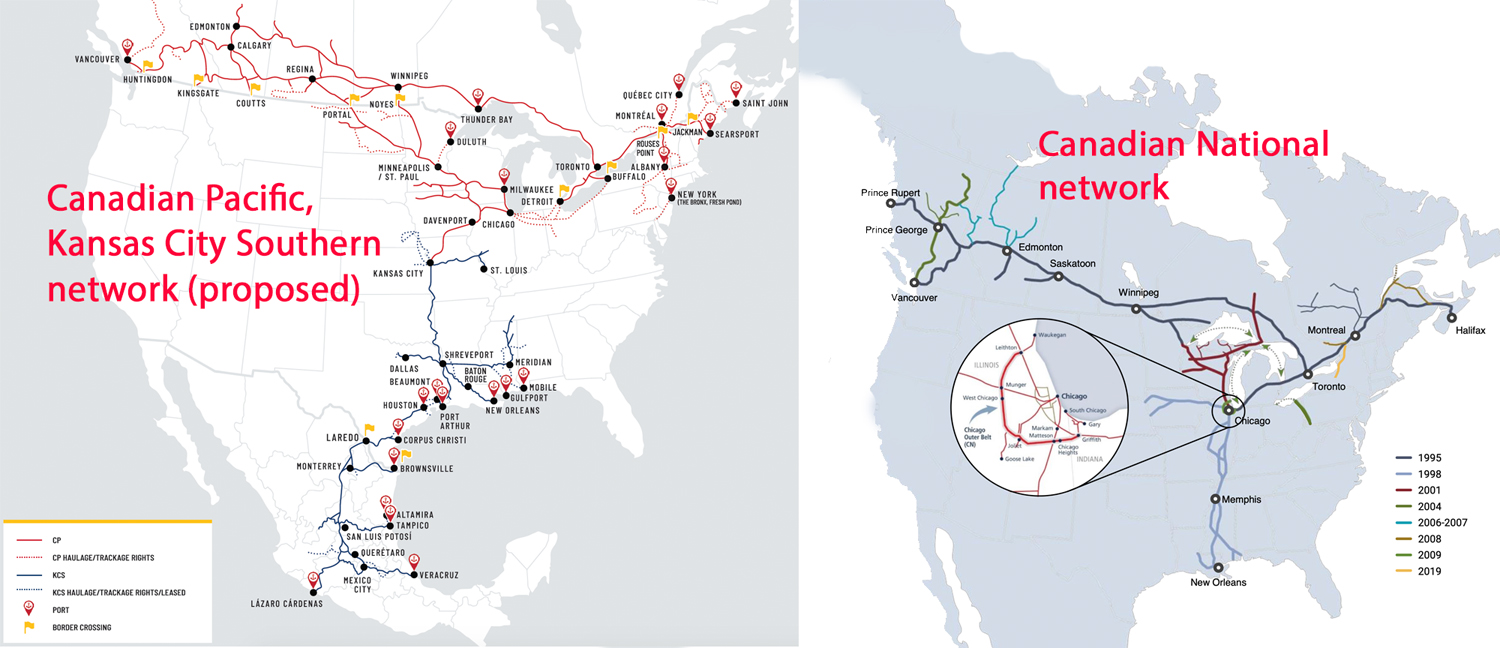
Maps taken from Canadian National, Canadian Pacific, and Kansas City Southern sources. Edited and stitched in Photoshop by Trains staff.
The KCS deal will cement Creel’s own legacy
Creel’s larger-than-life mentor, Hunter Harrison, considered KCS “a dog with fleas,” a reference to the risk that comes from KCS having merely a concession to operate KCS de Mexico rather than outright ownership. But Creel was convinced that KCS under CEO Pat Ottensmeyer has a deep understanding of Mexico that has allowed KCS de Mexico to thrive.
KCS’s cross-border traffic is the biggest railroad growth story in North America. KCS volume over its International Railway Bridge in Laredo, Texas, has more than doubled since 2012 thanks largely to intermodal, automotive, and refined products shipments. Yet periodic operational problems – including congestion at the Laredo gateway, in Mexico’s industrial centers, and on Union Pacific trackage rights in Houston – have prevented KCS from fully tapping the potential volume gains.
Although KCS has become more resilient over the past two years after adopting Precision Scheduled Railroading, tying the knot with CP should further improve operations. Since 2015 CP has been by far the most stable railroad based on its average train speed and terminal dwell figures. If CP can extend this performance to KCS, as expected, it can only help propel cross-border growth.
Railroad executives estimate that within three years CPKC will produce $780 million in annual merger-related synergies. Don’t believe it. CP has consistently underpromised and overdelivered on virtually everything since Creel became CEO in January 2017. The real number is probably closer to $900 million.
A true end-to-end merger
The combined CPKC system touches only at their shared Knoche Yard in Kansas City, Mo., and does not diminish most shippers’ existing railroad options. In fact, it creates more competition by adding a third single-line route linking Texas with Chicago and the Midwest. With 16,000 trucks crossing the border every day at Laredo, there’s plenty of opportunity to pick up traffic that now moves on rubber tires. CPKC aims to do just that with new single-line intermodal service.
Add all this up and it’s clear that CP-KCS should pass regulatory muster – whether it’s judged under the Surface Transportation Board’s old pro-merger rules or the tougher 2001 rules that have prevented a merger of Class I systems. And one thing’s for sure: If a merger of the two smallest Class I railroads can’t get through the STB, then nothing will.
You can reach Bill Stephens at bybillstephens@gmail.com and follow him on twitter @bybillstephens.
Share this article