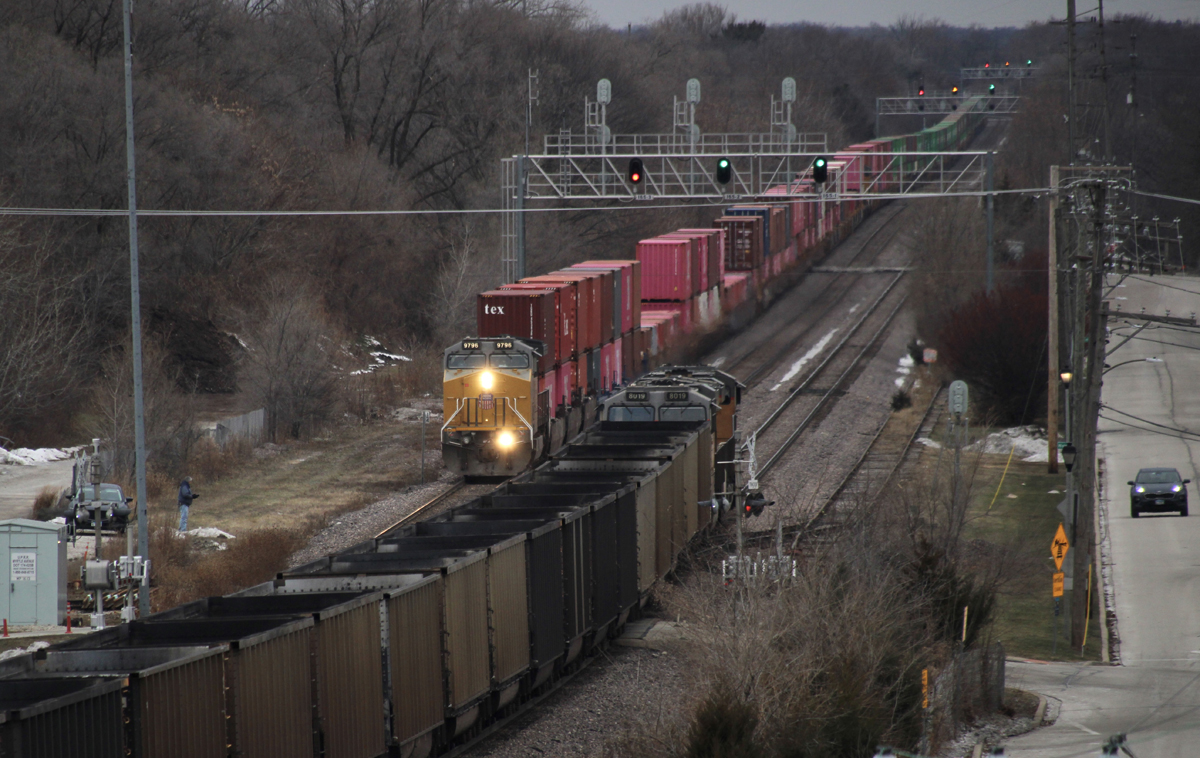
Industry analysts speaking at a RailTrends webcast on Thursday (Jan. 8, 2026) were skeptical about some of the claims Union Pacific and Norfolk Southern make in their merger application, including its central theme that the $85 billion combination is fundamentally about volume growth.
Independent analyst Rick Paterson noted that UP and NS volumes have been flat over the past decade, a period when truck tonnage increased 13% and the U.S. economy grew 26%.
And yet the railroads are projecting an 11% volume increase within three years of the merger, he says, with 77% of the growth expected to come from intermodal.
Paterson questioned the growth forecast for both intermodal and carload and bulk business.
“Intermodal, I’m a little bit more skeptical about for two reasons. No. 1, part of the rationale for a bump in intermodal volume seems to be an expectation built into this analysis that these two railroads will reduce price to customers,” he says. “And that’s simply not in these companies’ natures, and it’s not what the shareholders … expect or want, right?”
Of the 11% volume growth, only 2.5% is expected to come from carload business. That’s underwhelming, “and arguably too low,” Paterson says. Union Pacific is “the King of Carload” because it boasts the industry’s largest carload franchise, he notes.
Paterson also questioned the anticipated pace of growth, with 40% of it expected to come to the combined railroad in 2027, followed by 30% of the growth coming in both 2028 and 2029, assuming the merger is approved and reviewed on schedule.
The reason? The potential for operational disruptions related to the cutover of UP’s NetControl technology system onto the NS network. UP officials, citing a smooth cutover to NetControl on the railroad in 2024, say they’re confident the process can go without a hitch on NS, too.
Paterson says shippers may not have that same confidence. “Customers may be reluctant to give UP and NS more business ahead of the NetControl cutover in 2028 and 2029,” he explains, which would blow a hole in the growth forecast.
Farrukh Bezar, a former strategy and marketing executive at CSX and Canadian National who is a consultant and managing partner at Lynwood Partners, says an end-to-end merger like UP-NS has always made sense. There’s no question about the potential for volume growth, he says, particularly in the watershed area where the eastern and western railroads currently interchange.
The watershed — the vast swath of the American heartland that’s within 250 miles of the Mississippi River — has been underserved because of interchange friction and challenges over how railroads split revenue when moves in and out of the watershed are a short haul for one or both railroads. The expanded UP would be able to offer single-line service from coast to coast.
“I think it’s doable the way UP and NS have laid it out. A lot needs to fall in place for it to happen. So I would say I’m moderately skeptical,” Bezar says. The volume is there, he says, it’s just a question of timing when and if UP can convert it to rail.
From a shipper perspective, the merger is not “one size fits all,” Bezar says. UP and NS intermodal customers Hub Group and Knight Swift could have a “super clean” transition, he says, while others like Schneider and J.B. Hunt — who post-merger would still use different railroads in the east and west — will have to contemplate switching carriers.
David Woodruff, a former CN government affairs executive who is a consultant at Rubicon Strategy, says that for UP and NS the review process is all about momentum.
“The most potent force in American politics still really is a sense of inevitability,” he says. “Momentum is a tool to get you to inevitability. But really, in today’s divided country, … it’s often not about how do you convince 51% of the people that it’s a good thing, but really how do you convince 51% of the people that it’s going to happen. So over the next course of the next year, with this application now filed and the process going forward, it is an inevitability game.”
All politics is certainly local, he says, so members of Congress will be looking at the merger from the standpoint of how it might affect the mill on Main Street. The White House has yet to fully weigh in on the merger, the way it has with the Netflix-Warner Brothers combination. President Donald Trump has said he will be in the middle of that deal, citing concerns over market dominance, Woodruff says.
The Surface Transportation Board has sole authority over railroad mergers, independent analyst Anthony B. Hatch points out. And because it’s an independent agency, he says political influence from the White House or Congress is irrelevant, especially since several labor unions have backed the UP-NS deal in exchange for job protection.
It’s unclear, Hatch says, whether the STB in the coming days will accept the merger application as complete or reject it as incomplete. Hatch says he and many others believe the application failed to fully address how the merger will enhance competition, how it’s in the public interest, and how its benefits cannot be achieved by other means, such as interline partnerships.
A decision that the application is incomplete, Hatch says, would only mean a delay in the merger review process as UP and NS would aim to quickly provide the STB with the information it wants.
The analysts spoke at “Reflections on the STB Application: A Virtual Salon,” a RailTrends event sponsored by Hatch and trade publication Progressive Railroading.
— To report news or errors, contact trainsnewswire@firecrown.com.